
For tooling and process engineers
Pultrusion dies & tooling catalog
Compare pultrusion die families and prepare the drawing, mandrel scope, line interfaces and trial acceptance requirements.
Online buyer edition · 5 product families · Updated 2026-11-01
PDF: 2023 factory edition · 8 pages. Export enquiries: inquiry@pultrx.com.
How to use this buyer edition
Start with the finished-profile drawing and the line on which the die will run. These tooling families organize cavity geometry and process requirements. A die (mould) enquiry should distinguish the tool itself from mandrels, preformers, heating equipment and production trials.
Agree tooling inspection separately from finished-profile acceptance. Specify steel and surface treatment on the approved drawing, then define how trial profiles will be measured. Confirm ownership, refurbishment scope and the warranty party in the quotation.
Chapter 01
Tube and rod pultrusion dies
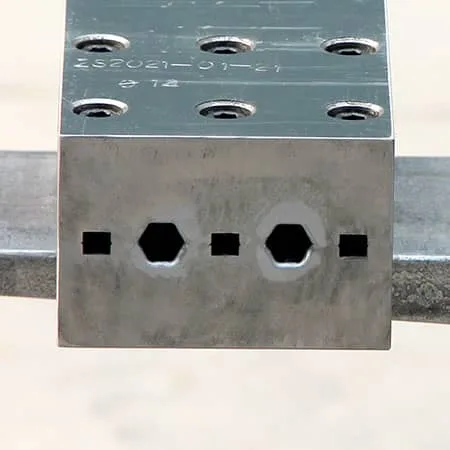
A tube pultrusion die shapes the outside of a continuous FRP tube while a mandrel defines its bore. Henan Zhongsheng lists round, square and other shaped tube tooling alongside solid rod dies, including a six-cavity example. These pultrusion molds are specified by section geometry, cavity layout and machine interfaces; catalogue examples are not stock sizes.
Product forms
- Round tube examples: φ20 × 2, φ32 × 3, φ38 × 3 and φ186 × 6 mm
- Square tube example: 60 × 60 mm
- Oval tube example: 280 × 100 mm
- Octagonal tube example: φ153 × 10 mm
- Round, square, hexagonal and oval rod examples
- Six-cavity round rod catalogue example
Selection questions
Hollow or solid section. Mark bore dimensions, minimum wall thickness and datum surfaces. Ask the die engineer to show the mandrel support and access for assembly on a hollow-section proposal.
Single or multiple cavities. Compare cavity spacing with puller width, gripping arrangement and the planned fiber paths. Request a trial plan that measures each cavity separately.
Include in your enquiry
- Section drawing with bore, wall and corner details
- Resin formulation and reinforcement schedule
- Machine die-table, heater and puller drawings
Acceptance focus: Verify die and mandrel identifiers against the approved drawing revision.
Chapter 02
Structural profile pultrusion dies
A structural profile pultrusion die forms a constant FRP cross-section. Henan Zhongsheng supplies I-beam pultrusion dies, channel and angle tooling, with handrail and toe-plate examples in its catalogue. Specify flange and web dimensions, corner radii, reinforcement placement and machine interfaces before tooling is released. Finished-profile structural performance requires a separate assessment.
Product forms
- I-beam catalogue examples
- Channel / C-section catalogue examples
- Angle / L-section catalogue examples
- Handrail section catalogue example
- Toe-plate catalogue example
Selection questions
Define the critical geometry. Identify flange width, web thickness, internal radii and connection faces. Give functional tolerances for assembled joints rather than a blanket tolerance for every dimension.
Separate section and assembly requirements. Ask how the proposed fiber layout and trial material will be assessed. Structural performance or a finished assembly rating needs its own test scope; it is not established by the die shape.
Include in your enquiry
- Dimensioned cross-section and drawing revision
- Critical connection surfaces and tolerances
- Resin, reinforcement and any product test requirements
Acceptance focus: Measure flange and web dimensions against the agreed profile drawing.
Chapter 03
Flat-strip and deck-board pultrusion dies
A deck-board pultrusion die forms a continuous board section from resin-wetted reinforcement; a flat-strip die forms a solid rectangular section. Henan Zhongsheng lists deck examples of 130 × 27, 150 × 18 and 200 × 50 mm and a 150 × 5 mm flat-strip example. These are customizable catalogue examples, not stock sizes or capability limits.
Product forms
- Deck-board example: 130 × 27 mm
- Deck-board example: 150 × 18 mm
- Deck-board example: 200 × 50 mm
- Flat-strip example: 150 × 5 mm
Selection questions
Choose the correct drawing family. The source separates three deck-board examples from a solid flat-strip example. Ask whether your board needs internal supports, removable inserts or mating-edge features, and require each item to appear on the approved tooling drawing and quotation.
Flat strip or shaped board. Provide the complete cross-section, including any internal webs, edge joints and surface features. Width and overall depth alone do not define a deck-board die.
Include in your enquiry
- Full cross-section drawing with edge joints and internal webs
- Width, thickness and flatness tolerances with measurement length
- Resin formulation, reinforcement and surface-finish requirements
Acceptance focus: Measure thickness at agreed locations across the board width.
Chapter 04
Grating T-bar pultrusion dies
A grating T-bar pultrusion die forms an individual continuous T-section for a pultruded grating system. Henan Zhongsheng publishes a customizable T-bar die listing without a fixed section size. The RFQ should define the T-profile and its assembly interfaces; this tooling does not establish the scope of grating assembly equipment.
Product forms
- Custom T-bar cross-section; dimensions to be agreed from drawing
- Flange, stem and root-radius details to be specified for the grating design
Selection questions
Resolve the T-section specification. The source names customizable T-bar tooling and lists steel and surface-treatment options. Request a section-specific drawing and inspection plan: generic references to pipes or a hardness value with length units do not define an acceptable T-bar tool.
Check the grating route. Confirm that the project calls for continuous pultruded T-bars. A molded grating production process needs different tooling and equipment and is outside this product scope.
Include in your enquiry
- T-section drawing with flange, stem and root-radius dimensions
- Cross-member interfaces and downstream hole or slot drawings
- Resin formulation and reinforcement plan
Acceptance focus: Measure flange width, stem depth, thickness and root geometry.
Chapter 05
Custom pultrusion die
A custom pultrusion die is built around a controlled cross-section drawing and the intended process. These custom FRP pultrusion molds require a review of materials, reinforcement, critical dimensions and line interfaces. Henan Zhongsheng lists ladder-profile and shutter tooling examples; other sections need feasibility review before agreeing the design, trial scope and acceptance plan.
Product forms
- Ladder-profile tooling catalogue example
- Composite shutter tooling catalogue example
- Other drawing-based sections subject to feasibility review
- Adaptation to an existing machine subject to interface review
Selection questions
Control the drawing revision. Identify the document that governs the quote and mark dimensions still under development. Agree how design changes after approval affect price, lead time and trial scope.
Define the deliverables. Specify whether the quote should include a layout, 3D model, guide drawings, sample report and maintenance instructions. Confirm ownership, use rights and confidentiality in the contract.
Include in your enquiry
- Controlled section drawing in PDF and available CAD format
- Critical dimensions, functional interfaces and acceptance criteria
- Resin formulation, reinforcement schedule and output target
Acceptance focus: Verify tooling and sample reports refer to the approved drawing revision.
From reading to quotation
Prepare a tooling enquiry
- Revision-controlled profile drawing, units, cavity count and finished-part tolerances.
- Resin formulation, reinforcement arrangement and planned process conditions.
- Die envelope, mounting, heating and thermocouple interfaces on the receiving line.
- Scope for mandrels, preformers, heaters, trial materials and sample acceptance records.
Use the worksheet to record requirements and open questions. Final dimensions, performance, supply scope, commercial terms and acceptance requirements are confirmed in the quotation and approved documents.
Manufacturer PDF edition
2023 factory edition · 8 pages · 3.27 MB. The PDF is a separate manufacturer edition; use the current online specifications and written quotation to resolve open requirements.
Download Pultrusion dies catalog PDF