
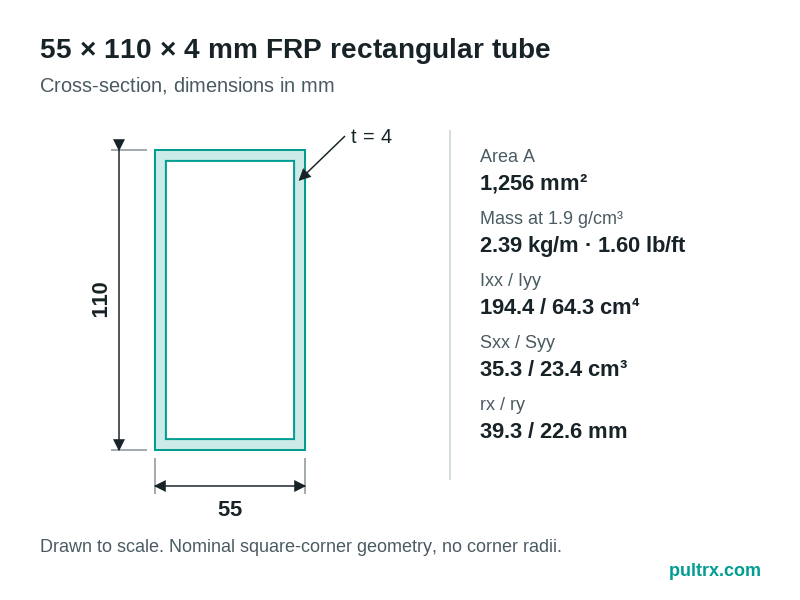
Geometry & mass
What are the nominal section properties and unit weight of 55 × 110 × 4 mm FRP rectangular tube?
Calculated from nominal millimetre dimensions before corner-fillet deductions, alongside equivalent S275 steel and 6063-T6 aluminum masses.
| Property | Metric value | Imperial / engineering note |
|---|---|---|
| Nominal designation | 55 × 110 × 4 mm | Width × height × wall (mm) |
| Inch equivalent | 2.17 × 4.33 × 0.16 in | Converted at 25.4 mm/in |
| Cross-sectional area (A) | 1,256 mm² | 1.95 in² (sharp-corner nominal) |
| FRP unit mass (at 1.9 g/cm³) | 2.39 kg/m | 1.60 lb/ft planning weight |
| Same-size S275 carbon steel mass | 9.86 kg/m | FRP saves 76% deadweight |
| Same-size 6063-T6 aluminum mass | 3.39 kg/m | FRP is 30% lighter than aluminum |
| Major-axis second moment (Ixx) | 194.4 cm⁴ | 4.67 in⁴ |
| Minor-axis second moment (Iyy) | 64.3 cm⁴ | Ratio Ixx / Iyy = 3.03 |
| Elastic section modulus (Sxx / Syy) | 35.3 / 23.4 cm³ | Extreme-fibre bending modulus |
| Radius of gyration (rx / ry) | 39.3 / 22.6 mm | Used for axial column slenderness L/r |
| External perimeter | 330 mm | Surface veil and coating perimeter |
| Tooling status | Existing die (partner factory) | Pultruded to order; no new die charge |
At 1,256 mm² area and 1.9 g/cm³ density, linear mass is only 2.39 kg/m (1.60 lb/ft) versus 9.86 kg/m in steel and 3.39 kg/m in aluminum, keeping greenhouse truss deadweight low while delivering Sxx = 35.3 cm³ and rx = 39.3 mm.
Standing the 110 mm web vertical produces Ixx = 194.4 cm⁴, whereas laying the 55 mm face vertical drops inertia to Iyy = 64.3 cm⁴ (Syy = 23.4 cm³, ry = 22.6 mm), a 3.02-to-1 stiffness difference between upright and flat orientations.
Preliminary stiffness check
How much does 55 × 110 × 4 mm FRP rectangular tube deflect across typical spans under E17 and E23 grades?
Euler bending estimates about the major axis (Ixx = 194.4 cm⁴) under a 1.2 kN/m uniform line load, comparing EN 13706-2 Grade E17 (17 GPa) and Grade E23 (23 GPa) minimum longitudinal moduli.
| Simple span (L) | Deflection at 1.2 kN/m (E17: 17 GPa) | Deflection at 1.2 kN/m (E23: 23 GPa) | Load for L/180 (E23) | Load for L/240 (E23) |
|---|---|---|---|---|
| 1.8 m (1800 mm) | 5.0 mm (L/363) | 3.7 mm (L/491) | 3.27 kN/m | 2.45 kN/m |
| 2.5 m (2500 mm) | 18.5 mm (L/135) | 13.7 mm (L/183) | 1.22 kN/m | 0.92 kN/m |
| 3.2 m (3200 mm) | 49.6 mm (L/65) | 36.6 mm (L/87) | 0.58 kN/m | 0.44 kN/m |
Oriented upright (110 mm vertical) under a 1.2 kN/m line load at 23 GPa modulus, Euler mid-span deflection measures roughly 3.7 mm at 1.8 m (L/490), 13.7 mm at 2.5 m (L/183) and 36.6 mm at 3.2 m (L/87); rotating the tube flat triples those deflections to 41.3 mm at 2.5 m.
On pitched roofs (for example 10 to 25 degrees), resolve gravity snow or live load into normal (cos θ) and downslope (sin θ) components; Iyy = 64.3 cm⁴ combined with closed Bredt torsional stiffness carries the downslope component cleanly across 2.0 to 2.8 m rafter bays.
Clear vertical web slenderness sits at 102 / 4 = 25.5, which is compact enough for normal roof purlin reactions over 60 mm wide rafter seats, though heavy point loads still require U-saddle brackets or internal spacer ferrules.
Run point loads, cantilevers or shear-corrected Timoshenko checks in the FRP section properties & deflection calculator, and verify material grade testing in EN 13706 & ASTM D3917 profile standards.
Fasteners & mating tolerances
How do rafter U-shoes and cladding fasteners connect to 55 × 110 × 4 mm rectangular tube?
Standardized 55 mm purlin width lets fabricators seat the tube upright inside 56 to 57 mm wide U-shaped FRP or stainless rafter shoes, cross-pinned horizontally through the 110 mm side walls with two M10 bolts plus internal 47 mm steel or composite spacer tubes so wrench clamping cannot pinch the 4 mm walls inward.
When fixing corrugated FRP roof sheets or polycarbonate glazing bars onto the 55 mm top face, use over-the-purlin saddle straps or through-bolted J-bolts around the 110 mm depth rather than relying on short sheet-metal screws in a 4 mm wall under wind uplift.
| Interface or feature | Drawing & assembly specification |
|---|---|
| Orientation callout | 55 mm width × 110 mm height; mark '110 mm face vertical' explicitly on erection drawings to preserve 3.02× major-axis stiffness. |
| Internal clear bore | 47 × 102 mm rectangular cavity; accepts 46 × 100 mm bonded splice cores at continuous ridge or eave joints. |
| Modular 55 mm shoe family | Matches the exact 55 mm width of our deeper 55 × 160 × 4 mm and 55 × 220 × 4 mm existing purlin dies for shared rafter brackets. |
| Thermal bridge break | Low thermal conductivity (~0.3 to 0.4 W/m·K) stops condensation dripping onto crops or livestock beneath cold roof sheets. |
Shop tooling, diamond blades and bonded-bolted joint layout: how to cut, drill and join fiberglass profiles.
Request a quotation
Get a quotation for 55 × 110 × 4 mm FRP rectangular tube
Send your cut lengths, piece count, resin system and destination port. An engineer in Shanghai reviews the schedule and replies in English.
Prefer email or chat? Write to inquiry@pultrx.com or message Celion on WhatsApp. Drawings can follow by email.
Service environments & resin selection
Where is 55 × 110 × 4 mm rectangular tube used in greenhouses, barns and corrosive roofs?
Commercial hydroponic greenhouses, swine and poultry confinement barns, mushroom grow rooms and composting halls choose 55 × 110 × 4 mm FRP purlins and rafters because warm humidity, fertilizer mist and ammonia gas destroy galvanized light-gauge steel within a few seasons while dripping rust onto plants. Simultaneously, low thermal conductivity eliminates cold-bridge condensation lines along glazing bars.
Because our partner factories operate a coordinated 55 mm wide box-purlin series on existing dies, engineers can use 55 × 110 × 4 mm on standard 2.0 to 2.6 m bays and step straight up to 55 × 160 × 4 mm or 55 × 220 × 4 mm on wider 3.5 to 5.0 m bays while keeping identical 55 mm rafter shoe tooling across the entire roof.
FAQ
What do buyers ask before ordering 55 × 110 × 4 mm FRP rectangular tube?
Does '110 × 55 × 4 mm' refer to the exact same profile as '55 × 110 × 4 mm'?
Yes, architectural purlin schedules often write depth × width (110 × 55 × 4 mm) while our metric box-tube chart lists width × height (55 × 110 × 4 mm) so major-axis Ixx = 194.4 cm⁴ always corresponds to standing the taller 110 mm dimension vertically. Always arrow the load direction on shop drawings so site crews never install purlins flat.
Why pick a closed 55 × 110 × 4 mm rectangular tube over an open C-purlin in greenhouses?
Greenhouse polycarbonate panels and twin-wall film extrusions provide minimal lateral diaphragm restraint to roof purlins, causing open C-sections to roll downslope unless cross-braced with sag rods that cast shadows and catch drip water. A closed 55 × 110 × 4 mm box resists torsion on its own and wipes clean during crop sanitation washdowns.
How do you splice continuous 55 × 110 × 4 mm purlins over multi-bay frames?
Insert a 300 to 400 mm long bonded FRP box sleeve or laminated timber/composite core block inside the 47 × 102 mm bore centered over a main truss rafter, pinned horizontally with two M10 bolts on each side of the joint. Leave a 3 to 5 mm expansion clearance at long expansion bays.
Which color and resin finish suit high-humidity agricultural interiors?
Light-reflective white or light-grey isophthalic polyester with an anti-fungal smooth synthetic veil boosts PAR light bounce inside greenhouses and resists high-pressure quaternary ammonium or peroxide washdowns. Add UV inhibitor whenever roof glazing transmits UV-A/UV-B wavelengths.
Is 55 × 110 × 4 mm produced on an existing die without tooling fees?
Yes, 55 × 110 × 4 mm runs on an existing die in our partner-factory network alongside its deeper 55 × 160 × 4 mm and 55 × 220 × 4 mm siblings. Provide bay lengths and bolt-hole drawings on your purchase order for made-to-order scheduling.