
Technical review: Yunkun Gong, Pultrusion Engineer, pultrx
What is a composite core, and why is it pultruded?
ASTM B987/B987M covers carbon fiber reinforced thermoset matrix composite cores used as strength members in overhead electrical conductors. The aluminum strands are stranded around the core in a later step. Carbon and aluminum must be kept apart. Idaho National Laboratory (INL) explains that galvanic corrosion of the aluminum occurs only if the carbon core is directly exposed to it. In the ACCC design that INL tested, a hybrid core, a glass fiber layer does that job. In the other carbon core conductor INL tested, the carbon strands are coated in PEEK. ASTM B987 sets a minimum thickness for the galvanic protection barrier layer, so the barrier is a measured product feature.
A CTC Global patent describes the core as carbon fiber in the center with glass fiber around it, pultruded through a multi-zone die, and states that the outer glass layer insulates the carbon from the aluminum wrapping. Treat the patent as one documented embodiment. Your own core design, resin system and barrier construction come from your product specification and your patent and license position. Settle both before you buy equipment.
Which standards define a composite core for conductors?
Pick the specification first, because diameters, bend limits, barrier thickness and the test program all follow from it. The table summarizes what each document's published scope says. Buy the full text before you write acceptance criteria.
| Document | Published scope | What it means for the line |
|---|---|---|
| ASTM B987/B987M-25 | Carbon fiber thermoset composite core for overhead conductors, diameters 0.180 to 0.835 in (4.57 to 21.21 mm); stranded-core strands 0.060 to 0.278 in (1.52 to 7.07 mm) | Die and bushing sizes, minimum bending diameter for the take-up reel, barrier thickness check, joints and packaging rules |
| IEC TS 62818-1:2024 | Terms, test methods and acceptance or failure criteria for single or multi-wire polymeric matrix composite cores; excludes compliance criteria | Test methods for the laboratory plan; compliance limits come from the purchaser's specification |
| PD CLC IEC/TS 62818-1:2026 | CENELEC adoption of the IEC Technical Specification, listed as current by BSI | Check which edition your European customers cite |
| GB/T 29324-2024 | Chinese recommended national standard for carbon fiber reinforced composite core for overhead conductors, listed as in force | Relevant if the core or conductor is sold into China; review the full text separately |
Which stations does a composite core line need?
The CTC Global patent describes a nine-zone embodiment in which each zone performs a different processing function, ending in a winding system. The table follows that order and lists what to ask for at each station. The station list is a planning frame. The equipment builder named in the quotation states what its line actually contains.
| Station | What the core needs | Include in the RFQ |
|---|---|---|
| Creel for carbon and glass | The patent provides tension adjustment for each spool to limit catenary and fiber cross-over and to aid wetting | Positions per fiber type, tension range per position, how tension is set and recorded, spool sizes accepted |
| Fiber preheat | The patent embodiment preheats the tows to evacuate moisture before impregnation | Whether a preheat or drying oven is quoted, temperature range and control |
| Impregnation | Wet-out tank with excess resin removal in the patent; injection is another route | Bath or injection, resin temperature control, pot life of the chosen system at that temperature |
| Preform bushings | Plates with passageways place carbon in the center and glass around it, then shape and compress the tows | Bushing drawings, number of stages, how the carbon-to-glass layout is fixed and checked |
| Staged heating | The patent separates B-stage, forming, cure, cooling, post-cure and post-cure cooling | Number and length of heated zones, setpoint ranges, die or oven tunnel construction, temperature logging |
| Puller | Continuous pulling; the patent uses two belts gripping the core from above and below | Belt or clamp type, grip pressure control, contact material, and how barrier damage is prevented |
| Inline inspection | The patent lists ultrasonic inspection, tow count, resin, oven and product temperature and pull speed monitoring | Which checks are quoted, including any inline diameter gauge, and how readings are stored against the lot |
| Take-up winder | The core is wound onto a wheel; the patent warns that winding must not overstress the core by bending | Drum diameter against the specified minimum bending diameter, reel capacity, anti-reverse brake, traverse and tension control |
| Lot marking | The patent describes a marking system that marks each core with its lot information | Marking method and the data carried on each reel |
For the interfaces, FAT and installation scope shared by every line, review the complete pultrusion production line
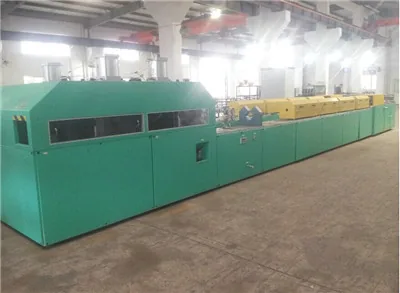
Enclosed heating tunnel on a composite core line: the core cures over a long heated length.
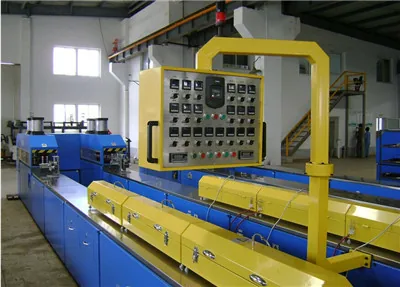
Control station over the die and heating zones of a multi-strand core line.
What sets the take-up reel size, run length and speed?
A profile line ends at a saw. A core line ends at a reel, and the reel diameter limits the largest core the line can make. In the patent embodiment the wheel is seven feet (about 2.1 m) in diameter and holds up to 6,800 feet (about 2,070 m) of core. The same patent states that a core larger than 0.375 in (9.5 mm) cannot bend to a seven-foot wrapping diameter without cracking, and that a 1/2 to 5/8 in core may need a 15-foot wheel. ASTM B987 includes a minimum bending diameter requirement. Compare the drum diameter with that value for the largest core you plan to make, and agree reel dimensions with the stranding plant and the shipping route.
Run length matters too. The patent gives carbon tow lengths of about 3,000 to 6,000 m per spool and glass lengths up to 36 km, depending on spool size. ASTM B987 also contains requirements for joints. Read that clause before deciding how spool changes, fiber splices and reel ends are handled during a run.
A Union Carbide patent application states that a typical maximum speed for ACCC core pultrusion is less than 8 ft/min (about 2.4 m/min). EPTA gives 0.02 to 3.0 m/min as the general thermoset range. Neither figure is a quotation value. Ask for a witnessed trial on your largest diameter with your resin system. Record speed, zone temperatures and pull force, then calculate annual output from that record and your planned uptime.
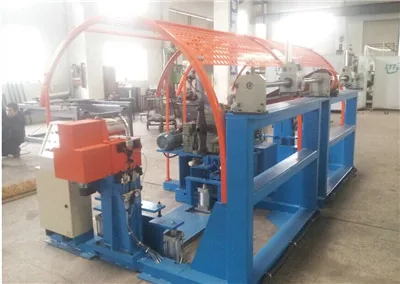
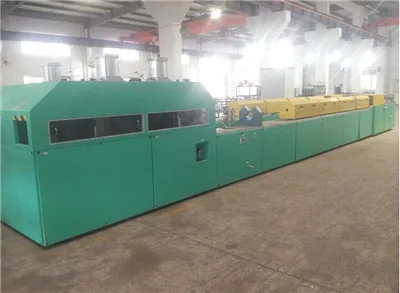
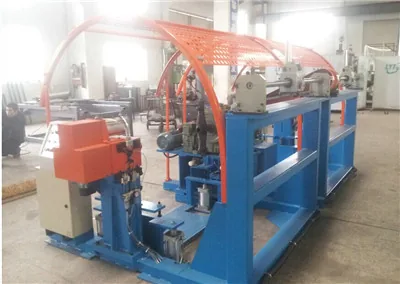
Dedicated take-up winder: the continuous core is coiled on a reel instead of being cut to length.
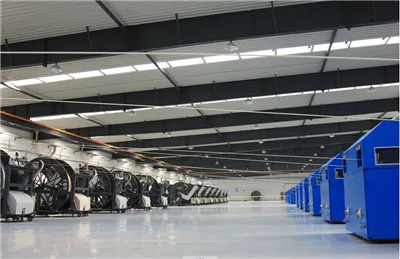
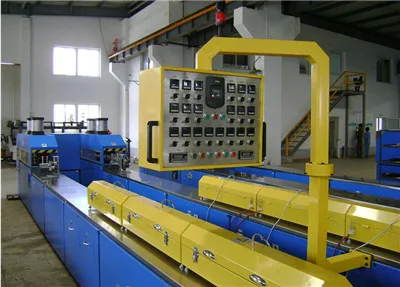
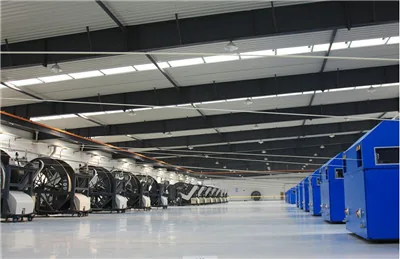
Take-up reels at the end of parallel core lines in a production hall.
Which tests must the composite core pass?
The ASTM B987 abstract lists these tests: tensile, glass transition temperature (Tg), bending, dye penetrant testing after bending, tensile after bending, heat exposure and heat/stress. IEC TS 62818-1 prescribes common test methods for polymeric matrix cores. Plan the laboratory with the line, because every lot needs data.
- Tg measurement on samples from each lot. Minard et al. found that thermal aging at 180 to 210 °C lowered the Tg of the carbon core of a hybrid rod and led to micro-cavities and cracks, so Tg is a cure and durability check.
- Tensile testing with grips suited to a small-diameter composite rod, before and after the bending test.
- A bending fixture at the specified diameter, followed by dye penetrant inspection.
- Barrier layer thickness measurement by the method the specification sets. INL notes that the protective layer can be damaged by improper fabrication, so check it on trial cores.
- Heat exposure and heat/stress equipment, or a contract laboratory, as the chosen specification requires.
What should a composite core line RFQ include?
| Item | What to state | Why it matters |
|---|---|---|
| Specification | ASTM B987/B987M, IEC TS 62818-1, GB/T 29324 or a utility specification, with edition | Sets diameters, bend limits, barrier and tests |
| Core sizes | Diameter list, solid or stranded core, carbon-to-glass layout per size | Sizes the dies, bushings and creel positions |
| Fibers | Carbon and glass grades, tow sizes, spool dimensions and lengths | Creel design and run length |
| Resin system | Grade, supplier, pot life, cure schedule, impregnation route | Bath or injection and heated zone layout |
| Output | Target annual length and planned shifts | Number of lines or strands |
| Take-up | Reel dimensions, minimum bending diameter, length per reel | Winder design and logistics |
| Inspection | Inline checks required and data format | Lot certification |
| Laboratory | Tests done in-house and tests sent out | Equipment list beyond the line |
| Site | Power, compressed air, extraction, building length | Staged heating makes the line long; in the patent, zones 4 to 6 alone span about 30 to 45 feet |
For pot life, impregnation route and the formulation record, see the pultrusion resin formulation guide
Trial and acceptance sequence
- 01
Freeze the specification
Buyer
Agree the standard, edition, core sizes and acceptance values in writing before the factory acceptance test (FAT) is planned.
- 02
Approve tooling drawings
Buyer and tooling supplier
Review die, bushing and guide drawings for the first core size, including how the barrier layer thickness is controlled.
- 03
Confirm materials
Buyer
Supply or approve carbon, glass and resin batches for the trial and record their identity, so the trial result applies to production materials.
- 04
Run the FAT
Equipment builder
Run the first core size at the agreed speed for the agreed length, logging zone temperatures, pull force, tension and inline readings, and wind the core onto a reel of the specified diameter.
- 05
Test trial cores
Buyer
Cut labeled samples from the start, middle and end of the run and test them to the chosen specification, in-house or at an agreed laboratory.
- 06
Install and repeat on site
All parties
Repeat the trial after installation with your operators, then extend acceptance to each further core size with its own trial record.
How pultrx reviews composite core line enquiries
Sources and further reading
- ASTM B987/B987M-25: Standard Specification for Carbon Fiber Thermoset Polymer Matrix Composite Core (CFC) for use in Overhead Electrical Conductors
Scope and abstract reviewed 2026-11-08. Covers carbon fiber reinforced thermoset matrix composite core strength members for overhead conductors, core diameters from 0.180 to 0.835 in (4.57 to 21.21 mm) and stranded-core strands from 0.060 to 0.278 in. Lists requirements for tensile strength, glass transition temperature, minimum bending diameter, minimum thickness of the galvanic protection barrier layer, joints and packaging, and the tests: tensile, Tg, bending, dye penetrant after bending, tensile after bending, heat exposure and heat/stress.
- IEC TS 62818-1:2024: Conductors for overhead lines, fiber reinforced composite core used as supporting member material, Part 1: Polymeric matrix composite cores
Abstract reviewed 2026-11-08. Edition 1.0, 2024-12-12, TC 7. Defines common terms, test methods for single or multi-wire polymeric matrix composite cores and acceptance or failure criteria when applicable; states that it does not apply to compliance criteria, with indicative values possible in annexes.
- BSI Knowledge: PD CLC IEC/TS 62818-1:2026
Lists the CENELEC adoption of IEC TS 62818-1 as current, published 28 February 2026.
- SAMR national standards portal: GB/T 29324-2024, Carbon fiber reinforced composite core for overhead electrical conductors
Search listing reviewed 2026-11-08 shows GB/T 29324-2024 as a recommended national standard in force. Title translated from Chinese; the full text was not reviewed.
- Idaho National Laboratory with EPRI: Corrosion Tests, in Advanced Conductor Testing: Compilation of Test Results and Summaries (2025)
Describes the ACCC conductor as using a hybrid carbon and glass fiber core, with the glass fiber layer protecting against galvanic corrosion; states that galvanic corrosion occurs only if the carbon core is directly exposed to aluminum, and that the protective layer could be damaged by improper installation or fabrication, fretting or thermal aging. Reports galvanic corrosion evaluation after thermomechanical cycle aging corresponding to 40 years of operation.
- US 9,093,191 B2 (CTC Global Corp): Fiber reinforced composite core for an aluminum conductor cable
Patent text describing one embodiment of a core process: per-spool tension adjustment, moisture-removing preheat oven, wet-out tank, bushings that shape and compress the tows, B-stage, forming, curing (about 350 to 400 °F), cooling and post-cure zones, a two-belt puller, a quality control system and a winding wheel (seven feet in diameter, up to 6,800 feet of core in one embodiment). States that cores above 0.375 in cannot bend to a 7-foot wrapping diameter. Describes one embodiment, not a current production practice.
- US 2011/0104364 A1 (Union Carbide Chemicals and Plastics Technology): High-speed pultrusion process for the manufacture of fiber reinforced composites
Patent application stating that a typical maximum speed of a pultrusion process for making ACCC composite core is less than 8 ft/min, and describing the conventional spool, resin bath, heated die and puller sequence.
- Minard et al. (2019), Journal of Composites Science 3(4):103: Thermal ageing of a hybrid composite rod for next generation overhead power lines
Peer-reviewed study; abstract reviewed via Crossref. Hybrid rod of epoxy-anhydride matrix with unidirectional carbon and glass fibers aged at 180 to 210 °C: thermolysis in the carbon core lowered the glass transition temperature and led to micro-cavities and cracks; thermal oxidation affected only a thin surface layer (typically 60 µm) of the glass-fiber shell.
- EPTA: Technical principles of pultrusion
Caterpillar take-off units or hydraulic clamps; thermoset line speeds between 0.02 and 3.0 m/min depending on wall thickness, reinforcement and profile complexity.
Questions buyers ask
How does a composite core line differ from a profile pultrusion line?
It feeds carbon and glass fibers under separate tension control, places them with preform bushings, cures the core through staged heated zones and winds it onto a reel instead of cutting it to length. The reel diameter must respect the core's minimum bending diameter.
Which standard covers carbon fiber composite core?
ASTM B987/B987M covers carbon fiber thermoset polymer matrix composite core for overhead conductors. IEC TS 62818-1 covers terms and test methods for polymeric matrix composite cores, and China publishes GB/T 29324-2024. Confirm which one your customers specify.
Why is there a glass fiber layer around the carbon?
Carbon in direct contact with aluminum can cause galvanic corrosion of the aluminum. In the hybrid design INL tested, the glass fiber layer is the protective barrier. ASTM B987 includes requirements for the barrier layer.
How fast does a composite core line run?
A Union Carbide patent application states that a typical maximum speed for ACCC core pultrusion is less than 8 ft/min. Your speed depends on diameter, resin system and heated length, so base capacity on a witnessed trial record.
Does pultrx sell a composite core line from stock?
No. Composite core line enquiries are reviewed as projects, with machines from the partner equipment factory named in the quotation and dies and preform tooling from the Henan Zhongsheng factory.
Summary
What is a composite core conductor production line?
A composite core conductor production line pultrudes a carbon fiber strength member inside a glass fiber barrier layer and winds it onto a reel instead of cutting it to length. It differs from a profile line in three places: a creel feeding two fiber types under separate tension control, a long staged heated section, and a take-up winder in place of the cut-off saw.
- Product standards
- ASTM B987/B987M; IEC TS 62818-1 for terms and test methods; GB/T 29324-2024 in China
- Glass fiber layer
- Barrier against galvanic corrosion where carbon would otherwise touch the aluminum strands
- Take-up
- Reel diameter must respect the core's minimum bending diameter
- Speed reference
- A Union Carbide patent application gives a typical maximum below 8 ft/min for ACCC core; base capacity on a witnessed trial
- Acceptance
- Standard, edition, core sizes and acceptance values frozen in writing before the factory acceptance test is planned
- Built by
- Machines and any resin injection unit: the partner equipment factory named in the quotation. Dies and preform tooling: Henan Zhongsheng, partner factory, or the partner die shop named in the quotation
- Supplied as
- A pultrx project proposal listing every station and every item quoted separately; no catalogue line, no list price, and no output figure without a trial record
Published by pultrx, an integrated pultrusion technology provider working with Henan Zhongsheng as a partner factory. This is a buyer planning guide; the manufacturer confirms project specifications in writing.
Ready to move from reading to a scoped quotation?
Request a line proposal