
Why module makers are moving to composite frames
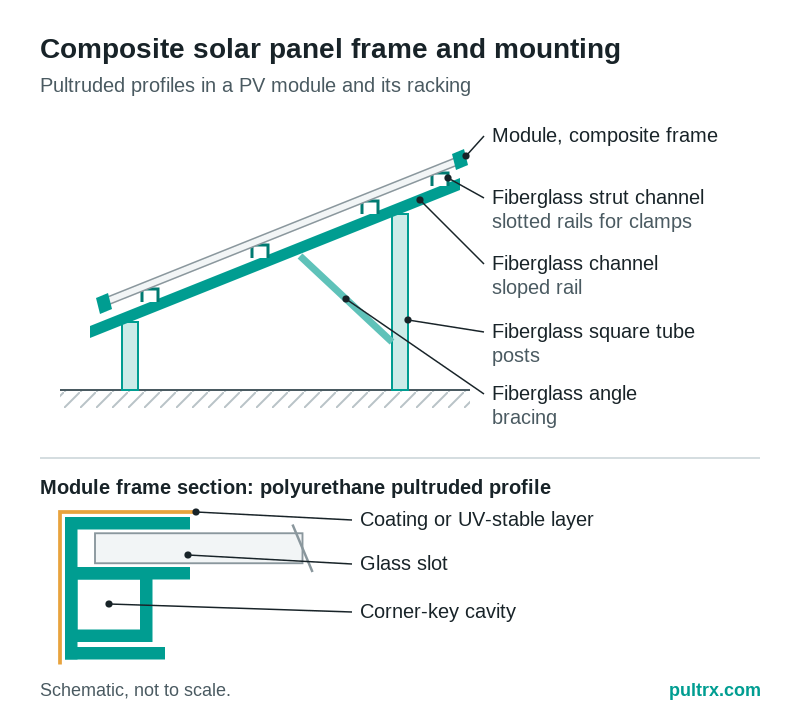
A glass fiber and polyurethane frame does not corrode in salt or ammonia and does not conduct, which changes how frame grounding and leakage current are handled in the module design. Polyurethane resin wets a high glass content at speed, so the wall can be thin. The surface needs a coating or a UV-stable layer for decades outdoors. Whether a composite frame suits a given module is decided by the module maker's own qualification tests.
Mounting structures
Fiberglass racking is used where galvanized steel has a short life: coastal plants, rooftops over livestock or chemical processes, and floating arrays. Sections are standard channels, tubes and angles, bolted with stainless hardware. FRP deflects more than steel, so the designer sets post spacing and rail depth for stiffness.
Buying profiles or making them
A module maker with large, steady volume may prefer to pultrude frames in its own plant. pultrx supplies both routes: profiles from the partner factory for qualification and smaller volumes, and a polyurethane pultrusion line with injection unit, dies and commissioning for in-house production. The solar frame line guide describes that line.
Line configuration, injection, die and downstream equipment for PV frame profiles. Pultrusion line for solar panel frames