
Technical review: Yunkun Gong, Pultrusion Engineer, pultrx
Carbon steel has an elastic modulus of 210 GPa under Eurocode 3, while an EN 13706 Grade E23 pultruded glass-fiber profile has a minimum longitudinal modulus of 23 GPa. Because the material modulus is roughly one ninth that of steel, increasing section depth H is the practical way to gain bending stiffness EI, since Ix grows with the cube of depth.
Which formulas calculate Ix, Sx and rx?
The calculator models each profile with square corners and uniform wall segments. Strong-axis bending assumes the load acts vertically in the plane of the web (or parallel to depth H for a rectangular tube).
| Section | Area A | Strong-axis Ix | Section modulus Sx |
|---|---|---|---|
| I-beam or H-beam (H × B × tf × tw) | 2 B tf + (H − 2 tf) tw | [B H³ − (B − tw)(H − 2 tf)³] ÷ 12 | 2 Ix ÷ H |
| Channel (H × B × tf × tw) | H tw + 2 (B − tw) tf | [B H³ − (B − tw)(H − 2 tf)³] ÷ 12 | 2 Ix ÷ H |
| Box tube (H × B × t) | B H − (B − 2t)(H − 2t) | [B H³ − (B − 2t)(H − 2t)³] ÷ 12 | 2 Ix ÷ H |
| Round tube (OD D, wall t, ID d = D − 2t) | π (D² − d²) ÷ 4 | π (D⁴ − d⁴) ÷ 64 | 2 Ix ÷ D |
| Solid round rod (diameter D) | π D² ÷ 4 | π D⁴ ÷ 64 | π D³ ÷ 32 |
| Equal angle (leg L, thickness t) | t (2L − t) | Parallel-axis sum of both legs about centroid | Ix ÷ (L − ȳ) |
Radius of gyration rx equals the square root of Ix divided by A, and weak-axis ry equals the square root of Iy divided by A. Compression struts and unbraced columns buckle about the axis with the smaller radius of gyration.
Why does shear deflection matter in pultruded FRP beams?
In isotropic steel beams, shear modulus G is large relative to longitudinal modulus E, so textbook beam checks ignore shear deformation except on very stubby girders. In a pultruded FRP profile, continuous roving runs along the member while resin and mat carry in-plane shear, so E divided by G is much larger than in steel. Published pultrusion design manuals add a shear deflection term to Euler bending deflection.
Under a uniform line load w on a single simple span L, bending deflection at mid-span is 5 w L⁴ divided by 384 E Ix, and web shear deflection is w L² divided by 8 G Ashear. Leave G at 0 in the calculator to isolate pure bending, or enter the in-plane shear modulus from your profile supplier's test data to see both components side by side.
What do worked examples show for common sections?
| Nominal section | Area A | Strong-axis Ix | Modulus Sx | Weak-axis Iy | Radius rx |
|---|---|---|---|---|---|
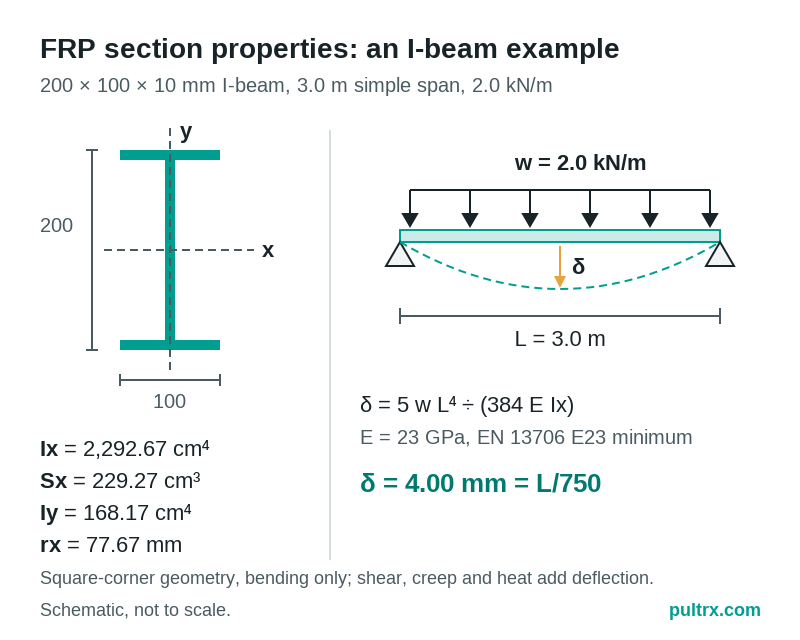
| I-beam 200 × 100 × 10 mm | 3,800 mm² | 2,292.67 cm⁴ | 229.27 cm³ | 168.17 cm⁴ | 77.67 mm |
| Channel 200 × 60 × 10 mm | 3,000 mm² | 1,570.00 cm⁴ | 157.00 cm³ | 82.50 cm⁴ | 72.34 mm |
| Square tube 100 × 100 × 6 mm | 2,256 mm² | 333.59 cm⁴ | 66.72 cm³ | 333.59 cm⁴ | 38.45 mm |
| Round tube 50 mm OD × 5 mm wall | 706.9 mm² | 18.11 cm⁴ | 7.25 cm³ | 18.11 cm⁴ | 16.01 mm |
Take the 200 × 100 × 10 mm I-beam on a 3.0 m simple span carrying a uniform service load of 2.0 kN/m. At the EN 13706 Grade E23 minimum modulus of 23 GPa, pure bending deflection at mid-span is 4.00 mm, or L/750. Adding a shear term or sustaining the load over years under creep and elevated temperature increases total deflection.
What limits does this geometric screen leave to the project engineer?
- Lateral-torsional buckling: an open I-beam or channel without top-flange bracing can buckle sideways well before reaching material strength or target deflection.
- Channel shear center: loading a C-channel through its web or flange without torsional restraint twists the section as well as bending it.
- Long-term creep and service temperature: sustained dead load and warm environments require time-effect and temperature reduction factors under structural FRP design codes.
- Local web crippling and bolted connections: concentrated bearing loads at supports and bolt holes often govern wall thickness before mid-span bending stress does.
- Fillets and corner radii: pultrusion dies carry inside fillets and outside radii, so catalog Ix and Sx differ slightly from square-corner geometry.
To see how US pultruders tabulate braced vs unbraced spans and deflection limits, read fiberglass I-beam span tables
Sources and further reading
- Fiberline: European standard EN 13706, minimum requirements for E23 and E17 profiles
Reproduction of EN 13706-3 Table 1: minimum longitudinal modulus of elasticity 23 GPa for E23 and 17 GPa for E17.
- Strongwell: EXTREN Design Manual, Section 8, Flexural Members (Beams), Rev.0924
Pultruded beam behavior: deflection and lateral-torsional buckling govern practical spans; shear deflection becomes noticeable on short, deep spans.
- Creative Composites Group: The PulTex Pultrusion Design Manual, Volume 5, Revision 15
Published beam tables include both flexural and shear terms in total deflection.
Questions buyers ask
Why are pultruded FRP beams usually governed by deflection rather than strength?
Glass-fiber pultruded profiles combine high longitudinal tensile strength with a relatively low elastic modulus, such as 23 GPa minimum for EN 13706 Grade E23 against 210 GPa for carbon steel. On most floor, walkway and platform spans, the beam reaches L/180 or L/360 deflection well before approaching its allowable bending stress.
Does cross-section moment of inertia Ix change between fiberglass and steel?
No. Area A, moment of inertia Ix and Iy, section modulus Sx and Sy, and radius of gyration rx and ry are pure geometric properties of the cross section. What changes between materials is elastic modulus E and shear modulus G, which multiply Ix and Ashear to set bending and shear stiffness.
When should shear deflection be included in an FRP beam calculation?
Include shear deflection whenever your supplier provides an in-plane shear modulus G, particularly on short spans or deep sections where span-to-depth ratio L/H is below about 15 to 20. Because longitudinal glass roving gives a high E-to-G ratio, shear deformation accounts for a larger share of total deflection than in steel.
Can I size a permanent structural frame from this calculator alone?
No. The calculator checks square-corner geometry and short-term elastic deflection on a laterally braced simple span. Permanent structures require an engineer to check lateral-torsional buckling, web bearing, long-term creep under sustained dead load, elevated-temperature reductions, fire protection and bolted joint capacity.
How do I increase bending stiffness if an FRP beam deflects too much?
Stepping up section depth H raises Ix roughly with the cube of depth and is usually more economical than thickening flanges alone. Shortening support spacing, bracing compression flanges, switching to a closed box section for torsion, or specifying a higher-modulus fiber architecture also reduces deflection.
Summary
How do you calculate the section properties and deflection of an FRP profile?
Cross-section area, moment of inertia Ix and Iy, section modulus Sx and Sy, and radius of gyration rx and ry depend only on section geometry. Mid-span bending deflection under a uniform load w over a simple span L equals 5 w L⁴ divided by 384 E Ix, plus a shear term w L² divided by 8 G Ashear on short spans when shear modulus G is included.
- Geometric outputs
- Area A, moment of inertia Ix and Iy, section modulus Sx and Sy, radius of gyration rx and ry
- Bending deflection
- 5 w L⁴ ÷ (384 E Ix) for a single simple span under uniform load w
- Shear deflection
- w L² ÷ (8 G Ashear), added when in-plane shear modulus G is entered from a test report
- EN 13706-3 modulus
- Minimum longitudinal modulus 23 GPa for Grade E23 and 17 GPa for Grade E17
- Scope limit
- Preliminary geometry and serviceability screen only; lateral buckling, creep, heat and joints need engineering design
Published by pultrx, an integrated pultrusion technology provider working with Henan Zhongsheng as a partner factory. This is a buyer planning guide; the manufacturer confirms project specifications in writing.
Ready to move from reading to a scoped quotation?
Send a structural profile list for quotation