
Technical review: Yunkun Gong, Pultrusion Engineer, pultrx
What does a pultrusion creel do?
The creel is the first station of a pultrusion line. EPTA, the European Pultrusion Technology Association, states that the continuous longitudinal rovings absorb the high take-off forces and that the reinforcement is accurately guided in front of the die (mould). Each roving end carries part of that force, so the creel has to deliver every end at an even tension.
A CertainTeed patent application on pultruded building products calls this reinforcement handling stage the creels, notes that creels of 100 or more packages are common and that they may be stationary or mobile. Strongwell publishes two roving creels for packages of 40 lb or more: 100 doffs on five shelves and 48 doffs on four. Mat, fabric and veil rolls run from separate mat stands.
For where the creel sits among the other stations, read the pultrusion process, step by step
What types of roving creels are used in pultrusion?
| Creel type | How the roving pays off | Published by |
|---|---|---|
| Rack or bookshelf creel | Packages stand on shelves and are pulled from the inside; guide eyes and tensioners at the shelf ends | Strongwell, Pultrex, Composite Machinery, ETC (filament winding) |
| Pallet creel | The roving pallet itself is the creel; doffs are spliced together, with an eyelet board over the pallet | Owens Corning (Creel-Pak), 3B (Creel-Pack), Composite Machinery |
| Spindle creel, mechanical brake | Packages sit horizontally on spindles and unwind from the outside against a brake | Composite Machinery; Van Wees (spring brakes, carbon) |
| Spindle creel, servo or closed loop | Outside unwind with sensors or a dancer arm that vary the tension | Composite Machinery; Pultrex lists these for filament winding |
| Rotating positions for glass | The package turns so the roving comes off tangentially; offered where twist is unwanted | Van Wees |
| Mat and veil stands | Rolls on mandrels set to the process centerline | Strongwell; Pultrex (per installation) |
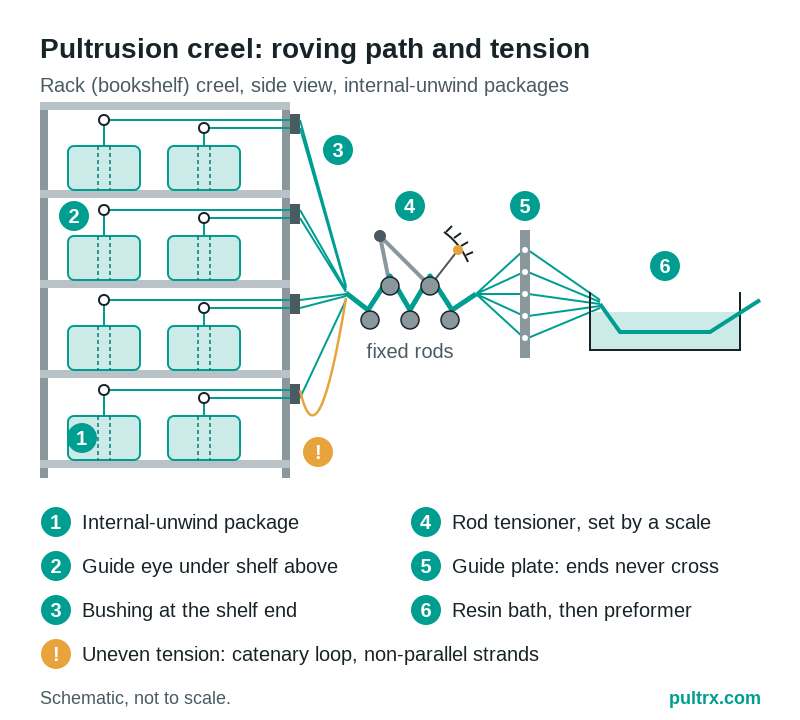
Pultrex, a UK machine builder, describes its creel rack (reviewed 2026-11-14): wooden shelves hold internal-unwind rovings, each roving has its own guide eyes under the shelf above, and the tension devices sit at the front of the rack. pultrx is not affiliated with Pultrex.
For how the two companies differ, see pultrx vs Pultrex
How do internal and external unwind rovings compare?
Roving packages pay off in one of two ways. An internal-unwind (center-pull) package has no core and the end is drawn from the inner bore. An external-unwind (outside-pull) package is wound on a cardboard tube and turns on a support. Owens Corning supplies its PulStrand 4100 pultrusion roving as a single-end internal-pull package. Older PPG data sheets offered a choice of outside (tubed) or inside (no-tube) payout.
Internal unwind (Irfan, 2013, Table 3)
- Easy transfer from one package to the next for continuous running
- Little packaging waste, since there is no core
- Simple creel stand and a simple tensioning mechanism
- Twist in the roving, because it leaves the inner bore
External unwind (Irfan, 2013, Table 3)
- Minimum twist
- Needs rotating spindles or mandrels
- Needs more complex tensioning methods and devices
- More downtime at package transfer, and cores to dispose of
Irfan's thesis adds that twist can affect the mechanical properties of the composite and the rate of impregnation, and that it reduces how far a roving can be spread. Van Wees makes the same point from the creel side: a stationary package unwound from the inside adds a twist with every turn, which is why its glass creel offers rotating positions for tangential unwinding. Irfan notes that pultrusion rovings are usually supplied from centre-pull packages. Where spreading or twist matters, ask for external-unwind positions and price the extra tension hardware.
Why does uneven roving tension cause defects in pultrusion?
Catenary: loops and non-parallel strands
The CertainTeed application defines catenary as uneven fiber-to-fiber tension that produces loops or non-parallel strands, and lists it, with fiber damage from creel or forming fixtures, among the factors that reduce axial properties. Part of the catenary arrives with the roving. A 1984 TBA patent traces it in multi-strand roving to tension differences between the packages combined into one roving, and a 1999 PPG patent to tension variations while the package is wound, which can also tangle the roving at payout.
The TBA patent also describes a sag test: run the roving 15 m between two bars under a 500 g weight and measure how far each bundle drops below the tightest one. It reports about 15 cm for a typical untreated roving against 2 or 3 cm for its own treated product. Those numbers belong to that product. The method is a useful incoming check when a lot runs badly on the creel.
Fiber position, wet-out and fiber damage
- Alignment: changes in pulling speed and tow tension can cause longitudinal fiber misalignment (Poulton, 2023, citing El-Hajjar et al.).
- Wet-out: tension compacts the filaments in a roving and lowers its permeability, and higher tension can damage the fiber. Keep tension high enough to hold the path without damaging the fiber (Irfan, 2013).
- Tension adds up along the path: over an impregnation pin in the resin, tension builds from the inlet tension, viscous drag and friction, and forming guides raise it again (Irfan, 2013). The tension an end leaves the creel with is the starting point for every later contact.
For dry fiber, voids and other symptoms and their first checks, see the pultrusion defects guide
Which devices control roving tension on a creel?
| Device | What it does | Source |
|---|---|---|
| Guide eyes (eyelets, bushings) | One per end; ceramic, steel, PTFE or UHMWPE; abrasion-resistant bushings at each shelf end | Irfan (2013); Strongwell |
| Multiple eyes or guide bars per end | Extra contact points to tailor the tension of each roving | CertainTeed application |
| Guide plates and eyelet boards | Hold every end in its position; plates in PP, PTFE or HMWPE; rovings must not cross | Irfan (2013); Owens Corning Creel-Pak |
| Tubes from creel to line | Polymer tubes carry the roving to the line and aid tension control | Irfan (2013); Owens Corning Creel-Pak |
| Interlocking-rod or S-wrap bars | The roving wraps over fixed and movable bars; the degree of interlock or wrap sets the tension | Pultrex creel rack; ETC bookshelf creel (filament winding) |
| Spring or mechanical brake | Brakes the spindle of an external-unwind package | Van Wees; Composite Machinery |
| Servo or closed-loop tensioner | Sensor or dancer arm varies the tension during the run | Composite Machinery; Pultrex (filament winding) |
On the Pultrex rack the lower set of polished rods is fixed and the upper set sits on a pivoting frame. Tension changes with the degree of interlocking, and a lock with a linear scale and locknut holds the setting. ETC, a filament winding equipment builder, describes adjustable S-wrap tension bars on its bookshelf creel for center-pull spools. Whatever the device, ask for a readable scale, so a setting can be written on the setup sheet and repeated after a die change.
How should rovings be routed from creel to bath?
- Guide each end from the package, through its eye, to a fixed position on the guide plate. Irfan stresses that rovings must pass the eyelets and guide plates without crossing over each other.
- Strongwell places intermediate guide rods above the packages and abrasion-resistant bushings at the end of each shelf, on steel frames with lockable casters so the creel can move between jobs.
- Mat stands: Strongwell's take rolls up to 610 mm in diameter on mandrels that adjust vertically to the process centerline, with spacing for splicing and brackets for creel cards that orient mat and roving through the creel.
- Forming guides: they squeeze out resin and air but add tension. Irfan warns that a poor guide profile causes fibrous build-up from fiber damage and snagging.
Preform guide plates, resin baths and mat stands are covered on pultrusion line tooling
How do fuzz, static, and humidity affect the creel?
Fuzz is loose, broken filament. Irfan warns of fibrous build-up at forming guides from fiber damage and snagging. Owens Corning states that low fuzz in its PulStrand 4100 roving gives smoother parts and less downtime for clean-up, and an older PPG sheet describes Hybon 2001 as free from catenary and abrasion resistant, which allows low operating tensions. Fuzz depends on the roving grade as well as on the guides.
Producers link humidity and static to how glass fibre behaves. PPG sheets advise storage at 65 ± 10% relative humidity and conditioning in the working area to avoid humidity or static problems. 3B gives 15 to 35 °C and 35 to 75% RH for storage, at least 24 hours of conditioning in the workshop, and 20 to 23 °C at 60 to 65% RH for processing. Owens Corning asks for 48 hours in the workshop to prevent condensation. Where the creel room is dry, ask whether static-dissipative guide eyes are available and record the room conditions with the setup.
How do roving tex and end count size the creel?
Tex is grams per kilometer. 3B lists its 399 pultrusion roving from 1200 to 9600 tex on nominal 25 kg bobbins, and Owens Corning its PulStrand 4100 from 600 to 9600 tex. The die's reinforcement schedule fixes the tex and the number of ends, and the number of ends fixes the creel positions. As arithmetic: glass mass per meter equals the section area times the glass volume fraction times the glass density (3B gives 2.62 g/cm³), and each end of T tex carries T/1000 g per meter. The roving count calculator at the top of this page does that arithmetic for your section.
Plan package changes as well as positions. Internal-unwind packages transfer easily from one to the next for continuous running (Irfan, 2013). Owens Corning wraps its packages to aid run-out and transfer, and its Creel-Pak pallets come spliced with air, cross-thread or knot splices so the pallet serves as the creel. Its own table claims 75% less splicing time than bulk doffs.
For roving grades, sizing, tex and yield, and receiving checks, see the pultrusion raw materials guide
Creel RFQ and acceptance checks
| Item | State in the RFQ | Check at acceptance |
|---|---|---|
| Packages | Roving grade, tex, package weight and diameter, internal or external unwind, pallet creel or not | A package of the ordered roving fits every position |
| Positions | Ends per profile from the reinforcement schedule, multiple profiles if run side by side | Position count and layout match the drawing |
| Guide eyes | Material, one eye per end, bushings at shelf ends, static-dissipative if required | Eyes are smooth and fixed; no end touches a frame edge |
| Tension device | Type (rod, S-wrap bar, brake or servo) and a readable scale with a lock | A setting can be set, read and repeated |
| Path to the bath | Guide plate or eyelet board, tubes, route and distance to the bath or injection box | Ends run to the plate without crossing |
| Mat and veil stands | Roll diameter, width and core, number of rolls, centerline height | Mandrels align with the process centerline |
| Frame | Castors or fixed frame, footprint, floor fixing | Frame matches the layout drawing |
| Roving quality | Producer data sheet; agree a catenary check for incoming lots if needed | Record lot numbers with the first run |
To fold these items into factory acceptance, use the pultrusion line FAT checklist
Who supplies the creel in a pultrx line?
pultrx is an integrated pultrusion technology provider in Shanghai and does not make creels. It specifies the creel with the line. Henan Zhongsheng, partner factory, or the builder named in the quotation supplies it, and the creel is a separate line in the quotation. Creels are stand-alone machines, so one can be added to an existing line. Send the make and model of the line, the roving plan and photographs of the interfaces.
For the full scope of a line from creel to saw, see the turnkey pultrusion line
Sources and further reading
- Owens Corning: Higher performance composites sell sheet (fiber and bulk glass properties table)
Reviewed 2026-11-14. Predicted fiber density: E-glass 2.60 to 2.62 g/cm³, Advantex E-CR glass 2.63 g/cm³; the source of the 2.6 g/cm³ example value in the roving count calculator.
- M. S. Irfan: Environmentally friendly pultrusion, PhD thesis, University of Birmingham (May 2013)
Reviewed 2026-11-14. p. 2: drawing roving from the inner bore needs no shafts, bearings or tension controllers but twists the roving, and twist can affect properties and impregnation rate. p. 7: rovings are usually supplied from centre-pull packages; eyelets are generally ceramic, steel, PTFE or UHMWPE; guide plates PP, PTFE or HMWPE; rovings must pass without crossing over; polymeric tubes are sometimes used from creel to line. pp. 11 and 12, Table 3: centre-pull against outside-pull packages; p. 12: the twist can be detrimental where lateral spreading is wanted (also p. 24). p. 15: forming guides increase roving tension, and their profile must avoid fibrous build-up from fibre damage and snagging. p. 53: tension compacts the filaments and lowers permeability; higher tension can damage fibre. pp. 56 and 58 (pin impregnation, citing Chandler et al. and Bates and Charrier): tension builds up over a pin from inlet tension, viscous shear and fibre-to-pin friction.
- M. Poulton: Structural integrity of pultruded GFRP bridge decks with variable fibre misalignments, PhD thesis, UCL (January 2023)
Reviewed 2026-11-14. p. 44, citing El-Hajjar et al. (2018): changes in pulling speed and tow tension can cause longitudinal fibre misalignments; the pulling force tends to minimise them.
- CertainTeed: US 2004/0009338 A1, Plastic rail system and other building products reinforced with polymer matrix composites (published 15 January 2004)
Reviewed 2026-11-14. A patent application, not a study. Calls the reinforcement handling system the creels; creels of 100 or more packages are common, stationary or mobile; some creels use multiple guide eyes (bushings) or guide bars to tailor the tension of each roving; axial properties can be reduced by fiber damage from creel or forming fixtures and by catenary, defined as uneven fiber-to-fiber tension giving loops or nonparallel strands.
- TBA Industrial Products: US 4,475,693, Method of producing glass fiber product (granted 9 October 1984)
Reviewed 2026-11-14. Defines catenary in a multi-strand roving as lateral separation of strands, caused by tension differences between the packages combined into it; describes a sag test over 15 m with a 500 g weight, the drop of each bundle measured against the tightest; a typical untreated roving shows about 15 cm, the patent's treated roving no more than 2 or 3 cm.
- PPG Industries: US 5,957,402, Method and apparatus for reducing catenary during winding of a fiber bundle (granted 28 September 1999)
Reviewed 2026-11-14. Tension variations between strands during package winding contribute to catenary; winding-tension fluctuations can cause tangling during payout, and sag can interfere with machinery and nearby rovings.
- PPG: Roving product data sheets, 1062, 1084, Hybon 2001 and others (revised 1999 to 2002; compilation hosted by a distributor)
Reviewed 2026-11-14. Old producer sheets. 1062 offers outside (tubed) or inside (no-tube) payout; Roving 1084 comes on bobbins with or without a cardboard core; several sheets state that catenary is kept to a minimum or that the roving is free of catenary; Hybon 2001 is described as free from catenary and abrasion resistant, which allows low operating tensions; storage at room temperature and 65 ± 10% relative humidity, conditioned in the working area before use to avoid problems with humidity or static electricity.
- Owens Corning: PulStrand 4100 single-end roving for pultrusion, product information (Pub. 10019658, January 2015; copy hosted by a distributor)
Reviewed 2026-11-14. Single-end internal-pull package; bulk or Creel-Pak pallets; Tack-Pak wrap to aid run-out and transfer; low fuzz stated to give smoother parts and less downtime for clean-up; 600 to 9600 tex; store in the workshop 48 hours before use to prevent condensation.
- Owens Corning: Creel-Pak packaging overview sheet (Pub. 10024511, October 2020)
Reviewed 2026-11-14. The pallet is used as the creel, doffs spliced together; 64-doff (16 per layer) and 48-doff (12 per layer) pallets; air splice, cross thread or knot splice by SKU; producer's table shows 75% splicing time saved; use an eyelet board over the pallets, with tensioners or tubing to aid tension control; pallet-to-pallet transfer by splicing. States it suits pultrusion with single-end roving.
- 3B Fibreglass: 399 Direct Rovings for pultrusion, data sheet (Pub. 3BDS_ADVGEENA4_0412-11)
Reviewed 2026-11-14. 1200 to 9600 tex (g/km); glass density 2.62 g/cm³; nominal C bobbin 25 kg; Bulk-Pack or Creel-Pack with bobbins connected for continuous unwinding; storage 15 to 35 °C and 35 to 75% RH; condition in the workshop at least 24 hours; process at 20 to 23 °C and 60 to 65% RH.
- Strongwell: PULSTAR pultrusion machine brochure
Reviewed 2026-11-14. Roving creels for packages of 40 lb or more: 100 doffs on five shelves or 48 on four; tubular steel frames with lockable casters; abrasion-resistant bushings at the end of each shelf and intermediate guide rods above the packages. Mat creels for eight or four rolls up to 610 mm diameter and width, with vertically adjustable mandrels for process centerline control and brackets for creel cards.
- Pultrex: Creels and mat stands
Reviewed 2026-11-14. A UK builder's page (not affiliated with pultrx). Wooden shelves hold internal-unwind rovings, each with its own guide eyes under the shelf above; tensioners at the front of the rack: two sets of interlocking polished rods, the lower fixed and the upper on a pivoting frame, with tension set by the degree of interlocking and held by a lock with a linear scale and locknut. Mat stands are designed per installation.
- Pultrex: Fibre tension systems (filament winding)
Reviewed 2026-11-14. Listed under filament winding: multi-spindle external-unwind tension systems, servo-controlled or electronic closed-loop (dancer arm; a magnetic particle brake on each spindle in the closed-loop units), self-compensating tensioners with a compensating arm riding on the spool, and modular bookshelf creels. The tensioner content is about filament winding, not pultrusion.
- Engineering Technology Corporation: Tensioning creels
Reviewed 2026-11-14. A filament winding equipment builder; the page does not mention pultrusion. Its bookshelf creel takes center-pull spools, uses adjustable S-wrap tension bars for tension control and holds 15 spools paying off from the front or side of the shelf.
- Composite Machinery: Creels
Reviewed 2026-11-14. Bookshelf creel: bobbins, mostly glass, on shelves, pulled inside out toward the resin tray. Mechanical creel with an integrated brake and servo creel with sensors for dynamic tension, both with horizontal bobbins pulled from the outside. Pallet creel supplies fiber parallel at a defined tension to the resin bath.
- Van Wees: Creel for carbon and glass fibers (March 2014)
Reviewed 2026-11-14. A stationary package unwound from the inside puts a twist in the yarn every circumference; the glass creel adds rotating positions for tangential unwinding; brake spring tension on the carbon creel is set by hand wheel. Applications named are laminates and tapes; pultrusion is not mentioned.
- EPTA: 2. Technical principles
Reviewed 2026-11-14. The continuous longitudinal rovings absorb the high take-off forces; the reinforcing materials are accurately guided in front of the mould.
Questions buyers ask
What is a roving creel in pultrusion?
The rack or frame that holds the roving packages at the start of the line and feeds each end through guide eyes and tension devices to the resin bath and preform guides. Strongwell publishes creels for 48 and 100 packages. A CertainTeed patent application notes that creels of 100 or more packages are common.
Internal or external unwind roving for pultrusion?
Internal (center-pull) packages need a simple stand and simple tensioning and transfer easily from one package to the next, but the roving comes off twisted. External unwind gives minimum twist but needs rotating spindles or mandrels and more complex tension devices (Irfan, 2013). Owens Corning supplies its PulStrand 4100 pultrusion roving as an internal-pull package.
What are S-wrap tension bars?
Bars that the roving wraps over and under on its way out of the creel. Changing the wrap or the interlock of the bars changes the tension. ETC fits adjustable S-wrap tension bars to its bookshelf creel, and Pultrex describes interlocking polished rods with a scale and locknut on its creel rack (reviewed 2026-11-14; pultrx is not affiliated with Pultrex).
Does a pultrusion creel need filament winding tensioners?
The pultrusion creels that Strongwell and Pultrex describe show none: packages stand on shelves and run through guide eyes or bushings and guide rods, with interlocking-rod tensioners on the Pultrex rack. Servo and closed-loop tensioners on external-unwind spindles, and self-compensating tensioners, are listed for filament winding, for example on Pultrex's fibre tension systems page (both Pultrex pages reviewed 2026-11-14; pultrx is not affiliated with Pultrex). Spindle brakes or servo control come in where external-unwind packages are used.
What causes catenary in roving?
Uneven tension between strands. Patents trace it to tension differences between the packages combined into a multi-strand roving and to tension variations while the package is wound. On the line, uneven tension between ends at the creel adds to it. A sag test over a fixed span shows how far each bundle drops below the tightest one.
Summary
What does a pultrusion creel do, and why does roving tension matter?
A pultrusion creel holds the roving packages and feeds every end to the resin bath and preformer at an even, repeatable tension. Rack (bookshelf) creels pay off internal-unwind packages through guide eyes and bar tensioners. Spindle creels unwind external packages. Uneven tension causes catenary: loops and non-parallel strands that can reduce axial properties.
- Creel types
- Rack or bookshelf creel for internal-unwind packages, pallet creel, rotating spindle creel for external unwind, mat stands
- Internal unwind
- Simple stand and tensioning, easy package transfer, but the roving is twisted (Irfan, 2013)
- External unwind
- Minimum twist; needs rotating spindles or mandrels and more complex tension devices
- Tension devices
- Guide eyes and bushings, eyelet boards, interlocking-rod or S-wrap bars, brake or servo tensioners
- Uneven tension
- Catenary (loops, non-parallel strands); tow tension changes can misalign fibers along the profile
- In a pultrx line
- Specified with the line, quoted as a separate line, supplied by Henan Zhongsheng or the builder named in the quotation
Published by pultrx, an integrated pultrusion technology provider working with Henan Zhongsheng as a partner factory. This is a buyer planning guide; the manufacturer confirms project specifications in writing.
Ready to move from reading to a scoped quotation?
Send your roving plan for a creel quotation