
Technical review: Yunkun Gong, Pultrusion Engineer, pultrx
Why do pultrusion plants slit reinforcement rolls in-house?
A fiberglass supplier sells continuous filament mat (CFM), stitched 0/90 or ±45 fabric and polyester surfacing veil quickest and cheapest in standard master roll widths (commonly 1,000 to 2,000 mm wide). By contrast, a 100 × 100 × 6 mm square tube, a 75 × 75 × 6 mm angle and a 200 mm channel each call for three or four distinct strip widths calculated from section perimeter, corner bends and lap joints.
- Inventory flexibility: three or four master roll weights in stock can feed dozens of profile dies without waiting weeks for custom-slit mill orders.
- Die-trial tuning: during a new die trial, an engineer often trims veil overlap or mat width by 3 to 5 mm to stop folding or corner resin richness. An in-house slitter makes a revised pancake roll in minutes.
- Reduced minimum order quantities: specialty flame-retardant veils, printed wood-grain veils or carbon stitched fabrics rarely come pre-slit in small trial widths.
How does a plunge roll slitter differ from a rewind slitter?
Two mechanical layouts appear in composite plants. Choosing between them depends on daily roll volume and how cleanly your fabrics cut on the core:
| Feature | Single-shaft plunge / baloney slitter | Unwind-slit-rewind web slitter |
|---|---|---|
| How it cuts | Master roll spins on one driven mandrel while a blade plunges radially through the roll into the cardboard core | Web unwinds over rollers, passes rotary shear or crush knives, and winds onto new cores on a rewind shaft |
| Setup time | Minutes: slide roll onto mandrel, index carriage to digital width readout, plunge cut, repeat across the roll | Longer: thread web, set individual knife holders, tape strips onto pre-cut cardboard cores |
| Footprint & cost | Compact frame with an overhead jib or gantry hoist; standard choice for small-to-medium pultrusion plants | Larger floor footprint and higher cost; used by high-volume reinforcement converters |
| Edge & tension behavior | Fast on CFM and polyester veil; heavy multi-axial stitched fabrics need sharp blade advance and controlled rpm to avoid fraying | Rewinds at controlled web tension onto fresh cores; avoids paper dust from slicing into the master core |
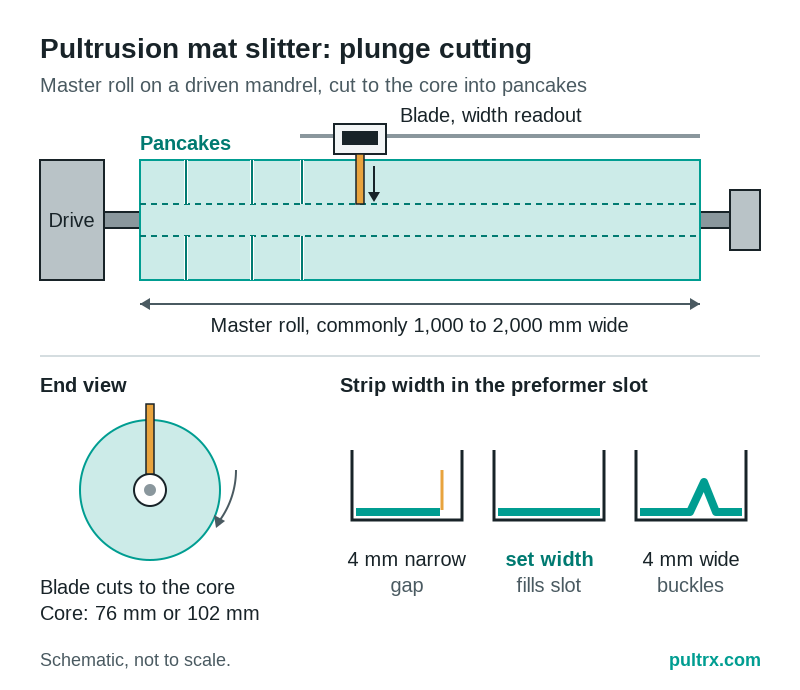
As a published reference point for the plunge style, Pultrex Limited (an unrelated UK machine builder, reviewed 2026-11-18) lists a manual roll slitting machine with hoist rated for master rolls up to 620 mm outside diameter by 2,000 mm length, supplied with two mandrels for 76 mm (3 in) and 102 mm (4 in) cores, variable reversible rotation from 0 to 75 rpm, a 15 m continuous blade canister and a digital cut-width display on 380 to 440 V three-phase power.
Why does strip width accuracy matter inside preform guides?
Inside a pultrusion preformer, flat mat and veil strips fold progressively around mandrels and into flange slots before entering the steel die taper. A strip slit 4 mm too narrow leaves a mat gap along a flange tip or lets raw unidirectional roving show through the surface veil (fiber prominence). A strip slit 4 mm too wide buckles against the preformer slot wall, doubles over on itself, raises pulling force and tears off mid-run.
Record the exact slit width for every ply on the die's setup card, check the first slit pancake with a steel rule before cutting the rest of a master roll, and label each cut pancake's inside core with gram weight (g/m²), material code and width in millimeters.
To see how slit pancakes mount on mat stands and feed into preformers, visit pultrusion preform guides and mat stands
What shop practices prevent frayed edges, crushed cores and moisture pickup?
- Match mandrel diameter to the paper core: 76 mm (3 in) and 102 mm (4 in) are both common across glass mat, stitched fabric and polyester veil suppliers. A loose core wobbles under blade pressure and produces a stepped cut.
- Advance fresh blade edge regularly: glass fiber dulls steel strip blades fast. A dull blade pushes and melts thermoplastic binder or frays stitching yarn instead of slicing cleanly, welding adjacent turns of a pancake together so it snags on unwind.
- Reversible spindle rotation: being able to reverse rotation lets the operator trim both roll ends cleanly and dress the cut edge according to fiber lay.
- Hoist loading and core support: a 2,000 mm master roll of heavy CFM or stitched fabric is too heavy for two operators to lift safely onto a cantilevered shaft without an integrated hoist or roll trolley.
- Re-wrap pancakes immediately: glass sizing and binder absorb shop humidity, and airborne dust settles on tacky edges. Keep slit pancakes wrapped in polythene film on off-floor racks until loaded onto the line.
What should you specify when requesting a mat and veil slitter quote?
- Maximum master roll length (for example 1,300 mm, 1,600 mm or 2,000 mm), maximum outside diameter (such as 600 mm) and maximum roll weight.
- Cardboard core inside diameters used by your mat, fabric and veil suppliers (76 mm, 102 mm, or adapters for both).
- Materials to be slit: CFM gram weights, stitched glass or carbon fabrics, polyester or glass surfacing veils, and minimum narrowest strip width.
- Digital width-indexing readout, blade style (continuous strip canister vs rotary circular knife) and dust/guard enclosure.
- Integrated roll-loading hoist or lift table, plus plant three-phase voltage and frequency.
Sources and further reading
- Pultrex Limited: Mat and veil slitting machines
Reviewed 2026-11-18. Published specification for a manual roll slitting machine with hoist: electrically driven roll 0 to 75 rpm, reversible for cutting on both edges, two mandrels for 76 mm and 102 mm cores, roll size 620 × 2,000 mm, 380 to 440 V 3-phase, 15 m blade canister and digital cut-width display. Pultrex Limited (UK) is unrelated to pultrx.
- US EPA: 40 CFR Part 63, Subpart WWWW, Table 4 Work Practice Standards
Read on ecfr.gov 2026-11-18. Table 4 Item 1 notes that composite materials uncovered to feed slitting machines should be re-covered after slitting.
Questions buyers ask
Can a pultrusion line use standard hand-layup chopped strand mat (CSM) rolls?
Ordinarily no. Standard chopped strand mat is held together only by an emulsion or powder binder that dissolves in styrene, so the strip pulls apart under line tension in the resin bath. Pultrusion uses continuous filament mat (CFM) or mechanically stitched mat/fabric that carries tensile pull into the die.
What core sizes do fiberglass mat and surfacing veil master rolls use?
Most composite reinforcement mills wind continuous filament mat, stitched fabric and polyester surfacing veil onto either 76 mm (3 in) or 102 mm (4 in) inside-diameter cardboard cores. Ordering a slitter with interchangeable mandrels or expanding chucks for both sizes avoids repacking rolls.
Why do slit mat pancakes sometimes stick together on the mat stand?
When a plunge blade grows dull or spins too fast without lubrication or cooling, friction heats the thermoplastic binder in CFM or melts synthetic veil fibers along the cut face, fusing adjacent layers. Advancing a sharp blade edge and lowering spindle speed stops edge fusion.
How narrow a strip can a pultrusion roll slitter cut?
Minimum practical width depends on roll diameter and material stiffness. Very narrow pancakes of tall outside diameter tend to telescope or tip over on unwind stands unless supported between side plates, so check the slitter's minimum index step alongside your mat stand's side-plate support.
Does every one-line pultrusion startup need its own slitter?
A plant starting with one dedicated product, such as solid rods that use roving only or a single profile running pre-slit rolls from its glass supplier, can defer buying a slitter. Once a plant runs several structural shapes, tubes and custom dies with different mat and veil widths, slitting master rolls in-house quickly pays back in lower stock and faster trials.
Summary
What does a pultrusion mat and veil slitter do?
A pultrusion mat and veil slitter mounts a full-width master roll of continuous filament mat (CFM), stitched multiaxial fabric or polyester surfacing veil onto a driven core mandrel and plunges a blade through the rotating roll down to the cardboard core, producing narrow pancake rolls matched to each die's preform guides.
- Materials cut
- Continuous filament mat, stitched glass or carbon fabric, and polyester or glass surfacing veil (never chopped-strand emulsion mat made only for hand lay-up)
- Two machine styles
- Single-shaft plunge/lathe roll slitter (cuts straight through a master roll on its core) vs unwind-slit-rewind web slitter
- Published example
- Pultrex publishes a manual roll slitter with 76 mm and 102 mm core mandrels, 620 × 2,000 mm roll capacity and 0 to 75 rpm drive
- Width accuracy
- Digital cut-width readout sets strip width so preformers neither starve corners nor fold and jam in the die
- Shop care
- Hoist roll loading, blade guard, binder-dust extraction and dry wrapped storage of cut pancakes
Published by pultrx, an integrated pultrusion technology provider working with Henan Zhongsheng as a partner factory. This is a buyer planning guide; the manufacturer confirms project specifications in writing.
Ready to move from reading to a scoped quotation?
Add a mat slitter to your line quotation