
Technical review: Yunkun Gong, Pultrusion Engineer, pultrx
What are the raw materials of a pultruded profile?
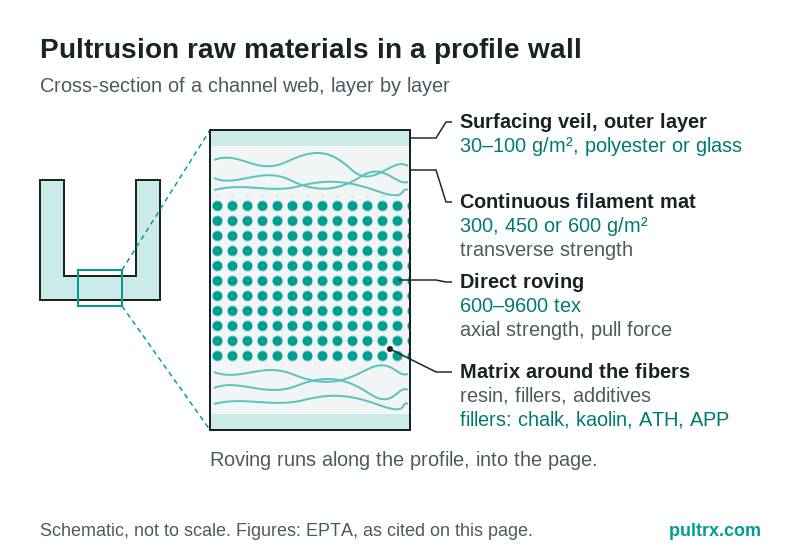
EPTA, the European Pultrusion Technology Association, lists the reinforcing materials of pultrusion as roving, mats, fabrics, complexes and non-woven fabrics. They are impregnated with a matrix of resin, fillers and additives in a bath or by injection, then pulled through a heated die (mould) where they cure. The longitudinal rovings carry the take-off force. Each item below is a separate purchase line with its own grade, data sheet, lot number and storage rule.
| Group | Typical items | Job in the profile |
|---|---|---|
| Longitudinal reinforcement | Direct glass roving; carbon or aramid for some profiles | Axial strength; carries the pulling force (EPTA) |
| Transverse reinforcement | Continuous filament mat, stitched or woven fabrics | Transverse and shear properties (EPTA, Vectorply) |
| Surface | Polyester or glass surfacing veil | Resin-rich outer layer; weathering (EPTA) |
| Matrix | UP, vinyl ester, epoxy, phenolic, methacrylate or PU resin | Binds and protects the fibers (EPTA) |
| Fillers | Chalk (calcium carbonate), kaolin, ATH, APP | Volume, shrinkage, fire behavior (EPTA, BYK) |
| Additives | Internal release, low-profile additive, wetting and air release additives, pigment | Die release, surface, color (EPTA, BYK) |
| Cure system | Peroxide initiators (UP, vinyl ester); hardener and accelerator (epoxy) | Cure in the die (EPTA, Nouryon, Gurit) |
The reinforcement forms and the matrix definition are taken from EPTA technical principles
Which fiberglass roving for pultrusion?
Direct (single-end) roving is the main reinforcement in most profiles. EPTA describes E, C or S glass (glass fibre) rovings of 600 to 9600 tex with a silane size that improves adhesion to the matrix, in smooth, textured and monofilament types.
For carbon roving, see the carbon fiber pultrusion guide
Tex and yield
Roving is quoted in two units. Tex is the linear density unit of the ISO tex system (ISO 1144, referenced in the roving standard ISO 2797). Yield, as CompositesWorld defines it, is yards of roving per pound. The two run in opposite directions: Owens Corning lists its PulStrand 4100 roving from 600 to 9600 tex, paired with 825 down to 52 yield. Put one unit and the nominal value on the purchase order, and use the same unit in the creel plan and the receiving record.
Sizing and resin compatibility
The sizing on the filaments decides wet-out speed and the bond to your resin. Owens Corning states that the PulStrand 4100 sizing is designed for fast wet-out and bonding in polyester, vinyl ester, polyurethane, acrylic and epoxy. Its pultrusion selection guide lists the resin families for each of five rovings, with tex ranges from 275 to 17,716. Check that your resin route appears on the data sheet of the grade you buy, and record the glass type (these grades use E-CR glass). The producer states that users must test suitability on their own process, so a listed resin family qualifies a grade for a trial only.
Resin families and tex ranges by roving grade are listed in the Owens Corning pultrusion product selection guide
Continuous filament mat or chopped strand mat for pultrusion?
Mat adds the transverse layer that roving lacks. EPTA describes continuous filament mat (CFM) as bonded or needled glass filaments, used mainly on the surfaces of large profiles, in weights of 300, 450 and 600 g/m². CompositesWorld places continuous-strand mat mainly in compression molding, RTM and pultrusion, and chopped strand mat (CSM) mainly in hand lay-up and continuous laminating.
Why the binder matters in pultrusion
In pultrusion the mat is pulled through the resin and the preformers while wet. An Owens Corning patent explains the risk: styrene can swell and degrade the binder on a mat, and the weakened mat may no longer withstand the pulling forces. Hand lay-up mats are built for fast wetting and air release. Owens Corning's M705 chopped strand mat uses an emulsion binder and is sold for hand lay-up. Its pultrusion mats, M8643 and the Unifilo 500 series, are random continuous filaments bonded with a thermoset binder.
Binder level is a choice too. Unifilo 500 runs from a conformable grade (U527) for complex die shapes to a stiffer grade (U529) aimed at demanding profiles and fast line speed. Name the binder type and level in the specification. M8643 is listed for unsaturated polyester and vinyl ester. Unifilo 500 adds acrylic and epoxy. Unifilo rolls can be slit to 3 to 40 cm strips on request, and M8643 prints product data on the film and paper tube so a slit roll stays traceable. If you slit in house, carry the roll number and date of manufacture onto every strip roll.
Mat stands and roll slitters are listed with the line stations in the pultrusion plant equipment list
Stitched and multiaxial fabrics
EPTA notes that woven and non-woven fabrics raise transverse strength, with 0°, 45° and 90° fibers and glass and carbon hybrids. In a 2023 conference presentation, Vectorply, a fabric producer, described stitched non-crimp fabrics (NCF) as straight fiber plies held by warp knitting, in unidirectional, biaxial, triaxial and quadraxial constructions:
- 0° plies carry bending and axial loads and can replace some roving, with smaller fabric creels.
- Bias plies (±45° or ±60°) give shear and torsional properties that single-end roving cannot place efficiently.
- 90° plies keep the dry fabric width stable and add transverse stiffness and strength.
- A CFM substrate is routinely attached, and it tracks through the die more reliably than a loose mat or veil.
The same presentation lists limits: PET stitch yarn can hamper performance at high temperature, warp unidirectional fabrics need a substrate, stiff dry fabric forms tight radii less easily than mat or veil, and bias plies in a non-symmetric schedule with a high-shrink resin can make the profile warp. Specify construction and ply angles, areal weight per ply, stitch yarn, substrate and width, and send the fabric supplier the die drawing.
Ply functions and fabric parameters are set out in Vectorply NCF reinforcements for pultrusion (NAPC 2023)
What does a pultrusion surfacing veil do?
A surfacing veil is the outermost reinforcement layer. EPTA describes polyester or glass veil-type surface mats of 30 to 100 g/m² that give a closed surface. Because pultruded profiles are usually not painted, EPTA states that this layer largely decides weatherability, UV resistance, colourfastness and chemical resistance.
Fibertex, a veil producer, describes its Surfitex polyester veil as hydro-entangled with no binder. For pultrusion it claims a resin-rich surface that resists corrosion and UV degradation, reduced print-through, no reinforcing fibers breaking the surface and reduced die wear, and it rates the polyester veil above C or ECR glass veils. Its grades run from 30 to 50 g/m². Treat these as producer claims and confirm them on your profile. Choose polyester or glass from the finished-product requirement, specify material, areal weight, width and resin compatibility, and keep the veil grade fixed once a profile is approved.
To write the service environment into the profile specification, use the FRP resin selection guide
The resin system in brief
EPTA lists unsaturated polyester, vinyl ester, epoxy, phenolic, methacrylate and polyurethane as pultrusion resins, and BYK calls UP the most common. For purchasing, a resin is a grade with a technical data sheet (TDS), a safety data sheet (SDS) and a batch certificate. Scott Bader's Crystic 272 polyester, recommended for pultrusion among other processes, lists viscosity, volatile content, acid value and gel time: the values to ask for per batch. Epoxy routes come as several parts. Gurit's GR220 is a resin, hardener and accelerator, each with its own shelf life.
Resin routes, cure systems, mixing order and pre-trial screening are covered in the pultrusion resin formulation guide
Fillers: calcium carbonate, kaolin and ATH
EPTA states that pultrusion UP grades are easy to fill with kaolin, chalk, ATH (aluminum trihydrate) or APP (ammonium polyphosphate). A pultrusion study by Boukhili et al. names calcium carbonate and kaolin as the most common fillers in low-cost FRP, and gives three process reasons for them: they help stop resin sticking to the die, lower the exothermic peak that causes internal cracking in thick parts, and raise line speed. In that study, raising filler from 20 to 40% cost a little shear strength with no change in flexural strength. BYK adds that fillers can reduce shrinkage, and that wetting and dispersing additives allow a higher filler load at the same viscosity.
Aluminum trihydrate for fire behavior
LKAB Minerals, an ATH producer, explains the mechanism: ATH begins to decompose at about 200 °C in an endothermic reaction that releases its bound water as steam, diluting flammable gases, and it is halogen-free. Huber's MoldX P18 is an ATH grade designed for fiberglass-reinforced polyester pultrusion. Its low viscosity allows a higher loading, which gives higher flame-retardant performance. EPTA cites ATH up to 200 parts in methacrylate resin for halogen-free fire profiles.
Fire performance belongs to the tested profile construction, so put the fire test in the profile specification and treat the filler as one input. On the filler order, name the grade and the certificate values per lot. Huber's sheet reports, for example, median particle diameter and free moisture.
For an ATH grade designed for pultrusion and its typical values, see the Huber MoldX P18 ATH data sheet
Additives: internal release, shrink control, pigments and UV
Internal mold release for pultrusion
EPTA states that release agents are added to the matrix to reduce friction against the die. Chem-Trend, a release producer, doses in phr (parts per hundred of unfilled resin by weight) and publishes typical ranges of 0.25 to 2.0 phr for polyester and 1.0 to 3.0 phr for epoxy pultruded stock. Resin, fillers, pigments and die geometry change the amount. Some systems already contain release: Gurit lists an in-built internal release for GR220. Check before adding a second one.
The phr basis and the published typical ranges come from the Chem-Trend internal mold release dosage FAQ
Low-profile and shrink control additives
Boukhili et al. describe low-profile additives (LPA) as thermoplastics, partly compatible with UP before cure, added to control cure shrinkage and improve the surface. PVAc is the most studied. In their pultrusion trials, LPA reduced shear strength without changing flexural strength. If the profile needs a smooth surface, agree the LPA with the resin supplier and test shear properties.
Pigments, wetting, air release and UV
BYK lists pigmentation, wetting and dispersing, air release and coupling additives for pultrusion, and notes that air bubbles left in the mix can become pinholes. EPTA notes that phenolic resin cannot be pigmented, and places UV behavior mainly in the surface layer. If the profile specification calls for a UV absorber or light stabilizer, buy it as a named grade with a dosage and enter it in the formulation record.
Initiators and catalysts
EPTA states that cure starts when the peroxide decomposition temperature is reached in the die. Nouryon's Trigonox 161-C65 is a pre-blended initiator for UP, vinyl ester and acrylic resins in the 80 to 125 °C range, with pultrusion among its applications. Nouryon's Perkadox 16 is usually combined with Trigonox C, and Nouryon states that pultruded rebar is typically made with this pair at 120 to 150 °C. Epoxy systems use a hardener and accelerator in place of a peroxide, as in Gurit's GR220.
Peroxides are also dangerous goods: Nouryon classifies Trigonox 161-C65 as organic peroxide type C, Division 5.2, UN 3113, temperature controlled. Purchasing must plan transport, cold storage and shelf life before the first order.
Purchase specification and receiving checks by material
Use the table as a template. It names what to agree with each supplier. The values and tolerances are yours to set.
| Material | What it does in the profile | What to put in the purchase specification | What to check on receipt |
|---|---|---|---|
| Direct roving | Axial strength; carries the pulling force | Grade, glass type, tex or yield with tolerance, listed resin families, package type | Grade and lot on labels; dry, intact packaging; certificate values for linear density, moisture and combustible matter |
| Continuous filament mat | Transverse strength; surface of large profiles | Pultrusion grade, binder type and level, weight, roll or strip width, core diameter | Roll number and manufacture date on labels; strip width; dry packaging |
| Stitched fabric | Shear, torsion, transverse properties | Ply angles, areal weight per ply, stitch yarn, substrate, width | Label against the ordered construction; width; no damaged plies |
| Surfacing veil | Resin-rich surface | Polyester or glass, areal weight, width | Weight and width against the order; roll clean and dry |
| Resin | Matrix | Grade, TDS and SDS revision, certificate values per batch (for example viscosity, gel time) | Batch and date; certificate values against the TDS; containers closed |
| Epoxy hardener and accelerator | Cure of the epoxy route | Grade, shelf life from manufacture | Sealed containers; expiry date on label |
| Fillers | Volume, shrinkage, fire behavior | Grade, particle size data, moisture limit | Grade and lot; dry bags; certificate values |
| Release, LPA, pigment, other additives | Die release, surface, color | Grade, function, dosage basis (phr), shelf life | Grade, lot and date; sealed containers |
| Peroxide initiator | Starts the cure | Grade, maximum storage temperature, transport class | Straight into the designated store; receipt date logged |
ISO 2797 sets a basis for roving specifications, which a producer, supplier or user may write. Its 1986 edition refers to ISO 1889 for linear density, ISO 3344 for moisture and ISO 1887 for combustible matter. ISO 1887 also covers mats. Name the method next to every agreed value.
How should pultrusion raw materials be stored?
Each data sheet has its own storage clause, and the grade you buy governs. The published examples below show the range a raw-material store has to hold.
| Material (example grade) | Producer storage guidance | Shelf life statement |
|---|---|---|
| Roving (Owens Corning PulStrand 4100) | Cool and dry, in original packaging (not waterproof); into the workshop 48 hours before use to prevent condensation | No known issue; retest advised three years after production |
| Continuous filament mat (Owens Corning M8643, Unifilo 500) | 10 to 35 °C, 35 to 85% relative humidity, original packaging; below 15 °C, condition in the workshop at least 24 hours | No known shelf life; retest advised three years after production |
| Isophthalic polyester (Scott Bader Crystic 272) | 5 to 25 °C in original unopened containers, protected from frost and sunlight | Stability 6 months at 20 °C; significantly reduced outside these conditions |
| Epoxy anhydride system (Gurit GR220) | Constant 10 to 25 °C, dry; closed drums, dry lines and desiccant for the moisture-sensitive hardener | From manufacture: resin 24, hardener 12, accelerator 24 months |
| Peroxide initiator (Nouryon Trigonox 161-C65) | Maximum 10 °C; never weigh out in the storage room; keep away from accelerators, amines and acids | Within specification at least 3 months after delivery |
| Peroxide initiator (Nouryon Perkadox 16) | Maximum recommended storage temperature 20 °C | Not stated in the leaflet reviewed |
ACMA, the US composites industry association, notes that a peroxide's maximum storage temperature is in Section 7 of its SDS and is considerably lower than its self-accelerating decomposition temperature (SADT). Size the cold store from the SDS of the grades you will buy, before the first delivery.
For the SDS sections that hold storage limits, see the ACMA guidance on organic peroxide storage
First in, first out
- Log the date of manufacture and the date of receipt for every lot; Owens Corning and Gurit count from production or manufacture.
- Issue the oldest lot first, and mark the shelf-life or retest date on the store location.
- Hold any lot past that date until it has been retested or released by the supplier.
- Keep glass in its original wrap until it goes to the creel, and condition it in the workshop as its data sheet says.
- Record store temperature and humidity, so a production problem can be checked against how the material was kept.
For diagnosing surface and cure faults on the line, see the pultrusion defects guide
Supplier qualification and incoming inspection
Producer data sheets are selection guides. Owens Corning states that the user is responsible for testing each application, and Nouryon that the customer must determine suitability by its own tests. Qualifying a raw material means running it on your own formulation, die and line.
- 01
Collect the documents
TDS, SDS, a sample certificate of analysis, the storage clause and the shelf-life statement for each candidate grade.
- 02
Agree the specification
Values, tolerances and test methods on each lot certificate, sampling, labeling (lot, date of manufacture) and packaging.
- 03
Screen and trial
Laboratory screening first, then a trial on the intended die, recording speed, pull force, die temperatures, surface and cure.
- 04
Approve and freeze
List the grade as approved with its trial reference and any alternate. A change of grade, producer or plant goes back through the trial.
- 05
Receive every lot
Check labels and packaging, compare certificate values with the specification, keep a retained sample where agreed and store the lot correctly the same day.
For the trial record of temperature, speed and pull force, use the pultrusion process parameters guide
The instruments for incoming checks are listed under the pultrusion quality control lab
Receiving finished profile lots is a separate job, with its own FRP incoming inspection checklist
Where pultrx fits
pultrx is an integrated pultrusion technology provider in Shanghai that supplies complete pultrusion production systems and equipment, and pultruded FRP profiles. Formulation selection and raw-material sourcing advice are part of its technical services, scoped per quotation: a material specification, a reinforcement schedule and a sourcing list of approved grades with alternates. Raw-material supply, where included, is a separate quotation item. The product names in this guide are examples from published producer documents. They are not a list of pultrx suppliers. For a review, send:
- The profile drawing and finished-product requirements (fire, weathering, appearance)
- The planned resin route and any grades already selected, with TDS and SDS
- The reinforcement schedule, if one exists
- Local availability of each material and your current storage conditions
See inputs, deliverables and acceptance for the formulation selection and raw-material supply scope
For the full plan of a new plant, from site to first profile, read how to start a pultrusion factory
To see how material cost enters the cost of each meter, use the pultrusion cost per meter guide
Sources and further reading
- EPTA: 4. Raw materials
Reviewed 2026-11-14. States that E, C or S glass rovings of 600 to 9600 tex are the main reinforcement, with a silane size for adhesion, in smooth, textured and monofilament types; continuous filament mats (bonded or needled) of 300, 450 and 600 g/m² are used mainly on the surfaces of large profiles; polyester or glass surface mats of 30 to 100 g/m² largely determine weatherability, UV resistance, colourfastness and chemical resistance because profiles are usually not painted; woven and non-woven fabrics raise transverse strength. Lists kaolin, chalk, ATH and APP as fillers for pultrusion UP grades and ATH up to 200 parts in methacrylate. Does not cover release agents, low-profile additives or initiators.
- EPTA: 2. Technical principles
Reviewed 2026-11-14. Lists roving, mats, fabrics, complexes and non-woven fabrics as reinforcing materials impregnated with resin, fillers and additives in a bath or by injection; states that longitudinal rovings absorb the take-off forces, that mould release agents are added to the matrix to reduce friction, and that cure starts when the peroxide decomposition temperature is reached.
- Owens Corning: Pultrusion product selection guide (Pub. No. 10025997-B, June 2024)
Lists five pultrusion rovings with tex ranges from 275 to 17,716 and the resin families each is intended for (epoxy, polyester, vinyl ester and polyurethane; one also lists polyamide). States that users must test suitability for their own process.
- Owens Corning: PulStrand 4100 single-end roving for pultrusion, product information (Pub. 10019658, January 2015; copy hosted by a distributor)
Producer document for one roving. States a sizing designed for fast wet-out, glass/resin bonding in polyester, vinyl ester, polyurethane, acrylic and epoxy, availability from 600 to 9600 tex (825 to 52 yield), and storage in a cool, dry area in original packaging, moved into the workshop 48 hours before use to prevent condensation; no known shelf-life issue, retest advised three years after production. Values apply to this product only.
- Owens Corning: M8643 continuous filament mat, product data sheet (Pub. No. 10010786-A, December 2025)
Continuous filaments randomly oriented and bonded with a thermoset binder; compatible with unsaturated polyester and vinyl ester; for pultruded shapes. Nominal weights 300, 450, 600 and 900 g/m²; roll labels carry roll number and date of manufacture, and information is printed on film and tube for traceability once slit. Storage 10 to 35 °C and 35 to 85% RH in original packaging; below 15 °C, condition in the workshop at least 24 hours; retest advised three years after production.
- Owens Corning: Unifilo 500 Series continuous filament mat for pultrusion, product data sheet (Pub. 10010965-D, January 2019)
Thermoset binder at several levels, from more conformable (U527) to stiffer (U529, higher tensile strength for demanding profiles and fast line speed); compatible with unsaturated polyester, vinyl ester, acrylic and epoxy; rolls can be slit into 3 to 40 cm strips on request. Same storage clause as M8643.
- Owens Corning: M705 chopped strand mat, product data sheet (December 2025)
Chopped strands bonded by an emulsion binder, designed for hand lay-up with fast wetting and quick air release in polyester and vinyl ester. Cited to show what a hand lay-up mat is built for; it says nothing about pultrusion.
- Owens Corning Intellectual Capital: US 11,401,639 B2, Corrosion-resistant non-woven for pipe liner pultrusion applications
Background section states that styrene can swell and degrade the binder on a reinforcement mat, weakening the mat so that it cannot withstand the pulling forces of pultrusion. A patent background, not a test standard.
- CompositesWorld: Fiber reinforcement forms
Defines yield as yards of roving per pound; states that chopped-strand mats serve mainly hand lay-up, continuous laminating and some closed molding, while continuous-strand mat is used primarily in compression molding, RTM and pultrusion; describes multiaxial fabrics as stitched or knitted plies that avoid the crimp of woven fabrics.
- Vectorply (T. Gundberg): NCF reinforcements for pultrusion applications, NAPC 2023 presentation hosted by ACMA
A fabric producer's conference presentation. Describes warp-knitted non-crimp fabric constructions; 0° plies for bending and axial loads that can replace some roving; bias plies for shear and torsion; 90° plies for dry fabric width stability and transverse properties; CFM substrates routinely added; and limits: PET stitching at high temperature, warp unidirectionals needing a substrate, stiff fabric at tight radii, warping risk with high-shrink resins and non-symmetric schedules. No test values used here.
- Fibertex Nonwovens: Surfitex synthetic surface veils (leaflet, January 2020)
Veil producer's leaflet. 100% polyester, hydro-entangled, binder-free veil for pultrusion and other processes; resin-rich surface against corrosion and UV degradation; for pultrusion lists reduced print-through, no surface penetration of reinforcing fibers, reduced die wear and UV discoloration resistance; compares itself with C or ECR glass veils. Grades of 30 to 50 g/m², 132 cm standard roll width. These are producer claims.
- Huber: MoldX P18 aluminum hydroxide (ATH) technical data sheet (revised 11/18)
ATH grade designed for fiberglass-reinforced polyester applications including pultrusion; low viscosity allows a higher loading, and higher loading gives higher flame-retardant performance; claims low pull force above 60% glass by weight compared with standard ATH. Typical values include a 5 µm median particle diameter and 0.25% free moisture. One grade; not a general ATH property.
- LKAB Minerals: What is aluminium trihydrate (ATH)?
Mineral producer's explainer. States that ATH begins to decompose at about 200 °C in an endothermic reaction that releases bound water as steam and dilutes flammable gases, and that ATH is halogen-free. Does not discuss pultrusion.
- Boukhili et al. (2004): Effect of fillers and low profile additives on the bending of pultruded composites, WIT Press, High Performance Structures and Materials II
Pultruded E-glass/UP study. Names calcium carbonate and kaolin as the most common fillers in low-cost FRP; states that pultrusion fillers prevent resin adhesion to the die, lower the exothermic peak that causes internal cracking in thick parts and raise line speed; describes LPAs as thermoplastics added to control cure shrinkage, PVAc being the most studied. At 51.6% fiber volume the profile could not be pultruded without filler; 20 to 40% filler gave a small loss in shear strength, and LPA reduced shear strength without changing flexural strength. Results apply to the materials studied.
- BYK: Additives for pultrusion (TS-A 11)
Additive producer's brochure. Names UP as the most common pultrusion resin and glass as the most common fiber; states that fillers cut cost and can reduce shrinkage or raise abrasion resistance and flame retardancy; describes wetting and dispersing (higher filler load at the same viscosity, anti-sedimentation), air release, internal release and coupling additives, and lists pigmentation additives.
- Chem-Trend FAQ: How much internal mold release should I mix into the resin for testing?
States that dosage is in phr of the unfilled resin; gives typical ranges of 0.25 to 2.0 phr for polyester and 1.0 to 3.0 phr for epoxy pultruded stock; says resin type, fillers, pigments and die geometry change the amount; recommends starting higher in testing.
- Nouryon: Trigonox 161-C65 product data sheet
Pre-blended initiator for UP, vinyl ester and acrylic resins at 80 to 125 °C, pultrusion among its applications. Maximum storage 10 °C, minimum -30 °C; SADT 40 °C; within specification for at least 3 months after delivery when stored as recommended; never weigh out in the storage room; avoid contact with accelerators, amines, acids and alkalis. Classified organic peroxide type C, Division 5.2, UN 3113.
- Nouryon: Perkadox 16 leaflet (GRP rebar)
Solid peroxydicarbonate for UP, vinyl ester and (meth)acrylic resins, usually combined with Trigonox C; states that pultruded rebar is typically made with this pair at 120 to 150 °C and gives a maximum recommended storage temperature of 20 °C.
- ACMA: Safe storage and handling of organic peroxides
Industry association guidance. States that a peroxide's maximum storage temperature is in Section 7 of its SDS and is considerably lower than its SADT, and that peroxides should be stored away from incompatible materials within the manufacturer's temperature range.
- Gurit: GR220 epoxy anhydride pultrusion system, product data sheet (PDS-GR220-2-0126)
Resin, hardener and accelerator for pultrusion with in-built internal release. Shelf life from date of manufacture at 10 to 25 °C: resin 24, hardener 12, accelerator 24 months, expiry on the container label. Anhydride hardener must be protected from atmospheric moisture (closed drums, dry lines, desiccant); temperature cycling can cause crystallization.
- Scott Bader: Crystic 272 isophthalic polyester, instructions for use
Recommended for filament winding, pultrusion and other processes. Lists viscosity, volatile content, acid value, gel time and stability (6 months at 20 °C); store at 5 to 25 °C in original unopened containers, protected from frost and sunlight; shelf life significantly reduced outside these conditions.
- ISO 2797:1986 Textile glass, Rovings, Basis for a specification (preview pages)
Preview of the 1986 edition. States that a specification may be set by a producer, supplier or user; names rovings used without chopping, for example for pultrusion; references ISO 1889 (linear density), ISO 3344 (moisture), ISO 1887 (combustible matter) and ISO 1144 (tex system). A later edition exists; use the current one.
- ISO 1887:2014 Textile glass, Determination of combustible-matter content (catalog listing)
Abstract states that the method applies to textile glass products including roving, fabric, and chopped-strand and continuous-filament mats.
Questions buyers ask
What raw materials are used in pultrusion?
Direct roving, continuous filament mat, stitched fabric and surfacing veil, a resin, fillers such as chalk, kaolin or ATH, additives such as internal release, and a cure system. EPTA describes the matrix as resin, fillers and additives.
What tex of fiberglass roving is used for pultrusion?
EPTA cites 600 to 9600 tex, and Owens Corning offers its PulStrand 4100 pultrusion roving across that range. The die's reinforcement schedule sets the tex for a profile.
Can chopped strand mat be used in pultrusion?
Hand lay-up chopped strand mats, such as Owens Corning's emulsion-bound M705, are made for fast wetting, and an Owens Corning patent explains that styrene can degrade a mat binder until the mat cannot withstand the pulling forces. Pultrusion mats such as M8643 use a thermoset binder. Buy a grade listed for pultrusion.
Polyester or glass surfacing veil for pultrusion?
EPTA lists both, at 30 to 100 g/m², and states that the surface layer largely decides weatherability, UV resistance and colourfastness. Fibertex claims better corrosion and UV behavior for its polyester veil. Choose from the finished-product requirement and confirm on your profile.
How much internal mold release goes into a pultrusion resin?
Chem-Trend publishes typical ranges of 0.25 to 2.0 phr for polyester and 1.0 to 3.0 phr for epoxy pultruded stock, based on the unfilled resin. Resin type, fillers, pigments and die geometry change the amount, and some systems, such as Gurit's GR220, already contain release.
How should glass roving and mat be stored?
Owens Corning's mat data sheets give 10 to 35 °C and 35 to 85% relative humidity, in the original packaging, which is not waterproof. Bring material into the workshop ahead of use to avoid condensation: 48 hours for its PulStrand 4100 roving and 24 hours for mat stored below 15 °C.
Does pultrx supply pultrusion raw materials?
Formulation selection and raw-material sourcing advice are part of pultrx technical services, scoped per quotation. Raw-material supply, where a project includes it, is a separate quotation item, and the quotation states what is supplied and by whom.
Summary
What raw materials does a pultrusion plant buy?
Pultrusion raw materials are the reinforcements (direct roving, continuous filament mat, stitched fabric and surfacing veil), the resin, mineral fillers, additives such as internal release, and the initiator. Specify each by grade, resin compatibility and producer data sheet; check lot identity and labels on receipt; store glass dry in its original packaging and peroxides below the producer's maximum temperature.
- Direct roving
- Bought by tex or yield; EPTA cites 600 to 9600 tex; sizing listed for named resin families
- Mat
- Owens Corning's pultrusion mats are continuous filament mats with a thermoset binder; its chopped strand mat is sold for hand lay-up
- Surfacing veil
- Polyester or glass, 30 to 100 g/m² (EPTA); gives the resin-rich outer layer
- Fillers
- Chalk, kaolin, ATH or APP in pultrusion UP grades (EPTA); ATH for fire behavior
- Glass storage
- 10 to 35 °C and 35 to 85% RH in original packaging (Owens Corning mat data sheets)
- Peroxide storage
- Below the producer's maximum, for example 10 °C for Trigonox 161-C65 (Nouryon)
Published by pultrx, an integrated pultrusion technology provider working with Henan Zhongsheng as a partner factory. This is a buyer planning guide; the manufacturer confirms project specifications in writing.
Ready to move from reading to a scoped quotation?
Request a raw-material and formulation review