
Technical review: Yunkun Gong, Pultrusion Engineer, pultrx
What does pultrusion technology cover today?
The European Pultrusion Technology Association (EPTA) describes the common core of every line: continuous reinforcement is impregnated with the matrix in a bath or by injection in the die, shaped and cured in a heated die (up to about 160 °C, depending on the resin), and drawn by caterpillar take-off units or hydraulic clamps. EPTA gives take-off forces of 6,000 kg and more, and line speeds between 0.02 and 3.0 m/min, with up to 20 m/min reached on thermoplastic matrices.
EPTA's history page names W. Brandt Goldsworthy in the US as a pioneer of the process and describes Ernst Kühne's work in Switzerland in the 1950s. Since then the process has split into the variants below. They share the creel, the wet-out station, the heated die, the puller and the cut-off saw, and differ at one or two stations, which is why a line built for one variant can sometimes be converted and sometimes cannot.
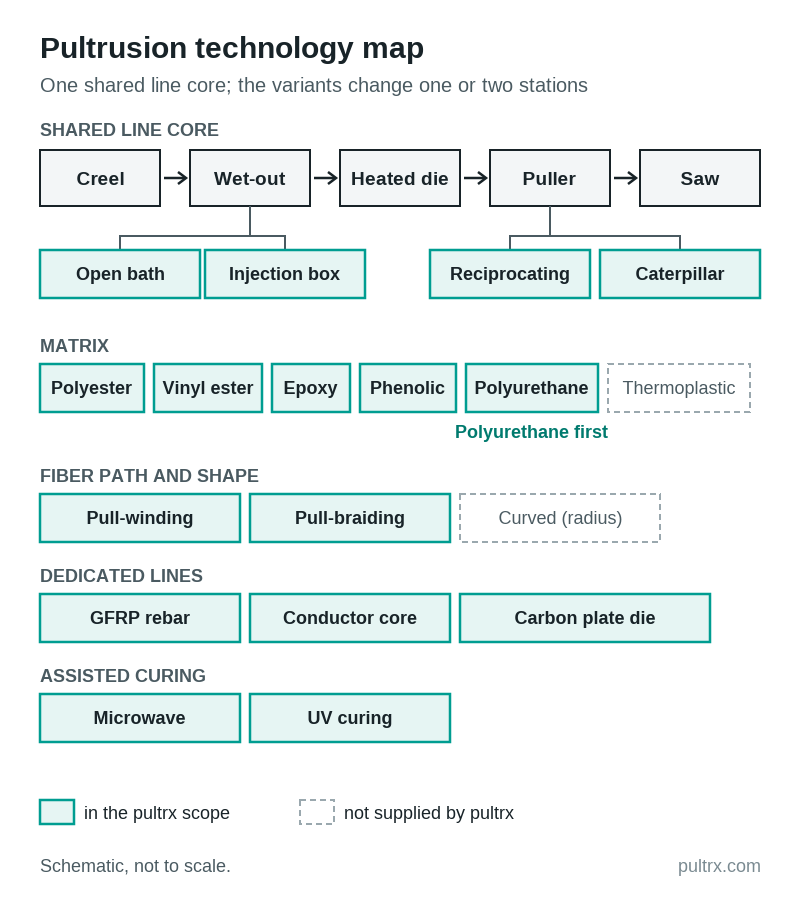
| Technology | What changes on the line | Matrices named in the sources | pultrx |
|---|---|---|---|
| Open bath, reciprocating clamps | Two clamps pull in turn; resin bath ahead of the die | Polyester, vinyl ester, epoxy, phenolic | Supplied: hydraulic 6 to 60 t, servo-hydraulic 20 to 40 t |
| Caterpillar puller | Two continuous tracks clamp and pull in one motion | As above | Supplied: caterpillar 3 to 10 t |
| Closed injection | Injection box at the die entry replaces the bath | Fast-reacting epoxy, polyurethane, polyamide 6 | Supplied for polyurethane: injection box with the PU die, two-component unit |
| Polyurethane pultrusion | Two components metered and mixed in line, then injected | Polyurethane | Focus resin |
| Pull-winding | Rotating heads wind fiber at an angle over the axial fiber | Thermosets | Winding units supplied as line tooling |
| Pull-braiding | Braiding machine ahead of the die | Thermosets and thermoplastics | Braiding units supplied as line tooling, quoted per project |
| Curved (radius) pultrusion | The die moves and pulls; profiles leave curved | Vinyl ester, epoxy, polyurethane, acrylic | Not supplied |
| Thermoplastic pultrusion | Melt or reactive impregnation | PP, PA, reactive acrylic | Not supplied; outside the pultrx scope |
| Carbon spar-cap plates | Wide flat carbon plate on high-volume lines | Vinyl ester, epoxy, polyurethane | Carbon fiber plate dies listed |
| GFRP rebar | Multi-strand bars, surface ribs or sand coating | Vinyl ester, epoxy | Quoted per project |
| Conductor cores | Carbon core with a glass overlay, long continuous lengths | Epoxy | Quoted per project |
| Microwave or UV assisted curing | Energy added in or after the die | Polyester, epoxy | Microwave or UV curing stations quoted per project |
Open bath or closed injection?
In an open-bath line the rovings and mats run through a resin bath, the excess is stripped by guides and the wet pack enters the die. In an injection line the dry pack enters a closed box fixed to the die entry and resin is pumped in under pressure. Fraunhofer IGCV lists both on its own lines and names the deciding factors for the closed chamber: resin systems with short pot lives, such as polyurethane, and lower emissions.
CompositesWorld reported in 2017 that KraussMaffei's iPul process encapsulates fiber infiltration in a closed injection box, which allows fast-reacting epoxy, polyurethane and polyamide 6 systems and raises production speed from the usual 0.5 to 1.5 m/min to about 3.0 m/min. KraussMaffei's own process page gives up to 3 m/min. These are the builder's figures for its system, not a general rule for injection lines.
Reciprocating clamps and caterpillar tracks
Strongwell's PULSTAR brochure states the difference plainly. A dual reciprocating puller uses two clamping and pulling mechanisms synchronised by a PLC, and is chosen for higher pull forces and frequent set-up changes. A caterpillar uses two continuous tracks that clamp and pull in the same operation, suits lower forces and is often used for high-volume, repetitive pulling of one profile, including multiple cavities. On a caterpillar, pull force depends on pull speed. On its reciprocating machines the full force is available at every speed.
The choice between the two pullers for one profile is worked through in hydraulic vs caterpillar pultrusion
Polyurethane pultrusion
EPTA's raw-materials page describes polyurethane as a two-component thermoset resin used successfully in pultrusion since the early 2000s, with very high impact and fatigue resistance, low shrinkage and a line speed comparable to unsaturated polyester. Covestro describes its Baydur PUL systems as highly reactive aromatic polyurethanes made of polyols and isocyanates, and states that they can save up to 20% of production cost compared with vinyl ester and epoxy systems. That is a resin supplier's claim, quoted as such.
A KraussMaffei customer magazine article of 2018 reports work with Covestro on polyurethane window profiles on an iPul flat-profile line, and with Huntsman on reinforcement for wind blades. The equipment a PU line adds to a polyester line (metering and mixing, the injection box, a stronger puller) and the pull forces reported for PU are set out in the polyurethane guide.
Line changes, pull force, dies and the PU quotation are covered in the polyurethane pultrusion guide
Pull-winding and pull-braiding
Plain pultrusion lays nearly all fiber along the profile. Exel Composites describes pull-winding as an extension of pultrusion in which angled reinforcement is combined with axial fibers, mats or fabrics and cured continuously in the same process. Exel writes that traditional tubes carry about 90 per cent lengthwise fiber, while optimised pull-wound tubes can be as much as 50 per cent crosswise fiber. In a 2023 article Exel adds that pull-winding can control fiber angles from 0 to almost 90 degrees.
Pull-braiding puts a braiding machine ahead of the die. Fraunhofer IGCV runs it in projects such as PulFlex, where thermoplastic pull-braided profiles are bent into recyclable crossarms for high-voltage lines, and presented braided pultruded pipes at the 2026 World Pultrusion Conference. pultrx supplies braiding units as line tooling for thermoset lines, quoted per project. To quote one it needs the profile, the braid angle and the number of braided layers.
Winding head speeds, tube types and retrofitting a winder are covered in the pull-winding guide
Curved (radius) pultrusion
Conventional pultrusion makes straight profiles. In Radius-Pultrusion, developed by Thomas Technik + Innovation, the heated die is no longer stationary: it moves and is itself the pulling stage, so the profile can leave the line curved. CompositesWorld reported in 2017 radii above 2,000 mm on the standard machine, custom rotating machines for smaller radii, glass or carbon fiber with vinyl ester, epoxy, polyurethane or acrylate resins, and licensees including KraussMaffei. The same builder's pullCUBE cell (2020) is reported at 3.5 m long, about 75% shorter than conventional pultrusion machines.
Fraunhofer IWU in Chemnitz runs an industrial moving-mould line and states that it makes solid and hollow profiles with a constant radius at fiber contents up to 70%. It hosted the sixth pultrusion symposium of its series in June 2026.
Thermoplastic pultrusion
Thermoplastic lines impregnate fiber either with molten polymer, which is shaped and cooled, or with a reactive monomer that polymerises in a heated die. EPTA gives up to 20 m/min with thermoplastic matrices. Arkema researchers reported in 2019 (Frontiers in Materials) pultruding E-glass profiles with the reactive acrylic Elium resin at temperatures between 100 and 140 °C, with flexural, tensile and compression strengths above 1,000 MPa in the fiber direction, and profiles that can be bent after pultrusion. A 2021 review by Minchenkov and co-authors (Polymers) notes that thermoplastic pultrusion still runs at much lower production volumes than thermoset pultrusion.
Thermoplastic pultrusion is outside the pultrx scope. It is listed here because buyers comparing technologies meet it, and because the AVK's report on the 2026 World Pultrusion Conference named thermoplastic systems as a focus. EPTA's programme for that conference lists thermoplastic papers from AIMPLAS, Fraunhofer ICT and Kindai University.
Dedicated lines: spar caps, rebar and conductor cores
Carbon spar-cap plates for wind blades
CompositesWorld (2018) reported Zoltek's PX35 pultruded plates at 3 to 6 mm thick and 75 to 300 mm wide, with fiber volume of 58 to 70% and voids under 1%, in vinyl ester, epoxy or polyurethane, and called pultrusion the preferred method for carbon spar caps. A Sandia and Oak Ridge study of pultruded composites for wind turbines states that modern blades with carbon spar caps use pultruded carbon planks exclusively, and that the pultrusion step adds 33 to 55% on top of material cost.
GFRP rebar
Schöck describes its ComBAR bars as pultruded glass fiber in two steps: the bars are pultruded, then the ribs are cut into the cured bar and the bars are lacquered. Researchers at TU Dresden reported in 2023 a helix pultrusion process that forms the surface of a carbon bar in the same pultrusion step. Bars are bought to ASTM D7957 and designed to ACI CODE-440.11-22 in the United States.
Strand count, surface treatment and cut-off for a rebar line are in the GFRP rebar production line guide
Composite cores for overhead conductors
CompositesWorld (2013) described the ACCC core as carbon fiber pultruded with a glass fiber overlay in an epoxy matrix through a dedicated steel die at up to 260 °C (500 °F), the glass layer separating carbon from the aluminum strands. In 2026 the same magazine reported more than 135,000 miles of CTC Global's conductors installed and named pultrusion as the most common process for composite cores.
Line stations for conductor cores are covered in the composite core conductor line guide
Assisted curing and process monitoring
Microwave-assisted pultrusion has been studied since at least 2000 (Methven and co-authors). In the EU Coaline project Fraunhofer ICT, with MUEGGE, developed a microwave module that needs no microwave-transparent insert in the metal die, which its paper names as the main barrier to industrial uptake of earlier designs. It reports higher pultrusion speed without visible loss of quality, without giving figures. Tena and co-authors (Composites Part B, 2016) studied ultraviolet curing out of the die to bend glass and polyester profiles. Vedernikov's 2022 thesis summarises their trials at 105, 157 and 210 mm/min, with 157 mm/min as the optimum. pultrx quotes microwave or UV curing stations per project as an option on a thermoset line. It publishes no speed figure for them; the gain depends on the profile and the resin and is set in the line proposal.
Skoltech and the University of Salerno model heat transfer, cure and pulling force. In Vedernikov's 2022 doctoral thesis, glass fiber flat laminates of 150 × 3.5 mm were pulled at 200 to 1,400 mm/min, and the work concludes that higher pulling speeds can raise output by at least a factor of 1.7 without loss of mechanical performance. Laboratory results on one profile are not a speed rating for an industrial line, but they show where the limit is set: by heat transfer and cure in the die.
Die temperature, line speed and pull force on a running line are set out in the pultrusion process parameters guide
Published figures, side by side
Builders and researchers state speed and force on different bases: one machine, one profile, one resin, a laboratory trial. The table keeps each figure with its basis. Read it as a map of what has been published, not as a ranking.
| Figure | Basis | Source, year |
|---|---|---|
| 0.02 to 3.0 m/min; up to 20 m/min thermoplastic | General range for the process | EPTA, technical principles (undated) |
| Take-off force 6,000 kg and more | General range for the process | EPTA, technical principles (undated) |
| 0.5 to 1.5 m/min usual; about 3.0 m/min with iPul | Open vessel compared with KraussMaffei's closed injection box | CompositesWorld, 2017 |
| 3 to 20 t; 5.0 m/min (3 t) to 2.0 m/min (20 t) maximum | Pultrex machine range, open bath or injection box | KraussMaffei / Pultrex brochure (undated) |
| 5,443 to 9,072 kg continuous; 10,886 to 18,144 kg tandem | Strongwell PULSTAR reciprocating machines | Strongwell brochure, 2020 |
| 3,630 kg and 6,350 kg continuous | Strongwell PULSTAR caterpillar machines | Strongwell brochure, 2020 |
| 200 to 1,400 mm/min | Glass flat laminate 150 × 3.5 mm, laboratory trials | Vedernikov, Skoltech thesis, 2022 |
| 157 mm/min optimum | UV-cured out-of-die bent glass/polyester profile, 10 × 2 mm | Tena et al., 2016, as summarised by Vedernikov, 2022 |
| 200 mm/min at 54.5% fiber volume | Composite-metal hybrid profile, Fraunhofer IWU | CompositesWorld, 2026 |
How big is pultrusion? What the associations publish
The AVK, the German composites federation that also hosts EPTA, publishes an annual volume series for European pultrusion. Its 2026 report expects European production of pultruded glass fiber composites to fall by 4.2% to 46 kt in 2025, and gives as examples of the main markets reinforcement in bridge and building construction, window and stair or ladder profiles, and antenna systems for 5G networks.
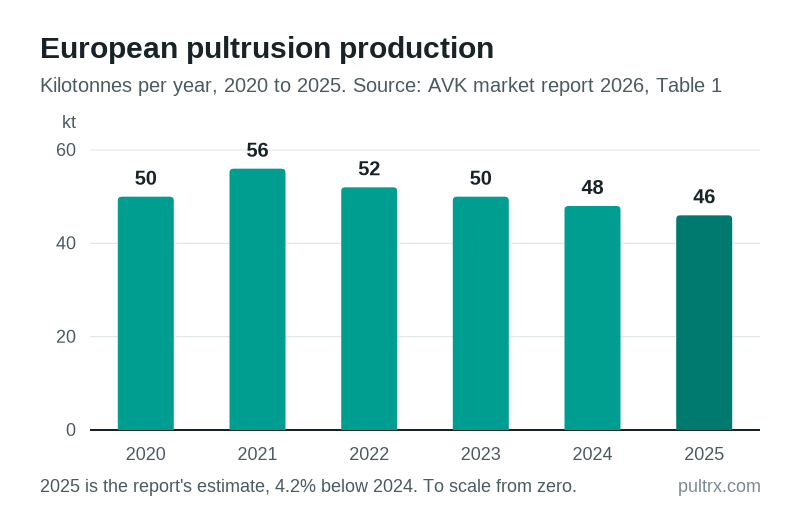
| Year | 2020 | 2021 | 2022 | 2023 | 2024 | 2025 |
|---|---|---|---|---|---|---|
| Pultrusion (kt) | 50 | 56 | 52 | 50 | 48 | 46 |
For North America, CompositesWorld's report of the 2018 World Pultrusion Conference quoted ACMA: pultrusion was 3% of the North American composites end-product market and was estimated at US$790 million in 2016. No association publishes a current global pultrusion volume. Figures sold as global market sizes by anonymous research firms are left out here.
Associations, conferences and standards
| Organisation | What it publishes or runs | Latest or next event |
|---|---|---|
| EPTA, European Pultrusion Technology Association | Founded 1989; under the AVK umbrella since 2006; process pages, World Pultrusion Conference with ACMA | 18th WPC, Valencia, 5–6 March 2026; 19th WPC, Istanbul, 2028 |
| AVK, Federation of Reinforced Plastics (Germany) | Annual European composites market report with a pultrusion line | Market report 2026, published March 2026 |
| ACMA Pultrusion Industry Council (US) | Proposed ANSI standard ACMA P01 for fabrication and installation of pultruded FRP structures (2025) | North American Pultrusion Conference, Chicago, 13–15 April 2027 |
| Composites UK | Trade association; in August 2026 reported a 400+ page technical book on GRP pultruded profiles by Gavin Williams (Engineered Composites), its vice chair | Not an event |
| JEC Group | JEC World trade show, Paris; the WPC is held the week before | JEC World, 2–4 March 2027 |
| Fraunhofer IWU | Pultrusion symposium series, Chemnitz | Sixth symposium, 16–17 June 2026 |
| Standard | Title | Publisher, edition |
|---|---|---|
| EN 13706-1, -2, -3 | Reinforced plastics composites. Specifications for pultruded profiles: designation; method of test and general requirements; specific requirements | CEN, 2002 |
| ASCE/SEI 74-23 | Load and Resistance Factor Design (LRFD) for Pultruded Fiber Reinforced Polymer (FRP) Structures | ASCE, December 2023 |
| ASTM D3917 | Dimensional tolerance of thermosetting glass-reinforced plastic pultruded shapes | ASTM, D3917-23 |
| ASTM D7957/D7957M | Glass fiber reinforced polymer (GFRP) bars for concrete reinforcement | ASTM, D7957-26 |
| ACI CODE-440.11-22 | Building code requirements for structural concrete reinforced with GFRP bars | ACI, 2022 |
How these standards are used in a profile order is covered in the FRP profile standards and testing guide
Research centres and review papers
| Institute | Pultrusion work they publish |
|---|---|
| Fraunhofer IGCV, Augsburg | Polyester, vinyl ester, epoxy and PU lines with bath or injection chamber; pultrusion lines up to 100 kN pull force; digitised "Pultrusion 4.0" line; pull-braiding |
| Fraunhofer IWU, Chemnitz | Moving-mould curved pultrusion; hybrid composite-metal profiles; bio-based fiber; embedded sensors |
| Fraunhofer ICT, Pfinztal | Microwave-assisted pultrusion; thermoplastic pultrusion |
| Skoltech (Moscow) with the University of Salerno | Simulation of cure and pulling force, pulling-speed limits, thermoplastic pultrusion |
| Harbin Institute of Technology | Co-authored a thermoplastic pultrusion study with Skoltech (Polymers, 2022) |
| TU Dresden | Helix pultrusion of carbon rebar with a formed surface (Polymers, 2023) |
| Leibniz-Institut für Verbundwerkstoffe (IVW), Kaiserslautern | Process analysis and modelling of thermoplastic pultrusion (dissertation, 2006) |
- Vedernikov A., Safonov A., Tucci F., Carlone P., Akhatov I. Pultruded materials and structures: A review. Journal of Composite Materials 54(26), 2020. doi:10.1177/0021998320922894
- Safonov A., Carlone P., Akhatov I. Mathematical simulation of pultrusion processes: A review. Composite Structures 184, 2018. doi:10.1016/j.compstruct.2017.09.093
- Baran I., Cinar K., Ersoy N., Akkerman R., Hattel J. A review on the mechanical modeling of composite manufacturing processes. Archives of Computational Methods in Engineering 24, 2017. doi:10.1007/s11831-016-9167-2
- Zhao S., Ju Z., Jiang Y. Research progress of pultrusion molding process for fiber reinforced composites. Technical Textiles (产业用纺织品) 43(5), 2025, in Chinese.
The pultrx thermoset program from China
pultrx works in thermoset continuous pultrusion: unsaturated polyester, vinyl ester, epoxy, phenolic and polyurethane. Polyurethane is the resin it puts first. Of the technologies above, pultrx supplies open-bath and injection equipment, the three puller types, winding and braiding units and microwave or UV curing stations, and quotes complete lines per project for rebar, conductor cores, structural profiles, tubes and rods, grating bars and PU solar frames. Machines and injection units come from the partner equipment factories named in the quotation. Dies come from Henan Zhongsheng or another partner die shop, and the quotation names the maker and warranty party of every die.
| Line technology | What pultrx supplies | Where it is published |
|---|---|---|
| Open bath, reciprocating | Hydraulic pullers 6 to 60 t; servo-hydraulic 20 to 40 t | /pultrusion-machines |
| Open bath | Resin baths as line tooling | /pultrusion-tooling |
| Caterpillar | Caterpillar pullers 3 to 10 t | /pultrusion-machines/caterpillar-pultrusion-machine |
| Polyurethane injection | Two-component injection unit, ratio adjustable 1:3 to 3:1 | /resin-injection-systems/polyurethane-pultrusion-injection-machine |
| Polyurethane dies | PU dies in Cr12 or SKD11 | /pultrusion-dies |
| Epoxy and carbon | Epoxy and carbon fiber dies in P20, Cr12, H13 or SKD11, including a carbon fiber plate die | /pultrusion-dies |
| Pull-winding | Winding units as line tooling, new or retrofitted | /guides/pull-winding |
| Pull-braiding | Braiding units as line tooling, quoted per project | This page |
| Assisted curing | Microwave or UV curing stations, quoted per project | This page |
| Complete lines | Quoted per project for rebar, conductor core, structural profile, tube and rod, grating bar and solar frame production; no catalogue line | /turnkey-pultrusion-line |
Not supplied by pultrx
Sources and further reading
- EPTA: Pultrusion, technical principles
Bath or injection wet-out, die temperature, take-off force, speed ranges
- EPTA: Historical development of pultrusion
Goldsworthy and Kühne in the 1950s
- EPTA: Raw materials
Resin families including polyurethane since the early 2000s
- EPTA: World Pultrusion Conference
18th WPC, Valencia, 5–6 March 2026, with ACMA; programme
- AVK: Composites market report 2026 (long version)
Table 1, European pultrusion production 2020 to 2025; markets
- KraussMaffei: Fiber-reinforced processes (iPul)
iPul straight and curved profiles, up to 3 m/min
- KraussMaffei / Pultrex: Pultrusion machines brochure
Px machine table, 3 to 20 t, open bath or injection box
- KraussMaffei ahead magazine (2018): New lightness on the construction site
PU window profiles with Covestro, wind blade work with Huntsman
- CompositesWorld (2017): KraussMaffei doubles pultrusion speed
Closed injection box; 0.5–1.5 m/min usual, about 3.0 m/min iPul
- Strongwell: PULSTAR pultrusion machinery brochure (2020)
Reciprocating and caterpillar pullers, forces and speeds
- Covestro: PU pultrusion technology
Baydur PUL systems; up to 20% production cost saving claim
- Exel Composites (2026): How pultrusion and pull-winding enable scalable composite design
Pull-winding definition; 90% lengthwise fiber vs up to 50% crosswise
- Fraunhofer IGCV: Pultrusion
Matrices, injection chamber, equipment, Pultrusion 4.0
- Fraunhofer IGCV: PulFlex project
Thermoplastic pull-braiding and bending for crossarms
- CompositesWorld (2017): Curved pultrusion? No longer an oxymoron
Radius-Pultrusion; radii above 2,000 mm; resins; licensees
- CompositesWorld (2020): Thomas Technik + Innovation pullCUBE
3.5 m long, about 75% shorter
- Fraunhofer IWU: Pultrusion, lightweight in profile
Moving-mould curved profiles, fiber content up to 70%
- Fraunhofer IWU: Symposium Pultrusion 2026
16–17 June 2026, sixth event of the series
- CompositesWorld (2026): Reinventing pultrusion (Fraunhofer IWU)
Hybrid profile at 54.5% fiber volume and 200 mm/min
- Zoller, Escalé, Gérard (2019): Pultrusion of bendable continuous fibers reinforced composites with reactive acrylic thermoplastic Elium resin, Frontiers in Materials
100–140 °C, strengths above 1,000 MPa
- CompositesWorld (2018): Wind blade spar caps, pultruded to perfection?
Zoltek PX35 plate dimensions and fiber volume
- Ennis, Das, Norris: Economic competitiveness of pultruded fiber composites for wind turbine applications (OSTI)
Carbon spar caps exclusively pultruded; pultrusion adds 33–55% to material cost
- Schöck: ComBAR
Pultrusion, then ribs cut and lacquered
- Wohlfahrt et al. (2023): Helix-pultruded CFRP rebar geometry variants, Polymers 15(15)
Surface formed in the pultrusion step
- CompositesWorld (2013): Composite-cored conductors, holding the line
ACCC core, carbon with glass overlay, die up to 260 °C
- CompositesWorld (2026): Composite conductor cores boost capacity
135,000 miles installed; pultrusion most common for cores
- Fraunhofer ICT: Microwave assisted pultrusion (MAP)
Coaline project; module without microwave-transparent insert
- Tena et al. (2016): The effect of process parameters on ultraviolet cured out of die bent pultrusion process, Composites Part B 89
UV out-of-die bent pultrusion; speeds as summarised in the Vedernikov thesis
- Minchenkov et al. (2021): Thermoplastic pultrusion, a review. Polymers 13(2)
Thermoplastic pultrusion volumes lower than thermoset
- Textination (AVK): Successful World Pultrusion Conference 2026
About 120 participants, thermoplastic focus, 19th WPC in Istanbul in 2028
- Vedernikov A. (2022): Effects of technological regimes on structural performance of pultruded profiles, Skoltech doctoral thesis
200–1,400 mm/min trials; output factor 1.7
- CompositesWorld (2018): Pultruded composites market growing, says EPTA
ACMA: 3% of North American end-product market, US$790 million in 2016
- ACMA: North American Pultrusion Conference 2027
Chicago, 13–15 April 2027, with EPTA and WPC
- ACMA (2025): Proposed ANSI standard for pultruded FRP structures (ACMA P01)
Pultrusion Industry Council
- ASCE/SEI 74-23: LRFD for Pultruded FRP Structures
ASCE, published December 2023
- ASTM D3917-23
Dimensional tolerance of pultruded shapes
- ASTM D7957/D7957M-26
GFRP bars for concrete reinforcement
- Composites UK news (August 2026): technical book on GRP pultruded profiles by Gavin Williams
400+ page book for engineers, designers and specifiers
- Exel Composites (2023): Achieving high hoop strength for composite tubes using pull-winding
Fiber angles from 0 to almost 90 degrees
- Methven, Ghaffariyan, Abidin (2000): Manufacture of fiber-reinforced composites by microwave assisted pultrusion. Polymer Composites 21(4)
Early microwave-assisted pultrusion study
- Polymers 14(11), 2022: thermoplastic pultrusion study by Skoltech with Harbin Institute of Technology
Co-authors from the HIT School of Civil Engineering
- Wiedmer S. (2006): Zur Pultrusion von thermoplastischen Halbzeugen, IVW-Schriftenreihe Band 66
IVW Kaiserslautern dissertation on thermoplastic pultrusion
- JEC World
Paris Nord Villepinte, 2–4 March 2027
- Vedernikov et al. (2020): Pultruded materials and structures, a review. Journal of Composite Materials 54(26)
Review of pultrusion research
- Safonov, Carlone, Akhatov (2018): Mathematical simulation of pultrusion processes, a review. Composite Structures 184
Review of process modelling
Questions buyers ask
What is pultrusion technology?
Pultrusion is a continuous process that pulls fiber reinforcement through resin impregnation and a heated die to make profiles of constant cross-section. Pultrusion technology today covers several line types: open-bath and closed-injection lines, reciprocating and caterpillar pullers, pull-winding and pull-braiding, curved pultrusion, thermoplastic pultrusion and dedicated lines for spar caps, rebar and conductor cores.
Which pultrusion technology is fastest?
EPTA gives 0.02 to 3.0 m/min for the process in general and up to 20 m/min with thermoplastic matrices. For thermosets, KraussMaffei reports about 3 m/min with its closed injection box against a usual 0.5 to 1.5 m/min in open vessels (CompositesWorld, 2017). Speed on any line depends on the profile, the resin and the die length, so compare figures only on the same profile.
Is closed injection replacing the open resin bath?
Not for every resin. EPTA describes impregnation in a bath or by injection in the die. CompositesWorld's 2017 report on curved pultrusion describes wet-out by resin injection or in an open bath where local environmental regulations permit. Injection is needed for resins with a short pot life such as polyurethane, and Fraunhofer IGCV names lower emissions as the other reason to choose it.
Which associations and conferences cover pultrusion?
EPTA in Europe, under the German AVK, and the ACMA Pultrusion Industry Council in North America. Together they run the World Pultrusion Conference (18th edition in Valencia, March 2026; the 19th is planned in Istanbul in 2028), and ACMA runs the North American Pultrusion Conference (Chicago, April 2027). The AVK publishes the annual European volume figures.
Does pultrx supply thermoplastic or curved pultrusion lines?
No. pultrx works in thermoset continuous pultrusion only: polyester, vinyl ester, epoxy, phenolic and polyurethane, with polyurethane first. Thermoplastic pultrusion and filament winding are outside its scope, and it does not supply curved (radius) pultrusion lines. Winding and braiding units and microwave or UV curing stations are quoted as options on a thermoset line.
Is pultrx linked to KraussMaffei or Pultrex?
No. KraussMaffei and its subsidiary Pultrex are quoted on this page as published sources. pultrx has no ownership, licensing or distribution link with either company and does not sell or service their machines.
Summary
What are the main types of pultrusion technology?
The main pultrusion technologies are open-bath lines with reciprocating or caterpillar pullers, closed injection lines for fast-reacting resins such as polyurethane, pull-winding and pull-braiding for off-axis fiber, curved (radius) pultrusion, thermoplastic pultrusion, and dedicated lines for carbon spar-cap plates, rebar and conductor cores. pultrx supplies thermoset lines for five resin families, with polyurethane first.
- Wet-out
- Open resin bath, or a closed injection box at the die entry
- Pulling
- Two reciprocating clamps pulling in turn, or two continuous caterpillar tracks
- Published speeds
- EPTA: 0.02 to 3.0 m/min in general, up to 20 m/min with thermoplastic matrices
- Europe
- 46 kt of pultruded composites expected for 2025, down from 56 kt in 2021 (AVK market report 2026)
- Standards
- EN 13706 parts 1 to 3, ASCE/SEI 74-23, ASTM D3917, ASTM D7957 for GFRP bars
- pultrx scope
- Thermoset continuous pultrusion: polyester, vinyl ester, epoxy, phenolic and polyurethane, polyurethane first; winding, braiding and microwave or UV curing as line options
Published by pultrx, an integrated pultrusion technology provider working with Henan Zhongsheng as a partner factory. This is a buyer planning guide; the manufacturer confirms project specifications in writing.
Ready to move from reading to a scoped quotation?
Ask for a thermoset or PU line review