
Technical review: Yunkun Gong, Pultrusion Engineer, pultrx
What does a pultrusion resin formulation contain?
The European Pultrusion Technology Association (EPTA) describes the pultrusion matrix as resin, fillers and additives, applied to the reinforcement in a bath or by injection and then cured by heating in the die (mould). BYK's pultrusion additive brochure splits the additive package by job: wetting and dispersing, air release, processing aids such as internal release, and coupling agents. Treat each item below as a separate line in the formulation record, with its own grade, supplier and batch.
| Component | Job in the line | What published sources say |
|---|---|---|
| Base resin | Binds and protects the fibers; sets the cure chemistry | EPTA lists vinyl ester, epoxy, unsaturated polyester, phenolic, methacrylate and polyurethane systems. BYK calls UP the most common pultrusion resin. |
| Cure system | Starts and completes the reaction in the heated die | EPTA: cure starts when the peroxide decomposition temperature is reached (UP and VE). Huntsman names resin, hardener and accelerator sets for epoxy. Covestro pairs polyols with isocyanates for PU. Bakelite pairs phenolic resins with a catalyst. |
| Fillers | Fill volume, cut cost, reduce shrinkage, add flame retardancy | EPTA: pultrusion UP types are easy to fill with kaolin, chalk, ATH or APP. BYK: fillers can reduce shrinkage and raise abrasion resistance or flame retardancy. |
| Internal release | Reduces friction against the die wall | EPTA: release agents are added to the matrix to reduce friction. Chem-Trend publishes dosage ranges by resin family. |
| Wetting, dispersing and air release additives | Control viscosity, keep fillers suspended, remove bubbles | BYK: wetting and dispersing additives allow a higher filler load at the same viscosity; air release additives prevent bubbles that become pinholes. |
| Coupling agents and fiber sizing | Bond between matrix, filler and fiber | BYK describes coupling agents for fiber-matrix adhesion. Owens Corning lists the resin families each pultrusion roving is intended for. |
| Pigment | Color | BYK lists pigmentation additives for UP, VE, epoxy and PU. EPTA states that phenolic cannot be pigmented. |
How do UP, vinyl ester, epoxy, PU and phenolic routes differ?
Each route changes the cure system, the mixing order and the impregnation equipment. The matrix below summarizes what the cited supplier documents and studies state. It does not rank the routes. Choose the route from the product requirement, then use the evidence column to plan what the resin supplier and the trial must show.
| Route | Formulation parts named in sources | Impregnation route in sources | Process watch points | Evidence to request |
|---|---|---|---|---|
| UP polyester | Resin, peroxide initiator, mineral fillers (kaolin, chalk, ATH, APP), internal release, wetting and air release additives | Bath or injection (EPTA, BYK) | Filler load against viscosity and pull force; initiator storage temperature; cure position in the die | Resin TDS and SDS, initiator data sheet, filler grade data, gel time by an agreed method, cure or Tg results on trial samples |
| Vinyl ester (VE) | Resin, peroxide initiator (Nouryon lists vinyl ester for Trigonox 161-C65), internal release mixed into the resin first, additives | Bath or injection (EPTA, BYK) | Set die temperature changed degree of cure and mechanical results in an industrial VE study (Chaparala et al.) | As for UP, plus the chemical or corrosion evidence the finished product needs |
| Epoxy | Resin, hardener (anhydride or amine), accelerator, internal release mixed into the less viscous component | Anhydride systems for the open bath; amine systems for the injection box (Huntsman) | Pot life at bath temperature; a general cure schedule may not suit pultrusion (Tucci et al.); release dosage differs from polyester (Chem-Trend) | Mix ratio, pot life at the operating temperature, DSC cure and Tg data for the chosen hardener |
| Polyurethane (PU) | Polyol and isocyanate components (Covestro), internal release mixed into the polyol (Chem-Trend) | 2K dosing and mixing machine with an injection box (Covestro); closed chamber because of short pot life (Strauss et al.) | Metering ratio, chamber temperature, residence time in the box, component storage per the supplier's documents | Mix ratio and metering record, component batch records, supplier storage requirements, injection box drawing |
| Phenolic | Phenolic resin and catalyst combination (Bakelite) | Bakelite: can process on traditional polyester pultrusion equipment | EPTA: water released during cure creates a danger of cracks and pores; no pigmentation | Cross-section inspection for voids and cracks; fire test reports that identify the tested construction |
EPTA also lists methacrylate resins for halogen-free flame-retardant profiles, with ATH filler contents up to 200 parts. Treat any route outside the five above as a separate review with its own supplier documents.
Should the formulation run in an open bath or injection box?
Huntsman's pultrusion page describes the two common impregnation routes. An open bath needs very latent, low-viscosity resins because the resin sits in the bath for a long time while it wets the fibers. In an injection box the resin enters at the die entrance. The box temperature lowers its viscosity and, with pressure, wets the fibers, which allows more reactive resins and a higher line speed. For epoxy, Huntsman assigns anhydride chemistry to the open bath and amine chemistry to the injection box.
Two peer-reviewed studies add the reasons. Tucci et al. list the drawbacks of the open bath as volatile emissions, uncontrolled resin flow, resin waste and pot life issues. Strauss et al. state that the short pot life of highly reactive systems moves impregnation from the open bath into a closed injection and impregnation chamber. Covestro's Baydur PUL brochure lists a 2K dosing and mixing machine and an injection box among the processing equipment for its polyurethane pultrusion resin.
Planning rule
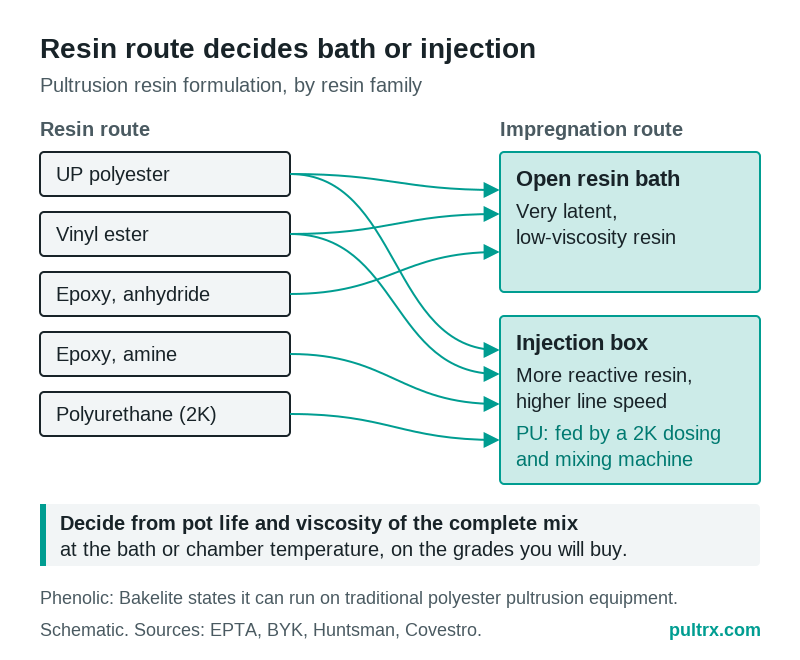
Temperature control at the impregnation point matters in both routes. Tucci et al. report that the viscosity of their epoxy system fell by up to about two orders of magnitude as it warmed from room temperature. EPTA notes that cooled sections at the die entry keep the material from curing early. Specify how the bath or box is heated or cooled, and where its temperature is measured.
For a PU route, review metering, mixing and injection box interfaces on the polyurethane pultrusion injection unit
For bath styles, the specification checklist and the US enclosure rule, see pultrusion resin bath design
What do published formulation examples actually cover?
Supplier documents give example dosages and process windows. Each one belongs to a named product and its test conditions. Use them to plan the screening work and keep the source attached to every number you adopt.
| Published example | Source | Limit of the example |
|---|---|---|
| Internal release at 0.5 to 2 phr in polyester, 1.5 to 4 phr in epoxy, 0.5 to 1.5 phr in PU | Chem-Trend Chemlease selector guide | Ranges for Chem-Trend's own grades |
| Typical internal release of 0.25 to 2.0 phr for polyester and 1.0 to 3.0 phr for epoxy pultruded stock; start higher in testing, then reduce | Chem-Trend FAQ | Chem-Trend says the amount depends on resin type, fillers, pigments and die geometry |
| Initiator for UP, VE and acrylic resins in the 80 to 125 °C range, used in pultrusion; maximum storage temperature 10 °C | Nouryon Trigonox 161-C65 data sheet | One initiator product; the blend and die profile are set for the project |
| Proposed 1 m die with 3 to 6 heating zones up to 230 °C; up to 3 m/min at 3 mm wall after start-up | Covestro Baydur PUL brochure | Covestro's own PU systems; Covestro states that users must test suitability |
| Impregnated reinforcement heated up to 160 °C inside the die, depending on the resin system | EPTA technical principles | General description across resin systems |
| ATH grade for pultrusion whose low viscosity allows a higher loading; low pull force claimed at above 60% glass by weight | Huber MoldX P18 data sheet | Supplier comparison against standard ATH; confirm on your own mix |
| VE die set at 80, 100, 120 and 140 °C: degree of cure 86.2% at 100 °C and 97.7% at 140 °C; best mechanical results at 120 °C | Chaparala et al. (2023) | One resin, die and pull speed |
| Epoxy supplier cure cycle of 4 h at 90 °C, which the authors state does not meet pultrusion requirements | Tucci et al. (2024) | Shows that a general TDS cure schedule is not a line setting |
Define the phr basis in the record. Chem-Trend counts phr against the unfilled resin, and for two-component systems against resin plus hardener, excluding other additives. A dosage written against the filled mix gives a different amount of release in the bath.
How is a formulation screened before a line trial?
Laboratory screening confirms that the components work together before reinforcement, die time and line hours are committed. The sequence below is a planning outline. The resin and additive suppliers set the test conditions for their products.
- 01
Confirm grade identity and documents
Collect the current TDS and SDS for resin, cure system, fillers, internal release, additives and pigment, plus batch identity. Check that each roving and mat grade is listed for the resin family. Owens Corning's selection guide gives this for each pultrusion roving.
- 02
Fix the mixing order
Chem-Trend's guide mixes internal release into the resin component before other additives for polyester and vinyl ester, into the less viscous component for epoxy, and into the polyol before adding isocyanate for PU. Write the order and batch size into the record.
- 03
Run compatibility checks
Chem-Trend recommends gel time first, citing SPI gel time with ASTM D7029 or ISO 584 for method details, then viscosity, then Tg of the cured resin by DSC. Repeat the checks when any component or dosage changes.
- 04
Check storage and handling
Record storage temperatures and shelf life from each data sheet. Nouryon gives a maximum storage temperature of 10 °C for Trigonox 161-C65 and refers users to the SDS for handling.
- 05
Plan the line trial
Define die temperature setpoints, line speed, sample positions and cure measurements. Chaparala et al. used dielectric analysis during industrial VE trials to follow cure progression in the die.
- 06
Release or revise
Approve the formulation revision only against the agreed sample results, and keep failed runs in the record.
For the trial record covering temperature, speed and pull force, use the pultrusion process parameters guide
Formulation record template
Keep one record per formulation revision and link it to the trial ID and profile drawing. Separate supplier data from your own measured results.
| Field | What to record | Why it matters |
|---|---|---|
| Formulation ID | Revision, date, approver, linked profile drawing and trial IDs | Ties samples to the exact mix that made them |
| Resin route and grade | Resin family, product name, supplier, batch, TDS and SDS revision | Prevents a generic family name standing in for a grade |
| Cure system | Initiator, hardener, catalyst or accelerator grades and dosages, with the phr basis | Cure behavior changes with each component |
| Fillers and pigments | Grade, particle size data from the TDS, dosage, drying or conditioning | Filler load affects viscosity and wet-out |
| Internal release and additives | Grade, function, dosage and supplier range | Release and additive dosages interact with filler and die |
| Mixing | Order of addition, mixer, mixing time, batch size, temperature | Supplier guides specify mixing order by resin family |
| Working properties | Gel time and method, viscosity and temperature, pot life at bath or chamber temperature | Sets the impregnation route and top-up practice |
| Impregnation | Bath or injection box, temperature control, measured temperature, residence time, metering ratio for two-component systems | Makes the feed conditions repeatable |
| Reinforcement | Roving, mat and veil grades, stated resin compatibility, schedule | Sizing must suit the resin family |
| Cure evidence | Die setpoints, cure measurement method, Tg or degree of cure, post-cure if any | A rigid profile at the die exit does not prove full cure |
| Changes | Substituted grade, reason, approver, affected material and repeat test | Keeps the approved baseline traceable |
What does the pultrx project review cover?
For a pultrx line package, the project review confirms supported systems and specialist work required. Start the review with your actual inputs so the resin route, impregnation equipment, die heating and trial plan are checked together.
- Profile drawing, target line speed range and the finished-product requirements
- Planned resin route and any grades already selected, with TDS and SDS
- Current or planned impregnation equipment: open bath or injection box
- Reinforcement schedule and roving, mat and veil grades
- Existing formulation records and trial results, if you run a line today
See inputs, deliverables and acceptance for the formulation selection and raw-material supply scope
To plan equipment, dies and formulation as one project, scope a complete pultrusion production line
Sources and further reading
- EPTA: 4. Raw materials
Reviewed 2026-11-08. Lists unsaturated polyester, vinyl ester, epoxy, phenolic, methacrylate and polyurethane among pultrusion resin systems. States that pultrusion UP types are easy to fill with kaolin, chalk, ATH or APP; that phenolic cure releases water with a danger of cracks and pores and that phenolic cannot be pigmented; and that PU offers a line speed comparable to UP.
- EPTA: 2. Technical principles
Reviewed 2026-11-08. Describes the matrix as resin, fillers and additives impregnated in a bath or by injection; heating up to 160 °C inside the die depending on the resin system; cure starting when the peroxide decomposition temperature is reached; mold release agents to reduce friction; and cooled die entry sections to avoid premature cure.
- Huntsman: Pultrusion (processes for composites)
Reviewed 2026-11-08. States that open bath processing needs very latent, low-viscosity resins, that an injection box allows more reactive resins and higher speed, that anhydride epoxy chemistry suits the open bath and amine chemistry suits the injection box, and names resin, hardener and accelerator combinations for each.
- Covestro: Baydur PUL polyurethane resins for pultrusion (brochure, 2022 edition)
Archived copy of 2024-06-29; the publisher site was under maintenance on 2026-11-08. Lists a 2K dosing and mixing machine, an injection box and a standard pultrusion line as processing equipment, proposes a 1 m die with 3 to 6 heating zones up to 230 °C, and gives up to 3 m/min at 3 mm wall thickness after start-up for its own systems. States that users must test suitability for their own processing.
- Covestro: Pultrusion, higher productivity with PU resins
Archived copy of 2026-04-13; the publisher site was under maintenance on 2026-11-08. Describes Baydur PUL as aromatic polyurethane resin systems made of Baydur PUL polyols and Desmodur isocyanates, designed for pultrusion with glass or carbon rovings or continuous strand mats.
- Strauss et al. (2023), Polymers 15(6):1544: Experimental and Simulative Analysis of the Pressure Development in a Closed Injection Pultrusion Process with Multiple Chamber Geometries
Peer-reviewed study. States that the short pot life of highly reactive resin systems moves fiber impregnation from the open bath to a closed injection and impregnation chamber, and defines pot life as the processing time at room temperature between mixing and curing.
- Tucci et al. (2024), Polymers 16(12):1642: Injection Pultrusion of Glass-Reinforced Epoxy: Cure Kinetics, Rheology, and Force Analysis
Peer-reviewed study. Lists open bath drawbacks (volatile emissions, uncontrolled resin flow, resin waste, pot life), reports that the studied epoxy system's viscosity falls by up to about two orders of magnitude from room temperature, and states that the producer's 4 h at 90 °C cure cycle does not meet pultrusion requirements.
- Chaparala et al. (2023), Polymers 15(18):3808: Characterisation of Curing of Vinyl Ester Resin in an Industrial Pultrusion Process: Influence of Die Temperature
Peer-reviewed study; abstract reviewed. Industrial trials at set die temperatures of 80 to 140 °C at constant pull speed, monitored by dielectric analysis. Reports a degree of cure of 97.7% at 140 °C against 86.2% at 100 °C, and the highest mechanical performance at 120 °C. Results apply to the studied resin, die and speed.
- Chem-Trend: Chemlease internal mold release for pultrusion (selector guide)
Lists effective loadings for its Chemlease grades of 0.5 to 2 phr in polyester, 1.5 to 4 phr in epoxy and 0.5 to 1.5 phr in PU, defines phr against resin plus hardener excluding other additives, and gives the mixing order for polyester and vinyl ester, epoxy and polyurethane.
- Chem-Trend FAQ: How much internal mold release should I mix into the resin for testing?
States that phr is based on the unfilled resin, that the amount depends on resin type, fillers, pigments and die geometry, gives typical ranges of 0.25 to 2.0 phr for polyester and 1.0 to 3.0 phr for epoxy pultruded stock, and recommends starting higher in testing.
- Chem-Trend FAQ: What tests are appropriate to ensure compatibility of the internal mold release before a production trial?
Recommends gel time first (SPI gel time, with ASTM D7029 or ISO 584 referenced for method details), then viscosity, and Tg of the cured resin by DSC.
- Nouryon: Trigonox 161-C65 product data sheet
Initiator for unsaturated polyester, vinyl ester and acrylic resins in the 80 to 125 °C range, applications including pultrusion. Gives a maximum storage temperature of 10 °C and an SADT of 40 °C, and refers users to the SDS.
- BYK: Additives for pultrusion (TS-A 11, 02/2026)
Names UP as the most common pultrusion resin, with vinyl ester, epoxy, acrylic, PU and phenolic also possible. Describes wetting and dispersing, air release, processing (internal release) and coupling additives, and states that wetting and dispersing additives allow a higher filler load at the same viscosity.
- Huber: MoldX P18 aluminum hydroxide (ATH) technical data sheet
ATH grade designed for fiberglass reinforced polyester pultrusion. States that its low viscosity allows a higher ATH loading and claims low pull force at above 60% glass by weight compared with standard ATH products.
- Bakelite: Phenolic resins for composites
Reviewed 2026-11-08. Lists pultrusion among the processes for its Cellobond resin and Phencat catalyst combinations and states that these can process on traditional polyester pultrusion equipment, are styrene-free and thermally cured.
- Owens Corning: Pultrusion product selection guide (Pub. No. 10025997-B, June 2024)
Lists the resin families each pultrusion roving is intended for, alongside tex range and application.
Questions buyers ask
What is a pultrusion resin formulation?
It is the complete mix fed to the bath or injection box: base resin, cure system, fillers, internal release, process additives and pigment, matched to the reinforcement. EPTA describes the matrix as resin, fillers and additives.
Can a polyurethane pultrusion resin run in an open bath?
The sources reviewed describe PU pultrusion with a dosing and mixing machine and an injection box (Covestro) and attribute the closed chamber to the short pot life of reactive systems (Strauss et al.). Confirm the route with the PU system supplier for the grade you plan to use.
Which pultrusion epoxy resin suits a resin bath?
Huntsman states that anhydride epoxy chemistry has high latency and suits the open bath, while amine chemistry offers higher reactivity and suits the injection box. Check pot life at your bath temperature before committing.
How much internal release goes into a pultrusion resin?
Chem-Trend gives typical ranges of 0.25 to 2.0 phr for polyester and 1.0 to 3.0 phr for epoxy pultruded stock, and says the amount depends on resin type, fillers, pigments and die geometry. Record the phr basis and confirm by testing.
Can phenolic resin run on polyester pultrusion equipment?
Bakelite states that its phenolic resins can process on traditional polyester pultrusion equipment. EPTA warns that water released during phenolic cure creates a danger of cracks and pores, so plan cross-section inspection in the trial.
Will pultrx supply a formulation for our line?
Formulation selection and raw-material supply is one of the know-how work packages. The project review settles which systems are supported and what specialist work is needed. Scope, disclosure and trials are agreed in the quotation.
Summary
What goes into a pultrusion resin formulation?
A pultrusion resin formulation is the complete mix that feeds the resin bath or injection box: base resin, cure system, fillers, internal release, process additives and pigment, matched to the reinforcement. The resin route (UP polyester, vinyl ester, epoxy, polyurethane or phenolic) decides which components the mix needs and whether an open bath can hold it.
- UP, vinyl ester
- Resin with a peroxide initiator; bath or injection (EPTA, BYK)
- Epoxy
- Anhydride systems for the open bath, amine systems for the injection box (Huntsman)
- Polyurethane
- Polyol and isocyanate through a 2K dosing and mixing machine and an injection box (Covestro)
- Phenolic
- Resin and catalyst; water released during cure creates a danger of cracks and pores (EPTA)
- Route decided by
- Pot life and viscosity of the complete mix at the bath or chamber temperature
- Before a trial
- Gel time, then viscosity, then Tg of the cured resin by DSC (Chem-Trend)
Published by pultrx, an integrated pultrusion technology provider working with Henan Zhongsheng as a partner factory. This is a buyer planning guide; the manufacturer confirms project specifications in writing.
Ready to move from reading to a scoped quotation?
Request a formulation and line-trial review