
Technical review: Yunkun Gong, Pultrusion Engineer, pultrx
What is polyurethane pultrusion?
Polyurethane (PU) pultrusion is thermoset pultrusion with a two-component polyurethane matrix. Covestro describes its Baydur PUL pultrusion resins as aromatic polyurethane systems made of a polyol and an isocyanate, for use with glass or carbon rovings and continuous strand mat. The two components start to react as soon as they meet. That is why they are kept apart until a metering unit doses them at a fixed ratio, mixes them and feeds the mix into an injection box at the entry of the heated die.
The rest of the line is the line used for polyester: creel, preforming guides, heated die, puller and cut-off saw. CompositesWorld reported in 2013 that Jeff Martin of Martin Pultrusion Group held that PU can run on existing pultrusion equipment after some investment and process changes: a machined injection box for each die, a meter and mix system with a static mixer, and measures for PU's high processing heat, low shrinkage and higher pull force.
The equipment list for converting a line to PU and the pull force figures are from CompositesWorld (K. Wood, 2013): Polyurethane pultrusion, next-gen equipment
For each station of a standard line, read the pultrusion process guide
Which thermoset resins does a pultrx line run?
pultrx works in thermoset continuous pultrusion only. Its lines are configured for unsaturated polyester, vinyl ester, epoxy, phenolic and polyurethane, and Henan Zhongsheng's die table assigns a die steel to each of the five. Thermoplastic pultrusion and filament winding are outside the pultrx scope.
| Resin | Impregnation equipment in a pultrx line | Die steels listed | Where pultrx shows the route |
|---|---|---|---|
| Unsaturated polyester (UP) | Resin bath from the line tooling; injection where the project asks for it | 40Cr, P20, Cr12, 38CrMoAl | Structural profiles, tubes, rods, grating bars, rebar |
| Vinyl ester (VE) | Resin bath; injection where the project asks for it | 40Cr, P20, Cr12, 38CrMoAl | Corrosion-duty profiles; tubes and rods listed in VE |
| Epoxy | Chosen with the hardener: bath or injection | P20, Cr12, H13, SKD11 (shared with carbon fiber dies) | Epoxy half-I die; carbon fiber plate die |
| Phenolic | Reviewed per project with the resin supplier | P20, Cr12 | Phenolic profiles, fire performance qualified per project |
| Polyurethane (PU) | Two-component injection unit and closed injection box | Cr12, SKD11 | PU dies with injection ports; PU profiles from the partner factory's own lines |
Die steels, hardness and surface treatment by resin are listed under pultrusion dies
Cure systems, fillers, release agents and the evidence to ask the resin supplier for are in the pultrusion resin formulation guide
What does a polyurethane line add to a polyester line?
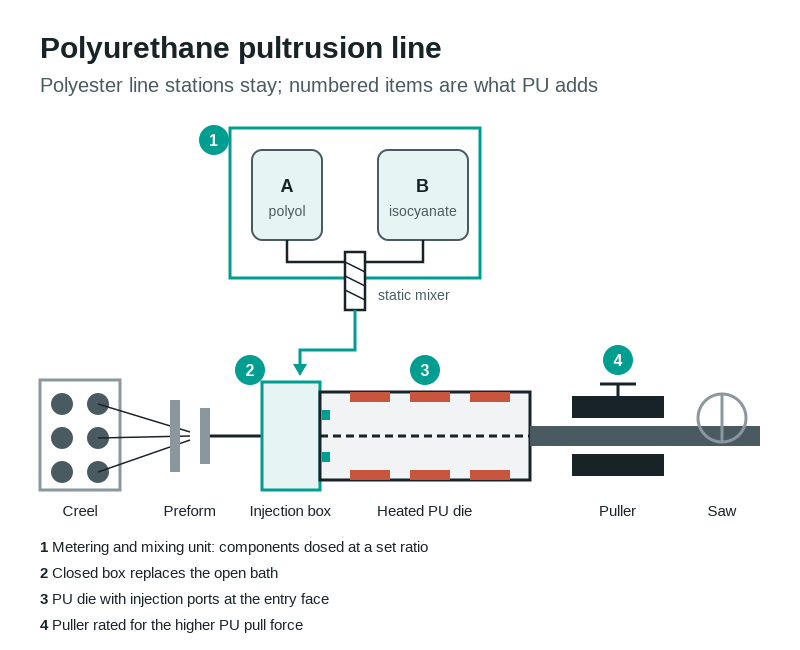
| Station | Open-bath polyester line | Polyurethane line | What to settle in the quotation |
|---|---|---|---|
| Resin preparation | Batch mixed in the mixing room and topped up in the bath | Polyol and isocyanate kept apart, metered at a set ratio and mixed in line | Ratio range, delivery at minimum and maximum demand, component conditioning |
| Impregnation | Open bath ahead of the preformer | Closed injection box at the die entry, one per die | Box drawing, connection to the die, allowable back pressure, purge and cleaning |
| Die | Polyester die steels and heating zones | PU die with injection ports and matching preform guides | Steel, ports, heating zones, ownership and charges as separate lines |
| Puller | Rated for the polyester section | Rated for the higher PU pull force | Rated force against the force expected on the section, checked in the trial |
| Emissions | Open bath releases styrene and other VOCs | Closed box contains the mix; CompositesWorld reports a large cut in VOC emissions | Extraction still planned for the die exit and the saw |
| Trial | Die trial on agreed materials | Die trial plus metering check, stop and restart | Numerical limits for ratio and delivery set before the trial |
Metering, mixing and the injection box
Mixed PU cures wherever it stands, so the line holds as little of it as possible. The metering unit pumps each component at the set ratio, a static mixer combines them, and the mix enters a small closed box fixed to the die entry where the dry fiber is wetted under pressure. Covestro's Baydur PUL brochure lists the processing equipment as a 2K dosing and mixing machine, an injection box and a standard pultrusion line. Martin put an injection box at a few thousand to about 20,000 US dollars and a meter and mix system at 25,000 to 40,000 US dollars per processing cavity, in 2013 prices.
In a pultrx line the metering duty is met by a two-component PU injection unit from the partner equipment builder named in the quotation. The reference unit adjusts mix ratio and output electronically over a 1:3 to 3:1 ratio range. Resin output and injection pressure are set for the formulation and the profile, then confirmed in the trial.
Reference data, supply boundary and acceptance checks are on the page for the polyurethane pultrusion injection unit
Pull force
PU profiles are usually pulled with high glass loading, and the cured resin is stiff, so the puller works harder. In the 2013 CompositesWorld report Martin said his polyester machines had about 6 tons of pulling force, that the lowest force his company had run in urethane was 12 tons, that most of its PU work needed 20 tons, and that one order then in hand needed 40 tons. These are one company's figures, not a rule. Size the puller from the force expected on your section and record the actual force in the trial.
pultrx configures hydraulic pullers from 6 to 60 t and servo-hydraulic pullers from 20 to 40 t, built by partner equipment factories in China. The force for a PU section is chosen from the profile, glass content and target speed, and the quotation states the rated force of the puller supplied.
How puller types carry force, and where each fits, is covered in the hydraulic vs caterpillar puller guide
The PU die
A PU section needs its own die. The entry face carries the injection ports, and the preform guides are made to match the box and the die. In the Henan Zhongsheng die table, polyurethane dies are made in Cr12 or SKD11 steel at a cavity hardness of HRC 55 to 60, with the treatment chosen per resin system and die type. A new PU die is quoted with its charges and ownership on separate lines.
Cavity, heating zone and preform design variables are in the pultrusion die design guide
How fast does a polyurethane pultrusion line run?
Published speeds come from equipment and resin suppliers, each for its own system and section. KraussMaffei reported in 2021 that a pultrusion line from its subsidiary Pultrex with iPul technology at Carbon TT in Buxtehude, Germany, wets carbon fiber with a polyurethane matrix in an injection box and runs at up to 2.25 m/min at 20 tons of pulling force, making chassis profiles for around 70,000 utility vehicles a year. Pultrex's iPul page gives haul-off speeds of up to 3 m/min. Covestro's brochure gives up to 3 m/min at 3 mm wall thickness after start-up for its own resin systems and says users must test suitability for their own processing.
Speed on a real line depends on wall thickness, die length and heating, resin reactivity and pull force. Treat these figures as what suppliers have published, and agree the speed for your section as a trial result. pultrx has no ownership, licensing or distribution link with KraussMaffei or Pultrex.
The Carbon TT speed, pull force and output are from the KraussMaffei press release (21 October 2021): Carbon TT relies on pultrusion systems from Pultrex with iPul technology
Why the two names differ by one letter and how the companies differ is set out in pultrx vs Pultrex
Which profiles are made by polyurethane pultrusion?
Polyurethane is chosen where a section has thin walls, needs toughness, or both. Henan Zhongsheng, pultrx's main partner, runs PU profiles on its own lines: solar module frames, multi-chamber window and door profiles, and T-slot framing profiles in 1 × 1 in, 1.5 × 1.5 in, 30 × 30 mm and 40 × 40 mm on existing dies. Covestro reports pultruded glass fiber PU frames for solar modules, with the resin tested by TÜV SÜD in 2023, and KraussMaffei the carbon fiber PU chassis profiles described above.
- Solar module frames: see the solar panel frame line guide for line scope and the PU profiles page for frames to drawing.
- Window and door profiles: multi-chamber sections in PU; state the thermal and structural requirements.
- T-slot framing profiles: four sizes on existing PU dies.
- Carbon fiber profiles: PU is one of the published resin routes, through closed injection.
To buy finished PU profiles to drawing, see polyurethane pultruded profiles
For a line that makes PV frames, read the solar panel frame pultrusion line guide
What to send for a polyurethane pultrusion line or die
| Item | Why it is needed |
|---|---|
| Profile drawing with wall thicknesses and chambers | Sets the die, the injection ports and the expected pull force |
| Reinforcement package: rovings, mat or fabric, glass or carbon | Sets the creel, preforming and the fiber content the force estimate rests on |
| PU system: supplier, product names, mix ratio, technical and safety data | Sets the metering ratio, pump arrangement and wetted-part materials |
| Target line speed and annual output | Sets resin demand at minimum, normal and maximum, and the number of cavities |
| Existing line, if converting: puller rating, die table, controls | Shows whether the puller has the force margin and where the injection unit connects |
| Plant voltage, frequency and utilities | Sets the panel design of the injection unit and the line |
| Trial materials and acceptance limits | Fixes what the factory acceptance test must show for ratio, delivery and profile quality |
Converting a polyester line
For a new plant built around PU profiles, start with the complete pultrusion production line
Sources and further reading
- CompositesWorld (K. Wood, 1 April 2013): Polyurethane pultrusion, next-gen equipment
Reviewed 2026-11-23. Supports conversion of existing lines to PU with an injection box per die and a meter and mix system with static mixer, their 2013 cost ranges, PU's high processing heat, low shrinkage and higher pull force, the 6 t, 12 t, 20 t and 40 t figures from Martin Pultrusion Group, and the VOC reduction of closed injection. One company's account.
- KraussMaffei press release (21 October 2021): Carbon TT relies on pultrusion systems from Pultrex with iPul technology
Reviewed 2026-11-23. Supports the polyurethane matrix in an injection box, up to 2.25 m/min at 20 tons of pulling force, CFRP chassis profiles for around 70,000 vehicles a year and the Buxtehude location. One installation.
- Pultrex: iPul profile
Reviewed 2026-11-23. Supports haul-off speeds of up to 3 m/min and iPul lines with injection box or open bath. Pultrex is not affiliated with pultrx.
- Covestro: Baydur PUL polyurethane resins for pultrusion (brochure, 2022 edition)
Archived copy of 2024-06-29. Supports the processing equipment list (2K dosing and mixing machine, injection box, standard pultrusion line) and up to 3 m/min at 3 mm wall thickness after start-up for Covestro's systems, with users to test suitability.
- Covestro: Pultrusion, higher productivity with PU resins
Archived copy of 2026-04-13. Supports Baydur PUL as aromatic polyurethane systems of polyols and isocyanates for glass or carbon rovings and continuous strand mat.
- Covestro press release (2023-05-25): Covestro receives polyurethane certificate for solar composite frames from TÜV SÜD
Archived copy of 2023-12-10. Supports glass fiber reinforced Baydur frames made by pultrusion and TÜV SÜD testing of the resin. Not a certificate for any frame supplied through pultrx.
Questions buyers ask
What is polyurethane pultrusion?
It is pultrusion with a two-component polyurethane matrix. The polyol and isocyanate are metered and mixed just ahead of the die, the mix wets the fiber in a closed injection box at the die entry, and the profile cures in the heated die. An open bath is not used because mixed PU reacts too quickly.
Which thermoset resins can a pultrx line run?
Unsaturated polyester, vinyl ester, epoxy, phenolic and polyurethane. Polyester and vinyl ester usually run from a resin bath, epoxy from a bath or an injection box depending on the hardener, and polyurethane through the two-component injection unit and a closed box. pultrx does not supply thermoplastic pultrusion or filament winding equipment.
Can an existing polyester pultrusion line run polyurethane?
Often, with changes: each PU section needs its own die with injection ports and an injection box, the line needs a two-component metering and mixing unit, and the puller must have enough force. Send the puller rating, die table interface and PU section drawing, and pultrx quotes the die, the injection unit and the connection to your controls.
Why does polyurethane pultrusion need more pull force?
PU profiles are usually pulled with high glass loading and the cured resin is stiff. One US pultruder told CompositesWorld in 2013 that its polyester machines had about 6 tons of pulling force while its PU work started at 12 tons and mostly needed 20 tons. Size the puller for the force expected on your section.
Who supplies the PU dies and the injection unit in a pultrx line?
PU dies come from Henan Zhongsheng or another partner die shop named in the quotation, in Cr12 or SKD11 steel. The two-component injection unit is built by the partner equipment factory named in the quotation, which also carries its warranty. Henan Zhongsheng does not make the injection unit.
Is pultrx linked to KraussMaffei or Pultrex?
No. KraussMaffei and its subsidiary Pultrex are quoted on this page as published sources for PU line speeds. pultrx has no ownership, licensing or distribution link with either company and does not sell or service their machines.
Summary
What is polyurethane pultrusion?
Polyurethane pultrusion pulls glass or carbon reinforcement through a closed injection box, where a freshly mixed two-component polyurethane (polyol and isocyanate) wets it, and then through a heated die where the profile cures. Mixed PU reacts too fast for an open bath, so the line adds a metering and mixing unit and an injection box, and usually needs more pull force than a polyester line.
- Resin
- Two components, polyol and isocyanate, metered and mixed just ahead of the die
- Impregnation
- Closed injection box at the die entry; no open bath
- Pull force
- One US pultruder: about 6 t on its polyester machines, 12 t minimum on PU, most PU work at 20 t (CompositesWorld, 2013)
- Published speed
- Up to 2.25 m/min at 20 t on a carbon PU line (KraussMaffei, 2021)
- Thermoset resins on pultrx lines
- Polyester, vinyl ester, epoxy, phenolic and polyurethane
- pultrx PU scope
- PU dies with injection ports, the two-component injection unit, pullers and PU profiles
Published by pultrx, an integrated pultrusion technology provider working with Henan Zhongsheng as a partner factory. This is a buyer planning guide; the manufacturer confirms project specifications in writing.
Ready to move from reading to a scoped quotation?
Ask for a polyurethane line or die review