
Technical review: Yunkun Gong, Pultrusion Engineer, pultrx
Pultruded profiles are bought by length, shipped by weight and installed by hand, so the weight per meter turns up in three places: the freight quotation, the lifting plan and the support or hanger design. The calculator above returns it for the seven common section families, in metric or inch units.
What formula does the calculator use?
Weight per unit length is the cross-section area multiplied by the density. With area in mm² and density in g/cm³, the product divided by 1,000 is kg/m. With area in in², multiply by the density, by 0.0361273 to convert g/cm³ to lb/in³, and by 12 to get lb/ft. The batch weight is the weight per meter times the cut length times the number of pieces, before packing.
| Section | Inputs | Area |
|---|---|---|
| Round tube | Outside diameter D, wall t | π/4 × (D² − (D − 2t)²) |
| Square or rectangular tube | Width B, height H, wall t | B × H − (B − 2t) × (H − 2t) |
| Solid round rod | Diameter D | π/4 × D² |
| Flat strip, bar or board | Width B, thickness t | B × t |
| Angle | Legs A and B, thickness t | t × (A + B − t) |
| Channel | Depth H, flange width B, flange thickness t, web thickness w | w × H + 2 × (B − w) × t |
| I-beam or wide-flange beam | Flange width B, depth H, flange thickness t, web thickness w | 2 × B × t + (H − 2t) × w |
Which density should you enter?
The default is 1.9 g/cm³, the mid-point of the 1.8 to 2.0 g/cm³ our partner factory states for its pultruded tubes. It is the same planning figure the inch size chart uses, so a size looked up on the chart and typed into the calculator gives the same lb/ft. Glass-reinforced plastics in general span 1.5 to 2.5 g/cm³ across all processes. A pultruded section sits near the top of that range because most of its weight is continuous glass roving.
- A higher glass content or a mineral filler in the resin raises the density.
- A resin-rich surface layer, a surface veil or a lower glass content lowers it.
- Carbon fiber pultrusions are lighter than glass at the same section; enter the density from the material data sheet.
- If the profile supplier gives a measured mass per meter for the section, that figure replaces the calculation.
How much does a fiberglass profile weigh? Worked examples
| Section | Area | FRP weight | Steel, same section | Aluminum, same section |
|---|---|---|---|---|
| Square tube 100 × 100 × 6 mm | 2,256 mm² | 4.29 kg/m | 17.71 kg/m | 6.09 kg/m |
| Equal angle 75 × 75 × 6 mm | 864 mm² | 1.64 kg/m | 6.78 kg/m | 2.33 kg/m |
| I-beam 200 × 100 × 10 mm (uniform thickness) | 3,800 mm² | 7.22 kg/m | 29.83 kg/m | 10.26 kg/m |
| Round tube 50 mm OD × 5 mm wall | 706.9 mm² | 1.34 kg/m | 5.55 kg/m | 1.91 kg/m |
| Flat strip 100 × 6 mm | 600 mm² | 1.14 kg/m | 4.71 kg/m | 1.62 kg/m |
| Square tube 2 × 2 × 1/8 in | 0.9375 in² | 0.772 lb/ft | 3.19 lb/ft | 1.10 lb/ft |
| Solid rod 1/2 in | 0.1963 in² | 0.162 lb/ft | 0.668 lb/ft | 0.230 lb/ft |
| Equal angle 3 × 3 × 1/4 in | 1.4375 in² | 1.184 lb/ft | 4.89 lb/ft | 1.68 lb/ft |
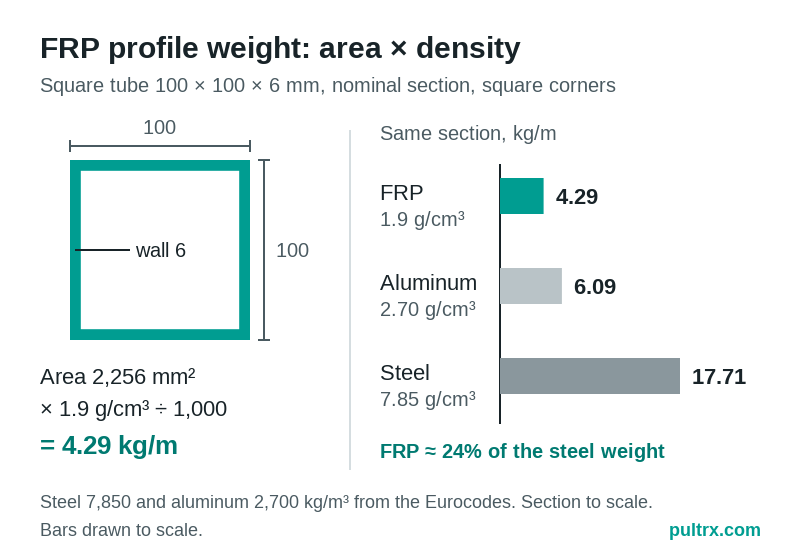
The steel and aluminum columns use 7,850 and 2,700 kg/m³ from the Eurocodes. They compare equal shapes only. A fiberglass member that replaces a steel one is often deeper or thicker, because FRP is far less stiff, so the weight saving of a real substitution is smaller than the ratio suggests. The I-beam span table and the FRP vs steel guide cover that sizing step.
Why does a catalog weight differ from the calculated one?
The calculator works on the nominal section with square corners. Real profiles carry inside and outside corner radii, and beams and channels carry fillets where the web meets the flange. Radii remove a little material at outside corners and fillets add some at inside ones, so a catalog mass can sit a few percent either side of the calculation. Glass content, filler and veil move it further. For freight that difference rarely matters; for a weight-critical design, ask for a measured mass per meter of the ordered section.
Where the weight goes in an order
- Freight: the batch weight plus packing gives the gross weight for the forwarder.
- Handling: the weight of one cut length tells you whether one person, two people or a lifting aid moves it on site.
- Supports and hangers: the self-weight per meter is the dead load a cable tray, pipe rack or platform frame carries before any imposed load.
- Quotation check: comparing the quoted weight per meter with the calculation catches a wrong wall thickness or a section mix-up before production.
Every inch size pultrx lists, with calculated lb/ft at the same density. FRP size chart in inches
Sources and further reading
- EN 1991-1-1 and EN 1999-1-1 via the European Commission JRC Eurocode portal
Densities used for the comparison come from the standards themselves: 7,850 kg/m³ for steel (EN 1991-1-1, Annex A) and 2,700 kg/m³ for aluminium alloys (EN 1999-1-1, 3.2.5).
- Wikipedia: Glass-reinforced plastic
General density range of glass-reinforced plastics, 1.5 to 2.5 g/cm³, across all processes.
Questions buyers ask
How much does a fiberglass square tube weigh?
It depends on the section. At the planning density of 1.9 g/cm³, a 100 × 100 × 6 mm square tube weighs about 4.29 kg/m and a 2 × 2 × 1/8 in square tube about 0.77 lb/ft. Enter your own size in the calculator for any other tube.
What density should I use for pultruded fiberglass?
Use 1.9 g/cm³ for planning: it is the mid-point of the 1.8 to 2.0 g/cm³ our partner factory states for its pultruded tubes. Higher glass content or filler raises it, a resin-rich surface lowers it. A measured mass per meter from the supplier replaces the calculation.
How much lighter is FRP than steel?
For the same section shape, a fiberglass profile at 1.9 g/cm³ weighs about 24% of a steel one at 7,850 kg/m³ and about 70% of an aluminum one at 2,700 kg/m³. A fiberglass member that replaces steel is often deeper because FRP is less stiff, so the real saving is smaller.
Can the calculated weight be used to accept a delivery?
No. It is a planning figure from the nominal section with square corners. Corner radii, fillets, glass content and veil move the real weight. Use it for freight, handling and support estimates, and agree any weight check for acceptance separately.
How do I convert kg/m to lb/ft for an FRP profile?
Multiply kg/m by 0.672 (2.2046 lb per kg times 0.3048 m per ft). A profile of 4.29 kg/m is about 2.88 lb/ft. The calculator shows both units for every result.
Summary
How do you calculate the weight of an FRP profile?
Multiply the cross-section area by the density. In metric units, area in mm² times density in g/cm³ divided by 1,000 gives kg/m. At the planning density of 1.9 g/cm³ a 100 × 100 × 6 mm square tube weighs about 4.29 kg/m and a 2 × 2 × 1/8 in square tube about 0.77 lb/ft. A steel section of the same shape weighs about four times as much.
- Formula
- kg/m = area (mm²) × density (g/cm³) ÷ 1,000
- Planning density
- 1.9 g/cm³, the mid-point of the 1.8 to 2.0 g/cm³ our partner factory states for its pultruded tubes
- Against steel
- About 24% of the weight of a steel section of the same shape (1.9 against 7.85 g/cm³)
- Against aluminum
- About 70% of the weight of an aluminum section of the same shape (1.9 against 2.70 g/cm³)
- Use
- Freight, handling and support estimates, never an acceptance criterion
Published by pultrx, an integrated pultrusion technology provider working with Henan Zhongsheng as a partner factory. This is a buyer planning guide; the manufacturer confirms project specifications in writing.
Ready to move from reading to a scoped quotation?
Send a profile drawing for a quotation