
Technical review: Yunkun Gong, Pultrusion Engineer, pultrx
How do GFRP rebar standards separate material, design, and approval?
A buyer who writes 'GFRP rebar to ASTM D7957' has named the first layer only. The engineer designed the member to a code that assumes certain bar properties, and the project owner may accept bars only from plants on its own list. Each market combines the three differently.
| Market | Bar material specification | Design code | Who accepts the supplier |
|---|---|---|---|
| United States, transportation | ASTM D7957, plus state specifications such as FDOT Section 932-6 and TxDOT DMS-7335 | AASHTO LRFD bridge design guide specifications for GFRP-reinforced concrete | State qualified product lists; Texas also requires AASHTO PEAS participation and Buy America certification |
| United States, buildings | ASTM D7957 | ACI CODE-440.11-22, adopted by the 2024 IBC for seismic design category A without fire rating | Building official; an ICC-ES evaluation report under acceptance criteria AC454 is one route |
| Canada | CSA S807 (modulus grades and durability classes) | CSA S806 for buildings, CSA S6 Section 16 for bridges | Owner lists, for example the Ontario MTO Designated Sources for Materials |
| European Union | No harmonised EN; EAD 260023-00-0301 leads to a European Technical Assessment and CE marking | EN 1992-1-1:2023 Annex R (informative; national annexes decide its use) | Technical assessment body for the ETA, notified body under AVCP system 1+ |
| Italy | CNR-DT 203 R1/2026 strength classes; CSLP 2021 guideline | CNR-DT 203 R1/2026 | CE marking under the EAD, or a CVT certificate under the CSLP guideline |
| Germany | National technical approval (DIBt abZ/aBG), product by product | DAfStb guideline on non-metallic reinforcement (2024) | DIBt |
| Australia | AS 5204:2023 (glass and basalt bars, P and T durability classes) | No national FRP design code; Queensland MRTS271 cites CSA S806 as an example | Queensland TMR registered suppliers, qualification at a NATA-accredited laboratory |
| Saudi Arabia and the Gulf | GSO 2699:2022 and GSO ASTM D7957/D7957M:2025, both based on ASTM D7957 | SBC 311-2024, arranged like ACI CODE-440.11 with added fire and seismic appendices | Project owner and engineer |
| China | GB/T 26743-2011 (revision in draft), JG/T 406-2013 for civil-engineering GFRP bars | GB 50608-2020; CJJ/T 280-2018 for urban bridges | Type test and factory inspection reports |
Approval schemes belong to the manufacturing plant. Listing one in this table does not say that any particular supplier holds it.
ISO 10406-1 sits beside all of these as a test-method standard. It tells a laboratory how to test a bar and sets no pass marks. Singapore adopted the 2015 edition as SS ISO 10406-1, and the European EAD and the Italian CNR guide use its methods. An ISO product specification for FRP bars and grids, ISO/DIS 13197, is in development.
How do tensile, modulus, and cure limits compare across specifications?
ASTM D7957 and CSA S807 are paid documents, so the table uses public owner specifications that adopt them: FDOT Section 932-6 for a US DOT reading of D7957, and Ontario OPSS.PROV 1640 for CSA S807 Grade III. MRTS271 shows the Australian road-agency version, CNR-DT 203 R1 the Italian classes, and GB/T 26743-2011 the current Chinese national minimum.
| Requirement | FDOT 932-6 (US) | OPSS.PROV 1640 (Ontario) | MRTS271 (Queensland) | CNR-DT 203 R1 (Italy) | GB/T 26743-2011 (China) |
|---|---|---|---|---|---|
| Fiber and resin | E-CR or R glass, vinyl ester only | E-CR glass, vinyl ester or epoxy | E-CR glass, vinylester or epoxy | Glass or carbon; thermoset or thermoplastic | Classes for glass, carbon and aramid bars |
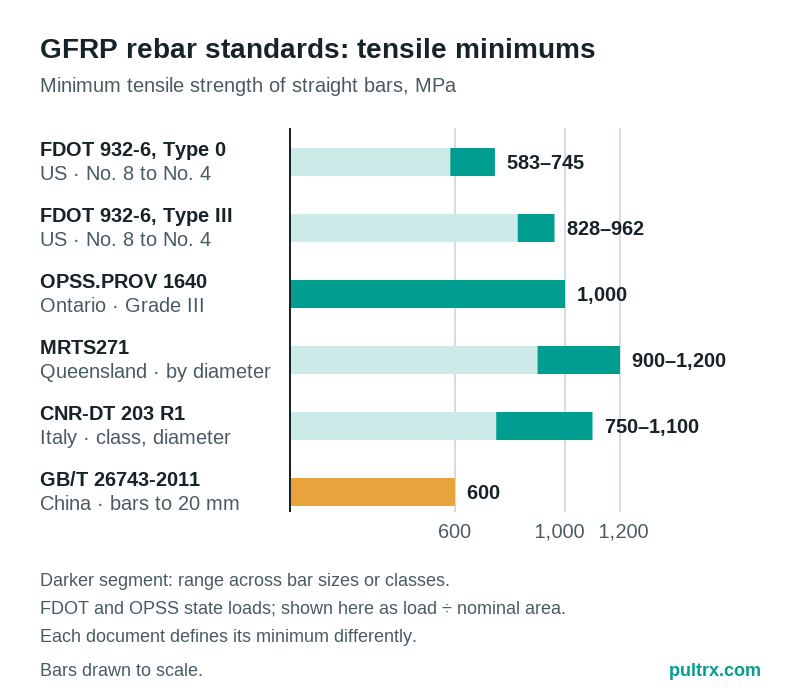
| Tensile strength | Type 0: 21.6 kip for No. 4 (745 MPa), 66.8 kip for No. 8 (583 MPa). Type III: 27.9 kip (962 MPa) and 94.9 kip (828 MPa) | Grade III: 129 kN for 13 mm to 510 kN for 25 mm, 1,000 MPa on nominal area | Over 1,200 MPa below 12 mm; over 1,000 MPa for 12 to 24 mm; over 900 MPa above 24 mm | Class E45/850 to E60/1100: 850 to 1,100 MPa; 750 to 1,000 MPa from 24 mm | 600 MPa, bars up to 20 mm |
| How the minimum is defined | Mean minus three standard deviations | Minimum specified load; a sublot fails if any sample is below it (5 % allowed above 20 samples) | Lower characteristic value, taken as equivalent to the CSA S807 classification strength | Characteristic value on the effective area | Specimen results checked against the table value |
| Tensile modulus | Type 0: 6,500 ksi (44.8 GPa). Type III: 8,700 ksi (60.0 GPa) | 60 GPa | Per CSA S807 Grade III | 45, 50 or 60 GPa by class (mean) | 40 GPa |
| Ultimate strain | Not in the acceptance table | 1.2 % minimum | Per CSA S807 | Declared | 1.8 % minimum |
| Transverse shear | Not in the acceptance table | 180 MPa minimum | Per CSA S807 | 115 MPa characteristic | Not required |
| Fiber content | 70 % by mass minimum | 70 % glass by weight minimum | Per CSA S807 | 70 % by weight or 50 % by volume (clause 3.1) | Not required |
| Glass transition temperature | 230 °F (110 °C) by DMA or 212 °F (100 °C) by DSC | DSC 100 °C, DMA 110 °C | Per CSA S807 | 100 °C | Not required |
| Degree of cure | 95 % of total polymerization enthalpy | 95 % | Per CSA S807 | Declared under the EAD | Not required |
| Water absorption, 24 h at 50 °C | 0.25 % maximum | 0.25 % (size 15 and up), 0.30 % (smaller); 0.45 % after one week | Per CSA S807 | Not set; factory production control under the EAD | Not required |
| Lot and sampling | Certificate of analysis per lot; project samples above 15,000 ft straight, 10,000 ft bent or spiral, or 20,000 ft combined | Lot up to 60,000 m, sublot up to 20,000 m, at most 7 days of production | Lot up to 60,000 m of straight bar | CVT products: three specimens per shipment batch on site | 500 bars per lot |
How to read the table: FDOT and OPSS state tensile loads, and the MPa figures here are those loads divided by the nominal area (FDOT No. 4 = 129 mm², No. 8 = 510 mm²; OPSS 13 mm = 129 mm², 25 mm = 510 mm²). 'Per CSA S807' means MRTS271 adopts the CSA value without restating it. 'Declared' means the value is stated in the product's assessment rather than checked against a pass mark.
The Chinese national minimum is lower
How does guaranteed strength differ from characteristic strength?
FDOT, following ASTM D7957 practice, defines the guaranteed tensile load as the mean of the test results minus three standard deviations (Table 932-10, note a). The European EAD, the Italian CNR guide, China's GB 50608 and the GB/T 26743 revision draft use a characteristic value near the 5 % fractile, about the mean minus 1.645 standard deviations for a large sample. The 2011 edition of GB/T 26743 checks the specimens against the table value. Ontario tests at least five samples per sublot and rejects the sublot if any one falls below the specified load (more than 5 % if over 20 are tested). For a bar that averages 1,000 MPa with a standard deviation of 50 MPa, the US-style value is 850 MPa and the 5 % characteristic value is about 918 MPa. The same test data can pass one standard and fail the other, so ask the supplier to report the mean, the standard deviation and the number of specimens, and state which definition the quotation uses.
How do alkali resistance test methods differ across standards?
Concrete pore water is alkaline, and glass fibers lose strength if the resin does not protect them. Every scheme tests for it, with different test liquids, temperatures, durations and loads.
- CNR-DT 203 R1 accepts a glass bar that keeps 60 % of its mean tensile strength after 3,000 hours at 60 °C in the ISO 10406-1 alkaline bath (8.0 g NaOH and 22.4 g KOH per liter, pH above 13), or 80 % in a calcium hydroxide bath (118.5 g Ca(OH)₂, 0.9 g NaOH and 4.2 g KOH per liter, pH 12.6 to 13.0).
- China's GB/T 34551-2017 uses that same calcium hydroxide bath at 60 °C, with or without sustained load, with readings at 7 to 90 days. The GB/T 26743 revision draft asks 70 % retention for glass bars after 90 days.
- The EAD runs the ISO 10406-1 exposure for 1,000 hours under a sustained 3,000 microstrain and for 3,000 hours, and the result is declared in the ETA without a pass mark.
- AASHTO PEAS audits require an alkali resistance test to ASTM D7705 once a year, and a bond test to ASTM D7913 once a year.
A retention figure means little without its test liquid, temperature, duration and load. Name the method in the RFQ, and if the bars are for Europe, ask for the 3,000 hour result: under EN 1992-1-1 Annex R the designer otherwise uses default factors.
Why do concrete design codes reward long-term test data?
Design codes do not use the short-term bar strength directly. In EN 1992-1-1 Annex R the long-term characteristic strength is the short-term value multiplied by a temperature factor, a sustained-load factor Cc and an ageing factor Ce. Without tests, a paper explaining Annex R gives Cc = 0.35 for glass bars and Ce = 0.7, which with the partial factor of 1.5 leaves a small fraction of the short-term strength for design. Creep-rupture and alkali tests to ISO 10406-1 can replace those defaults. China's GB 50608-2020 divides the characteristic strength by a material factor of 1.25 and an environment factor of 1.25 to 1.6 for glass bars (2.0 in strongly alkaline exposure). CNR-DT 203 R1 uses 0.70 to 0.85 environment factors and a partial factor of 1.25 in bending. A supplier's long-term test record therefore changes how much bar the design needs.
How are production lots, plant audits, and lab tests defined?
- Ontario: a production lot is at most 60,000 m of one grade and diameter and 7 days of production, split into sublots of at most 20,000 m. A machine change, a production break or a new raw-material batch starts a new lot.
- Queensland: qualification tests are done by an independent NATA-accredited laboratory and add compressive strength, thermal expansion, creep, density and fatigue to the CSA S807 tests. Bars come from a registered supplier.
- Florida: the producer sends a certificate of analysis for each production lot. The contractor provides samples for the engineer when a project uses more than 15,000 ft of straight bar, 10,000 ft of bent or spiral bar, or 20,000 ft in total.
- AASHTO PEAS: auditors visit the plant once a year and draw bar samples from retained lots for an AASHTO-designated laboratory; Texas and South Carolina require participation.
- European Union: under AVCP system 1+ a notified body inspects the factory before the first ETA-based delivery and audits it every year; factory production control tests each lot of up to 60,000 m per diameter.
- Italy: for products qualified by a CVT certificate, the site engineer tests three specimens from each shipment batch, and each must reach 95 % of the certified characteristic strength. For CE-marked bars with a declaration of performance, site testing is at the engineer's discretion.
What to write in a GFRP rebar RFQ
| Item | Example wording |
|---|---|
| Material specification and edition | ASTM D7957/D7957M-26 (or the edition the project names); or CSA S807:19 Grade III, durability class D1; or MRTS271 (March 2023) |
| Bar sizes and designation | US No. 3 to No. 8, or metric 10 to 25 mm; nominal area basis for strength |
| Fiber and resin | E-CR glass to ASTM D578, vinyl ester resin (or as the owner allows) |
| Strength definition | Guaranteed load as mean minus 3 standard deviations; report mean, standard deviation and specimen count |
| Lot definition | Lot size, sublot size and sampling plan from the governing specification |
| Tests per lot | Tensile load and modulus, measured area, fiber content, Tg, degree of cure, 24 h absorption |
| Qualification tests and laboratory | Transverse shear, bond, bent-bar strength, alkali resistance (named method), creep rupture; independent accredited laboratory if required |
| Supplier approval required | For example MTO Designated Sources, TMR registration, AASHTO PEAS, an ETA, or none |
| Bent shapes | Bending schedule with inside bend diameters; bends are made in the factory |
| Documents | Lot certificate traceable to bundle labels, test reports, laboratory accreditation |
How does pultrx quote GFRP rebar to a project standard?
Henan Zhongsheng, our partner factory in Xinxiang, makes GFRP reinforcing bars and mesh, and pultrx, an integrated pultrusion technology provider in Shanghai, quotes and exports them. The catalogue does not state conformity to any standard on this page or any supplier listing. Send the specification and edition, the size schedule and the tests your project requires. The quotation states which tests are reported for the ordered lots, by which laboratory, against which definition of strength, and what is quoted separately.
See the product page for the supply scope, the RFQ checklist and the acceptance checks. GFRP rebar: bar schedules, standards and lot documents
For where GFRP replaces steel and the ACI 440.11 and IBC limits, read GFRP rebar vs steel rebar
Sources and further reading
- FDOT Standard Specifications for Road and Bridge Construction, FY 2026-27, Section 932-6 FRP reinforcing bars
Table 932-9 bar sizes and minimum guaranteed tensile loads (Type 0 and Type III); Table 932-10 project material acceptance tests; a certificate of analysis for each production lot; E-CR or R glass with vinyl ester for GFRP; project sampling triggers in 932-6.3.1.
- Ontario OPSS.PROV 1640, Material specification for GFRP reinforcement (November 2023)
CSA S807 Grade III and durability class D1, E-CR glass with vinyl ester or epoxy, Tables 1 to 3, 60,000 m lots and 20,000 m sublots, manufacturer on the MTO Designated Sources for Materials list. The file on the MTO site is headed DRAFT.
- Queensland TMR MRTS271, Glass fibre reinforced polymer reinforcement (March 2023)
Registered supplier, E-CR glass with vinylester or epoxy, lower characteristic strength by diameter, CSA S807 Grade III D1, qualification by a NATA-accredited laboratory, 60,000 m production lots.
- TxDOT DMS-7335, GFRP concrete reinforcement manufacturer qualification (October 2025)
ASTM D7957 plus a minimum modulus of 7,500 ksi, AASHTO PEAS participation and Build America, Buy America certification.
- AASHTO PEAS work plan CCR-26-01, BFRP and GFRP bar manufacturers
Audit program for bar plants: lot quality control tests, annual alkali resistance (ASTM D7705) and bond (ASTM D7913) tests, and samples drawn by the auditor.
- EOTA EAD 260023-00-0301, Fibre reinforced polymer bars for concrete (cited in the OJEU 2024)
Basis for a European Technical Assessment and CE marking: 5 to 32 mm bars, declared performance, AVCP system 1+, factory production control lots up to 60,000 linear meters of one diameter.
- CNR-DT 203 R1/2026, Guide for the design and construction of concrete structures reinforced with FRP bars (Italian National Research Council)
Table 3-1 qualification thresholds, Table 3-3 strength classes E45/850 to E60/1100, alkali resistance thresholds tied to the alkaline test liquid, site acceptance per shipment batch.
- ASTM D7957/D7957M-26, Standard specification for glass fiber reinforced polymer (GFRP) bars for concrete reinforcement
Paid standard. The public scope covers GFRP bars with a surface enhancement and excludes bars that are not solid and round; it lists qualification tests (Table 1) and lot acceptance tests (Table 2). Check the edition your project names.
- ISO 10406-1:2025, Fibre-reinforced polymer (FRP) reinforcement of concrete, test methods, Part 1: FRP bars
Paid test-method standard. The EAD and CNR-DT 203 R1 still cite the 2015 edition.
- Standards Australia AS 5204:2023, Fibre reinforced polymer bars
Paid product standard for glass and basalt FRP bars, with permanent (P) and temporary (T) durability classes.
- Oller, Torres and de Diego (2023), FRP reinforcement in EN 1992-1-1 Annex R, Hormigón y Acero (open access)
Paper explaining Annex R. Source here for the Annex R long-term strength factors and their defaults; check the published EN text for the project.
- China national standards platform (search GB/T 26743-2011 and GB/T 34551-2017)
GB/T 26743-2011 Fiber reinforced polymer bars for structural engineering, and GB/T 34551-2017 test method for alkali resistance of GFRP bars at elevated temperature.
Questions buyers ask
What is the standard for GFRP rebar in the United States?
ASTM D7957/D7957M is the material specification; ACI CODE-440.11-22 is the building design code that references it. State DOTs add their own specifications, such as FDOT Section 932-6 and TxDOT DMS-7335, and some, such as Texas and South Carolina, require the AASHTO PEAS audit.
What does CSA S807 Grade III mean?
CSA S807 grades bars by tensile modulus. Ontario's OPSS.PROV 1640 requires Grade III bars with 60 GPa modulus and specified loads equal to 1,000 MPa on the nominal area for 13 to 25 mm straight bars (bent bars have lower values), plus durability class D1.
Is there a European standard for GFRP rebar?
There is no harmonised EN. Bars are CE marked through a European Technical Assessment issued against EAD 260023-00-0301, which declares performance without pass marks. EN 1992-1-1:2023 Annex R gives design rules; national annexes decide whether it applies.
Is ISO 10406-1 a product standard?
No. ISO 10406-1 gives test methods for FRP bars and sets no limits. A product specification, ISO/DIS 13197, is in development.
Does a GB/T 26743 test report show conformity to ASTM D7957?
No. GB/T 26743-2011 has lower strength and modulus minimums, a different statistical basis and none of the glass transition, cure, absorption or fiber content tests. Ask for the tests of the standard your project names.
Which Chinese standards cover GFRP rebar?
GB/T 26743-2011 for FRP bars in structural engineering (under revision), JG/T 406-2013 for GFRP bars in civil engineering, GB/T 34551-2017 for alkali resistance testing, and GB 50608-2020 and CJJ/T 280-2018 for design.
Summary
Which GFRP rebar standards apply in each market?
GFRP rebar standards work in three layers: a material specification, a design code and an owner or approval scheme. The material specification is ASTM D7957 in the United States, CSA S807 in Canada, AS 5204 in Australia and GB/T 26743 in China. The European Union has no harmonized EN; bars are CE marked through EAD 260023-00-0301.
- United States
- ASTM D7957; building design to ACI CODE-440.11-22; state specifications such as FDOT Section 932-6 and TxDOT DMS-7335
- Canada
- CSA S807; Ontario OPSS.PROV 1640 requires Grade III, 60 GPa modulus and durability class D1
- European Union
- No harmonized EN; EAD 260023-00-0301 leads to a European Technical Assessment and CE marking, without pass marks
- Australia
- AS 5204:2023; Queensland MRTS271 requires bars from a registered supplier
- China
- GB/T 26743-2011 asks 600 MPa (bars up to 20 mm) and 40 GPa; it says nothing about conformity to ASTM D7957 or CSA S807
- pultrx supply
- Bars made by Henan Zhongsheng, partner factory; the catalogue states no conformity to any standard on this page
Published by pultrx, an integrated pultrusion technology provider working with Henan Zhongsheng as a partner factory. This is a buyer planning guide; the manufacturer confirms project specifications in writing.
Ready to move from reading to a scoped quotation?
Send a GFRP rebar schedule and specification