
Skip to content
pultrx

Application · Updated 2026-11-08

FRP framing for enclosures, racks and machine frames

Fiberglass framing is specified where an aluminum or steel frame would corrode, conduct electricity or sit too close to live parts: control panel enclosures, equipment racks in humid or salt-laden air, battery production lines, EMI/RFI test areas, wash-down and chemical areas, and shipyards. The frame is built from pultruded profiles: square tube posts and rails, angle brackets, channels and flat sheet, or fiberglass T-slot profiles in 1 × 1 in, 1.5 × 1.5 in, 30 × 30 mm and 40 × 40 mm.

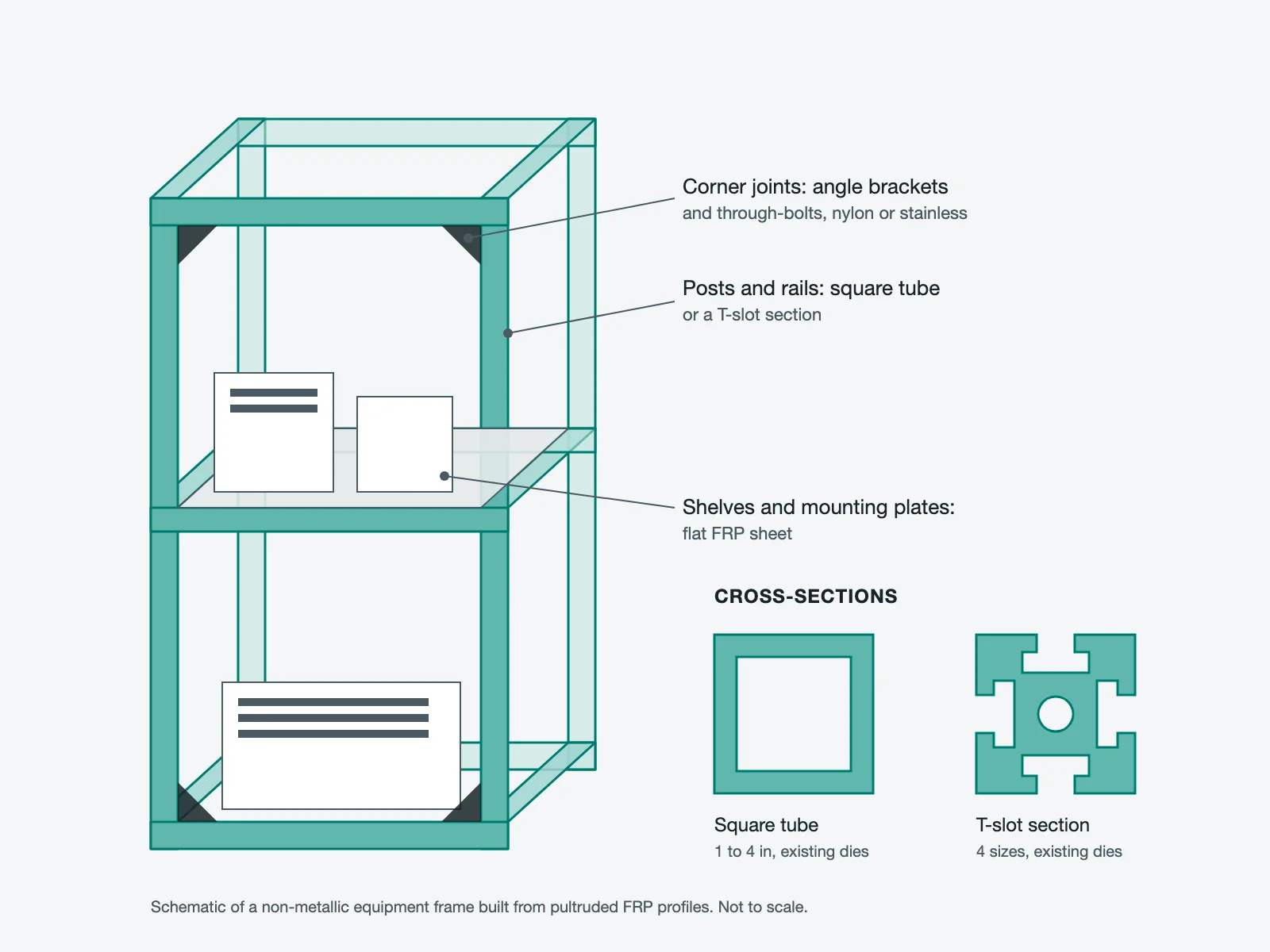
Schematic of a fiberglass equipment frame with square tube posts, angle brackets, and square tube and T-slot cross-sections

Buying products for this application? Each family below links to its specification page. Running or planning a pultrusion line for these products? Jump to make these products on your own line.

Product families

Which FRP products does this application use?

Each card opens the product page with its forms, specification questions and RFQ checklist.

Order requirements

What should the RFQ specify?

Put these items on the RFQ so the factory quotes the same product the project drawing describes.

  1. 01Frame drawing or bill of materials: each profile, cut length, quantity and hole pattern.
  2. 02Build method: T-slot profiles (1 in, 1.5 in, 30 mm or 40 mm) or square tube and brackets; other T-slot sizes need a new die.
  3. 03For a T-slot frame: the section size, end machining, and drawings or samples of the nuts and brackets that must fit.
  4. 04Fastener and hardware material: FRP, nylon, stainless steel or other; state if the frame must contain no metal.
  5. 05Electrical requirement: the voltage near the frame and any dielectric test required on the profile; whether the area is ESD-protected.
  6. 06Environment: chemicals, humidity or salt, outdoor UV, operating temperature near heat sources.
  7. 07Fire requirement for the resin system, such as a flame spread or flammability classification.
  8. 08Color, surface finish, packaging and whether cutting and drilling are done at the factory.

Request a quotation

Get a quotation for this application

Send the drawing or the list above. An engineer reviews the request and replies in English with one quotation.

Prefer email or chat? Write to inquiry@pultrx.com or message Celion on WhatsApp. Drawings can follow by email.

Quotation request details

A few short fields, optional section drawings and one line about what you need.

PDF, DXF, DWG, STEP, IGES, PNG, JPG or WebP. Up to 3 files, 4 MB total. Larger CAD files can follow to inquiry@pultrx.com.

Standards and documents

Which standards and documents do buyers cite?

Named so the RFQ can refer to them. Citing a standard does not establish that a quoted product conforms to it; conformity, tests and evidence are agreed in the quotation.

ASTM D149
Test method for dielectric breakdown voltage of solid insulating materials; cite it if the frame must insulate live parts, and ask for results on the quoted profile.
UL 94 and ASTM E84
Flammability and flame spread classifications commonly asked for enclosure parts and building interiors; request the report for the quoted resin system.
IEC 61340-5-1
ESD control program for protected areas. Standard fiberglass is an insulator, so state the surface resistance required if the frame stands in an ESD-protected area.
EN 13706
Specification for pultruded profiles that may be cited for structural frame members; grade, tests and tolerances are set per order.
Cut, drill and join fiberglass
This site's guide to bolted, bonded and insert joints in pultruded profiles, with sources.

Where non-metallic framing is specified

  • Control panel and junction box enclosures near live equipment, indoors or outdoors.
  • Racks and cabinets for electronics in humid, coastal or chemical atmospheres.
  • Battery cell and module production lines, where fixtures and guards stand near energized parts.
  • EMI/RFI test areas and rooms where a metal or magnetic frame is unwanted.
  • Wash-down, chemical dosing and plating areas where aluminum and steel corrode.
  • Shipyards, offshore modules and coastal plant.

Square tube and brackets, or a T-slot section

There are two ways to build the frame. A tube-and-bracket frame uses square tube posts and rails joined with angle brackets or gusset plates and through-bolts. A T-slot frame uses a square section with open slots on each face; nuts slide into the slots, so brackets, panels and shelves can be moved without new holes. Aluminum T-slot profiles are extruded; fiberglass T-slot profiles are pultruded. Our partner factory runs fiberglass T-slot profiles in 1 × 1 in, 1.5 × 1.5 in, 30 × 30 mm and 40 × 40 mm, and square tube, angles and channels, all on existing dies, so the order covers cutting, machining and hardware. Another T-slot size or slot layout needs its own die.

Tube and bracketsT-slot section
DieExisting dies for 1 to 4 in square tube, angles and channelsExisting dies for 1 × 1 in, 1.5 × 1.5 in, 30 × 30 mm and 40 × 40 mm; other sizes need a new die
JointsThrough-bolts with angle brackets or gusset plates; bonded joints where the frame stays fixedSlot nuts with brackets; the nut load bears on the slot lips
Changes laterNew holesSlide the bracket along the slot
Metal in the frameNone if FRP or nylon bolts are usedDepends on the nut and bracket material
Hardware fitBolts and brackets drilled to the frameFit of a given maker's nuts and brackets is confirmed on the quoted section

In a pultruded section the glass fibers run along the length. A slot nut pulls across the fibers on the slot lips, where pultruded material is weaker than along its length, so ask for the nut pull-out and bracket slip values to be checked on the quoted section with the hardware you will use.

Fasteners decide whether the frame is non-metallic

A fiberglass frame is only as non-conductive and corrosion-resistant as its hardware. Steel nuts and bolts put metal back into the frame; stainless steel resists corrosion but still conducts. Where no metal is allowed, specify FRP or nylon bolts and nuts and check their strength for the joint. Threads cut directly into fiberglass hold little, so bond a threaded insert where a removable joint carries load.

Electrical and static behavior

Glass-fiber FRP is an electrical insulator and is nonmagnetic. Carbon-fiber profiles conduct, so specify glass fiber. Insulating material does not by itself give the frame an electrical rating: if the frame separates people from live parts, state the voltage and the dielectric test you need and ask for results on the quoted profile. Insulators also hold static charge, so a standard fiberglass frame is not static-dissipative; in an ESD-protected area, state the surface resistance the area requires.

Stiffness, temperature and fire

A fiberglass profile is less stiff than an aluminum section of the same size, so deflection usually decides the span of a shelf rail or the height of an unbraced post. Check deflection with the section properties of the quoted profile, add diagonal bracing or move up a size. Resins soften as temperature rises, so state the operating temperature near heaters, motors or power supplies. For enclosures in buildings, state the flammability or flame spread classification the project requires for the resin system.

For manufacturers

Can you make these products on your own line?

The dies, machines and planning guides for a factory that wants to pultrude these products itself. The same factory that makes the profiles builds the dies.

FAQ

Questions buyers ask

Which fiberglass T-slot sizes are available?

1 × 1 in, 1.5 × 1.5 in, 30 × 30 mm and 40 × 40 mm, each with four open T-slots, run on existing dies. For another size or slot layout, send the section drawing; our die shop quotes a new die.

Are fiberglass frames ESD-safe?

Not as standard. Glass-fiber FRP is an insulator and holds static charge. If the frame stands in an ESD-protected area, state the surface resistance required. Whether it can be met is answered for that requirement.

Can aluminum T-slot nuts and brackets be used in a fiberglass T-slot profile?

Fit with a particular maker's hardware is not assumed. Send the drawing or a sample of the nuts and brackets so fit can be checked before an order. Metal nuts and brackets also put metal back into the frame.

Which square tube sizes run on existing dies?

Square tube from 1 × 1 to 4 × 4 in in 1/8, 3/16 and 1/4 in walls, listed with weights in the inch size chart.

Which resin should the frame use?

Choose by the environment and the evidence the project needs. The factory lists polyester, vinyl ester, epoxy and phenolic systems for its profile families and runs polyurethane profiles on its own PU lines. The resin selection guide compares polyester and vinyl ester, and the quotation names the resin for each profile.

Summary

FRP framing for enclosures, racks and machine frames in brief

FRP equipment frames are built from pultruded glass fiber profiles: fiberglass T-slot profiles (1 × 1 in, 1.5 × 1.5 in, 30 × 30 mm and 40 × 40 mm, four open slots, polyurethane matrix) so nuts and brackets can slide, or square tube (1 to 4 in) joined with angle brackets and through-bolts, both on existing dies. Buyers specify the frame drawing, the profile sizes, the slot geometry and mating hardware, the fastener material, the electrical and fire requirements and the environment.

Products
Fiberglass T-slot profile, Fiberglass square tube, Custom FRP profiles, Polyurethane pultruded profiles, Fiberglass angle, Fiberglass channel, Flat strips and boards
Also searched as
FRP equipment frame, non-conductive framing, non-metallic equipment frame, FRP enclosure frame, fiberglass rack frame, composite T-slot profile
Made by
Henan Zhongsheng Composite Material Co., Ltd., Muye District, Xinxiang, Henan, China
Sold by
pultrx, Shanghai, China: an integrated pultrusion technology provider and exporter of record
Supply basis
Sections, panels and bars made to the project drawing or a catalogue form; design, loads and code compliance stay with the project engineer.
Pricing
Quotation only, by drawing and quantity. Incoterm (FOB China port, CIF or DAP), currency and contract language are stated in the quotation.

Send the framing for enclosures, racks and machine frames drawing or schedule. Get a scoped quotation.

Every quotation names the manufacturer, the exporter of record and the warranty party, and lists what is included.