
Technical review: Yunkun Gong, Pultrusion Engineer, pultrx
Why do module makers consider composite solar panel frames?
Covestro describes the module frame as the part that fixes and seals the module and strengthens it for transport and installation, and notes that aluminum profiles are currently the dominant frame material. Covestro and BASF have both published glass fiber reinforced polyurethane frames. Covestro states that its frames are made through a pultrusion process. A 2025 study by Liu et al. states that PV composite frames are pultruded with unidirectional continuous glass fiber, generally at about 70 to 80% by mass. The claims below are supplier statements, and your own module tests have to confirm each one.
| Claim | Who states it | What to verify |
|---|---|---|
| Axial tensile strength more than 7 times that of a typical aluminum alloy | Covestro | Section stiffness and module load tests; tensile strength alone does not set frame deflection |
| Modules with the frame passed salt mist and ammonia corrosion testing | Covestro (IEC 61701 and IEC 62716) | The same tests on your module construction and coating |
| A non-metal frame reduces potential-induced degradation (PID) | Covestro | The PID testing your customers require |
| 85% lower product carbon footprint than aluminum frames | BASF | The study basis and boundaries before you repeat the figure |
| Mechanical properties depend mainly on matrix compactness and fiber-matrix bonding | Liu et al. (2025) | Resin choice and cure on samples from your own die |
What equipment does the polyurethane pultrusion route need?
Covestro's Baydur PUL brochure lists three items of processing equipment: a 2K dosing and mixing machine, an injection box for fiber impregnation and a standard pultrusion line. It proposes a die 1 m long with 3 to 6 heating zones up to 230 °C, and gives up to 3 m/min at 3 mm wall thickness after start-up for its own systems, adding that users must test suitability. Strauss et al. explain why the bath is closed: the short pot life of highly reactive resin systems moves impregnation from an open bath into a closed injection and impregnation chamber. In their trials resin viscosity had the greatest effect on chamber pressure, so ask how chamber pressure and temperature are measured on the quoted line.
For metering ratio, resin demand and the injection box interface, review the Polyurethane pultrusion injection unit
For PU mixing order, internal release and the formulation record, see the pultrusion resin formulation guide
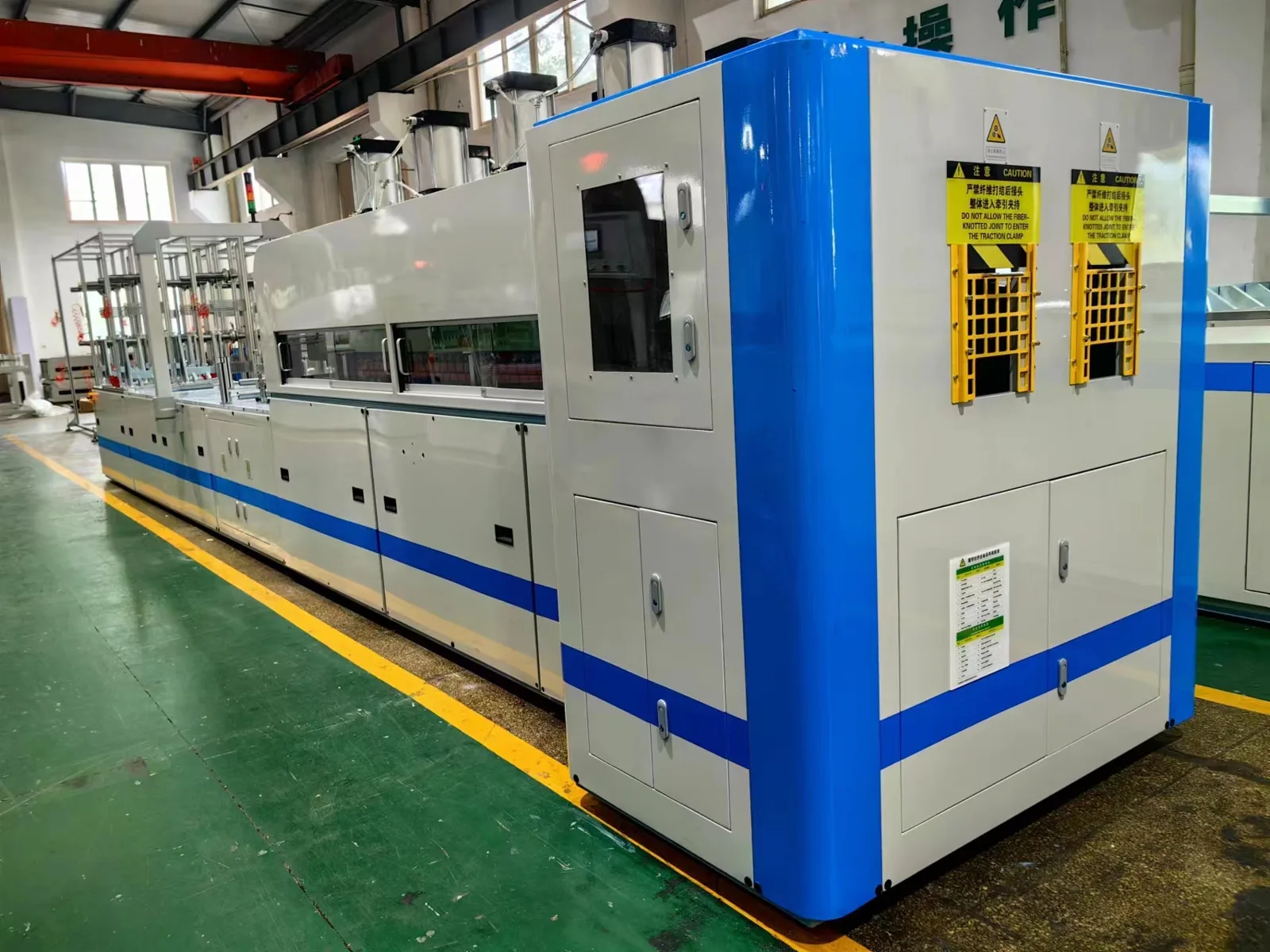
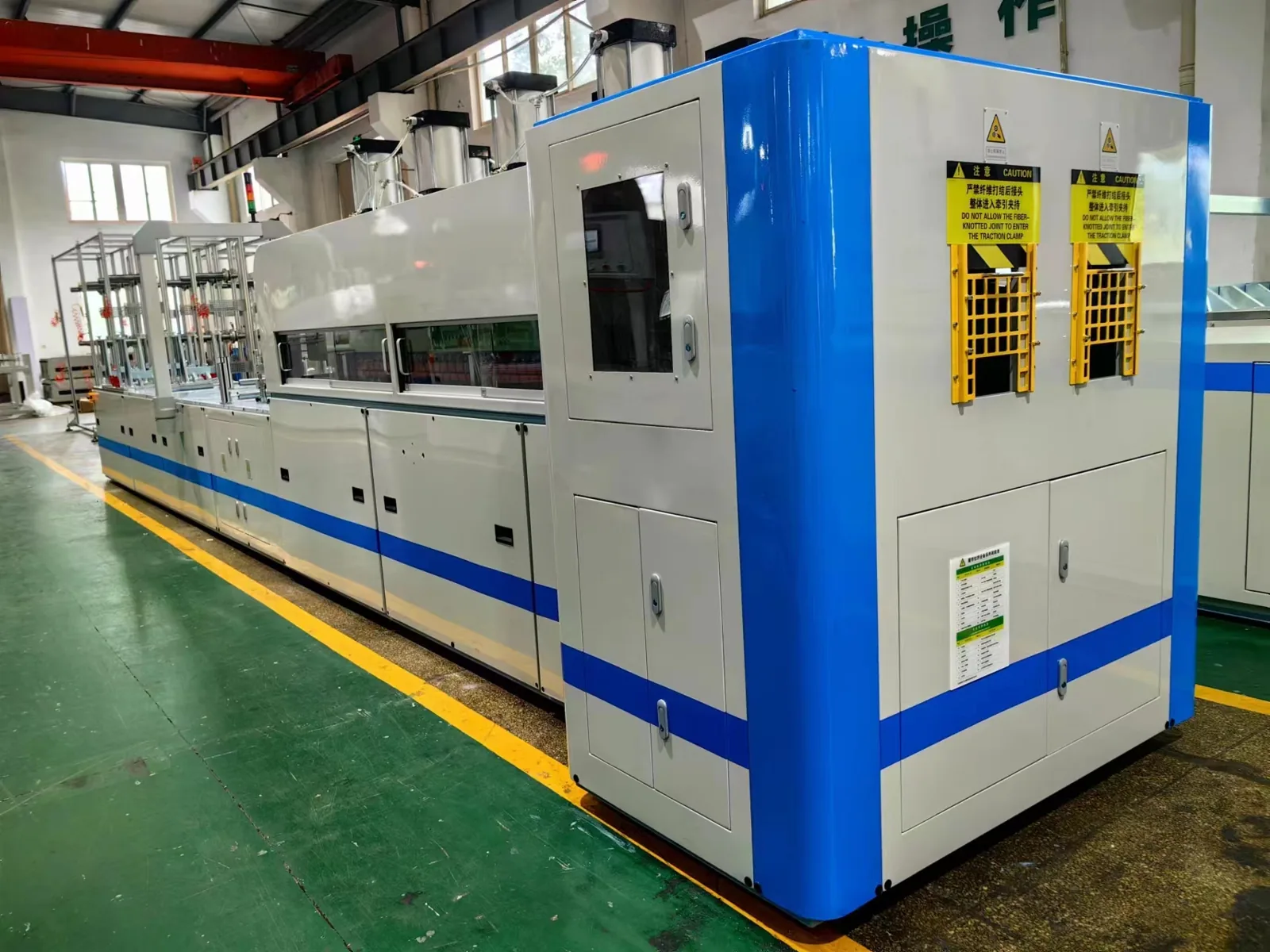
Enclosed line for solar frame profiles: creel frames on the left, guarded pullers at the right.
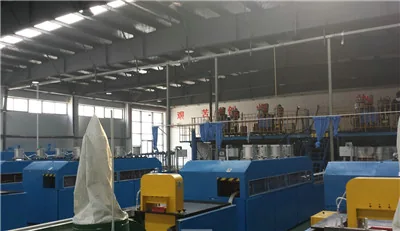
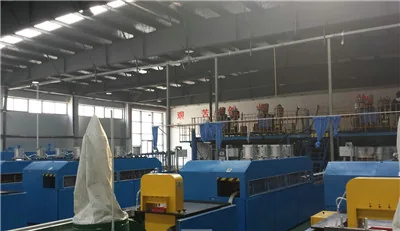
Polyurethane pultrusion lines in a production hall; the injection and metering units sit at the die end.
Which stations make up a solar frame pultrusion line?
| Station | Purpose on a frame line | Include in the RFQ |
|---|---|---|
| Roving creel | Feeds unidirectional glass; add mat or veil positions only if the section design uses them | Positions, roving tex, tension control, mat or veil stations if any |
| 2K metering and mixing | Doses polyol and isocyanate at a fixed ratio | Ratio range, resin demand at minimum, normal and maximum speed, component conditioning |
| Injection box | Closed impregnation at the die entry | Chamber drawing for each cavity, pressure and temperature sensors, purge and cleaning method |
| Heated die | Cures the frame section | Cavity count, heating zones, setpoint range, mandrels for hollow chambers |
| Puller | Caterpillar or hydraulic clamp pulling (EPTA) | Pads shaped to the frame section and limits on marks on visible faces |
| Cut-off saw | Cuts the profile to frame length | Length tolerance, square or miter cut, dust extraction |
| Secondary machining | Miter, drainage, mounting and grounding holes from the frame drawing | Which operations are in the line scope and which belong to the frame plant |
| Coating | Covestro and BASF both pair the frame with a water-borne coating | Whether a coating line is quoted, or the boundary to a separate coating supplier |
For interfaces, FAT, installation and training shared by every line, review the complete pultrusion production line
How many dies and cavities does a frame section need?
The frame section belongs to the module design: glass slot, hollow chamber, mounting flange and hole pattern. Long and short sides may use different sections, and each section needs its own die. Frame height also changes stiffness. Pander and Jaeckel report that the stiffness of current frames, 28 to 35 mm high, is considerably lower than that of older frames of 40 mm and above, so fix the section with the module engineer before the die is designed.
If the quotation proposes a multi-cavity die that pulls two or more frame profiles at once, ask how resin is fed to each cavity, whether each cavity has its own pressure measurement, and what happens to the other cavities when one strand breaks. Agree what counts as a scrap length for each cavity before the trial.
Buying finished frame profiles by drawing rather than a line? Review polyurethane pultruded profiles
How are frame corners, holes and coating handled?
Aluminum frame practice is well documented in patents. SolarWorld describes miter-cut profiles joined by corner connectors, with drainage holes drilled or punched into the hollow chambers. Zep Solar describes a toothed corner key inserted into the hollow, with a tool head pressing indentations into the profile to lock it, and notes that the corner key may also provide an electrical bonding path between frame members. A pultruded frame needs its own answer to each of these points. Ask the frame designer how corners will be joined: crimped, bonded, screwed or pinned. Run corner trials on pultruded sections before adopting the aluminum method. Confirm whether any bonding requirement applies to the frame in the module's safety design.
Both published PU frame systems include a water-borne coating, so the coating is part of the frame specification. Name the coating supplier, surface preparation, film checks and who applies it. Cutting and drilling glass fiber composites also needs dust extraction and tools suited to the material.
For tooling and dust control on secondary operations, see the cutting, drilling and joining guide
Which module tests must a composite frame support?
Qualification applies to the module, with the frame in it. IEC 61215-1 lays down design qualification requirements for terrestrial modules for long-term operation in open-air climates, and states that test results are not a quantitative prediction of module lifetime. IEC 61730-1 sets construction requirements for safe electrical and mechanical operation, with testing in IEC 61730-2. The module maker and its test laboratory run these tests. The frame line supplies production frames for them.
| Document | Level | Published scope | What the frame line supplies |
|---|---|---|---|
| IEC 61215-1:2021 and IEC 61215-2 | Module | Design qualification and type approval; 2,400 Pa is the IEC 61215-2 minimum load (Pander and Jaeckel) | Frames from the production die and resin for test modules |
| IEC 61730-1:2023 and IEC 61730-2 | Module | Construction and testing for electrical, fire and mechanical safety | Material and flammability data for the frame |
| IEC 61701:2020 | Module | Salt mist corrosion test sequences | Frames with the production coating |
| IEC 62716:2013 | Module | Ammonia corrosion test sequences | Frames with the production coating |
| T/CPIA 0081-2024 | Frame (China group standard) | Glass fiber reinforced composite frames for PV modules; Liu et al. prepared test specimens to it | Specimens cut from production frames; full text not reviewed here |
| TÜV SÜD PPP 58208A | Resin material | Mechanical, physical, flame retardant and heat resistance testing of Covestro's resin | The resin supplier's certificate, which does not approve a module |
RFQ, trial and acceptance
| Item | What to state | Why it matters |
|---|---|---|
| Frame drawings | Each section with tolerances, glass slot, hole pattern and visible faces | Die design and puller pads |
| Module data | Module size, glass thickness, target load ratings and the IEC tests planned | Section stiffness and test frame quantity |
| Resin system | PU grade and supplier, mix ratio, pot life, TDS and SDS | Metering, injection box and die heating |
| Reinforcement | Roving grades and any mat or veil | Creel layout |
| Output | Frames per year, profile meters per section, shifts | Number of lines and cavities |
| Cut and machining | Length tolerance, miter or square cut, holes in line or offline | Saw and machining scope |
| Corner method | Corner key type or bonding method | Corner trials and machining |
| Coating | Coating system and who applies it | Scope boundary |
| Site | Power, compressed air, isocyanate storage, extraction | Plant services and permits |
- 01
Freeze section and resin
Buyer
Approve the frame drawings, the PU system and the reinforcement schedule in writing.
- 02
Approve die and chamber drawings
Buyer and tooling supplier
Review the die, mandrels and injection chamber for each cavity, with heating zones and sensor positions.
- 03
Verify metering
Equipment builder
Check mix ratio and output at the agreed operating points with a collection test or equivalent method before reinforcement is threaded.
- 04
Run the FAT
Equipment builder
Run each section at the agreed speed and length, logging zone temperatures, chamber pressure, pull force and ratio, and cut to frame length.
- 05
Inspect and assemble
Buyer
Measure labeled samples against the drawing, machine holes and miters, and assemble trial corners with the chosen method.
- 06
Build test modules
Buyer and test laboratory
Supply production-route frames to the module test program, and extend acceptance to each further section with its own trial record.
How pultrx reviews solar frame line enquiries
Sources and further reading
- Covestro: Sustainable PU composite frame, breaking through for solar panel frames (2022 story)
Archived copy of 2026-04-12; the publisher site was under maintenance on 2026-11-08. Describes the frame as fixing and sealing the module and strengthening it, aluminum profiles as the dominant frame material, an axial tensile strength more than 7 times that of a typical aluminum alloy, modules with the PU composite frame passing salt mist (cited as IEC 61701) and IEC 62716:2013 ammonia testing, reduced PID with a non-metal frame, and a two-component waterborne PU coating for the frame. Supplier statements.
- Covestro press release (2023-05-25): Covestro receives polyurethane certificate for solar composite frames from TÜV SÜD
Archived copy of 2023-12-10. States that the frames are made of Baydur resin reinforced with glass fiber through a pultrusion process, and that testing under TÜV SÜD technical specification PPP 58208A evaluated mechanical properties, substrate physical properties, flame retardant grades and heat resistance of the resin.
- Covestro: Baydur PUL polyurethane resins for pultrusion (brochure, 2022 edition)
Archived copy of 2024-06-29. Lists a 2K dosing and mixing machine, an injection box for fiber impregnation and a standard pultrusion line; proposes a 1 m die with 3 to 6 heating zones up to 230 °C; gives up to 3 m/min at 3 mm wall thickness after start-up for its own systems, and states that users must test suitability.
- BASF news release (2024-03-21): CHINAPLAS 2024, BASF unveils photovoltaic frame co-created with Worldlight
Describes a module frame of glass fiber-reinforced polyurethane composite with a water-borne coating and states an 85% reduction in product carbon footprint compared with aluminum frames. Supplier statement; the release does not name the forming process.
- Liu Yi et al. (2025), Plastics Science and Technology 53(10):66-70: Effect of different resin matrices on mechanical properties of glass fiber reinforced composite frame
Peer-reviewed journal (Chinese). States that PV composite frames are made by pultrusion with unidirectional continuous glass fiber, generally about 70 to 80% by mass; compares vinyl ester, polyurethane, acrylic-polyurethane and modified polyurethane matrices; prepares specimens to T/CPIA 0081-2024; attributes property differences mainly to matrix compactness and fiber-matrix interface bonding.
- Strauss et al. (2023), Polymers 15(6):1544: Pressure development in a closed injection pultrusion process with multiple chamber geometries
Peer-reviewed study. The short pot life of highly reactive resin systems moves impregnation from the open bath to a closed injection and impregnation chamber; of the variables studied, viscosity had the greatest effect on pressure development.
- IEC 61215-1:2021: Terrestrial PV modules, design qualification and type approval, Part 1: Test requirements
Abstract reviewed on the Estonian standards body listing (IEC webstore entry 68594 shows the same edition, 2021-02-23). Requirements for modules suitable for long-term operation in open-air climates; test results are not a quantitative prediction of module lifetime.
- IEC 61730-1:2023: Photovoltaic (PV) module safety qualification, Part 1: Requirements for construction
Edition 3.0, 2023-09-13. Construction requirements for safe electrical and mechanical operation, covering prevention of electrical shock, fire hazards and personal injury; IEC 61730-2 defines testing.
- IEC 61701:2020: Photovoltaic (PV) modules, salt mist corrosion testing
Edition 3.0, 2020-06-11. Test sequences for the resistance of PV modules to corrosion from salt mist containing chloride.
- IEC 62716:2013: Photovoltaic (PV) modules, ammonia corrosion testing
Edition 1.0, 2013-06-27. Test sequences for the resistance of PV modules to ammonia.
- Pander and Jaeckel (2025), PV-Symposium Proceedings 2: The increasing importance of the substructure for PV modules under high mechanical loads
Fraunhofer CSP. Gives 2,400 Pa as the IEC 61215-2 minimum load, reports that the mechanical stiffness of current frames (28 to 35 mm height) is considerably lower than older frames (40 mm and above), and concludes that load testing requires the correct substructure.
- US 9,057,540 B2 (SolarWorld Industries Thueringen): Frame for a solar module
Describes aluminum frames of miter-cut profiles joined by corner connectors, with drainage holes drilled or punched into the hollow chambers.
- US 2014/0102997 A1 (Zep Solar): Photovoltaic module frame
Describes a corner key with teeth engaging the hollow of adjacent profiles, a tool head that creates indentations to engage the teeth, and the corner key as a possible electrical bonding path between frame members.
- EPTA: Technical principles of pultrusion
Caterpillar take-off units or hydraulic clamps; reinforcement wetted in a bath or by injection in the mould.
Questions buyers ask
Can an existing polyester pultrusion line make polyurethane solar frames?
The puller and saw may be reusable, but Covestro lists a 2K dosing and mixing machine and an injection box for PU pultrusion, and the die heating must suit the PU system. Have the existing line reviewed against the PU resin supplier's requirements.
Which standards apply to a composite solar frame?
Module standards such as IEC 61215 and IEC 61730 apply to the module that uses the frame, with IEC 61701 and IEC 62716 where salt mist or ammonia exposure is specified. In China, T/CPIA 0081-2024 covers glass fiber composite frames. The module maker runs these tests.
How fast does a PU frame line run?
Covestro gives up to 3 m/min at 3 mm wall thickness after start-up for its own Baydur PUL systems and states that users must test suitability. Base capacity on a witnessed trial of your section.
How are corners of a pultruded frame joined?
Aluminum frames commonly use corner keys pressed into the hollow. For a pultruded section, confirm the method with the frame designer and run corner trials before ordering the machining scope.
Does pultrx sell a solar frame pultrusion line from stock?
No. Solar frame line enquiries are reviewed as projects, with machines and injection equipment from the builders named in the quotation and dies and preform tooling from the Henan Zhongsheng factory.
Summary
What is a solar panel frame pultrusion line?
A solar panel frame pultrusion line makes module frame profiles from glass fiber and resin in place of extruded aluminum; in the resin supplier examples cited, the resin is a two-component polyurethane. The core is a PU pultrusion line (metering and mixing unit, injection box, heated die, puller and cut-off saw), with corners, holes, coating and the module tests specified around it.
- Resin route
- Two-component polyurethane through a 2K dosing and mixing machine and an injection box, as Covestro lists for PU pultrusion
- Speed reference
- Covestro gives up to 3 m/min at 3 mm wall thickness after start-up for its own Baydur PUL systems; base capacity on a witnessed trial of your section
- Module standards
- IEC 61215 and IEC 61730 on the module, IEC 61701 and IEC 62716 where salt mist or ammonia exposure is specified, T/CPIA 0081-2024 in China; the module maker runs these tests
- Corners
- Joining method confirmed with the frame designer and proven in corner trials before the machining scope is ordered
- Existing PE line
- Puller and saw may be reusable; metering, injection box and die heating are reviewed against the PU resin supplier's requirements
- Built by
- Machines and any resin injection unit: the partner equipment factory named in the quotation. Dies and preform tooling: Henan Zhongsheng, partner factory, or the partner die shop named in the quotation
- Supplied as
- A pultrx project proposal listing every station and every item quoted separately; no catalogue line, no list price, and no output figure without a trial record
Published by pultrx, an integrated pultrusion technology provider working with Henan Zhongsheng as a partner factory. This is a buyer planning guide; the manufacturer confirms project specifications in writing.
Ready to move from reading to a scoped quotation?
Request a line proposal