
Technical review: Yunkun Gong, Pultrusion Engineer, pultrx
Which pultrusion machine manufacturers in India publish specifications?
The builders below publish their own product pages. The table copies what each page states, in the builder's units, as reviewed on 8 November 2026. It is a reading aid and not a complete list: marketplace directories show more sellers in Gujarat and Maharashtra, most without a specification table. A catalogue figure does not show what a machine achieves on your profile.
| Builder and location | Machine types on its website | Published pull force | Other published figures |
|---|---|---|---|
| Ashirvad Industries, Chhatral, Gandhinagar district, Gujarat (Ahmedabad area) | Reciprocating hydraulic with pneumatic mechanical grippers (AIHP-PNGR); reciprocating hydraulic with vertical hydraulic platen clamping (AIHP-HGR); caterpillar | PNGR 8,000 to 16,000 kgf; HGR 10,000 to 20,000 kgf; caterpillar 1,000 to 4,000 kgf | Pulling speed 2.4 to 70 m/h (60 m/h at the top of the HGR range); 800 mm puller stroke; 6 to 9 PID heating zones; caterpillar 0.02 to 4.0 m/min; also lists creels, resin bath, resin injection system, section cutter and dies |
| SVS Hydraulics, Jeedimetla, Hyderabad, Telangana | Pultrusion machines and ancillary items; GFRP rebar straight, mesh and bent lines | Not published on its website | States it has built pultrusion machines since 2002; also lists filament winding machines and hydraulic presses |
| Devanshi Hydromatic, Vadodara, Gujarat | Pultrusion machine, model DEMHP-PNGR-06 | 6,000 kgf | 2 grippers of 500 mm; 700 mm stroke; die clamping area 800 × 1,000 mm; 3 to 4 kW |
| Paradise Industries, Ahmedabad, Gujarat | Pultrusion machines with hydraulic actuating gripper; accessories | Capacity written as 6 to 30 tons | Power consumption written as 8 to 30 hp |
| Megha Engineering, Waluj MIDC, Aurangabad, Maharashtra | FRP/GFRP rebar machine | Not published | No specification table on its rebar machine page |
Indian profile makers are a separate group. Innovate Materials in Hyderabad, for example, presents itself as a manufacturer of pultruded grating, structural profiles and GRP rebar, and its website shows no machine range. Before you compare offers, ask each Indian supplier whether it builds the machine in its own shop or resells one.
Convert before you compare
Builders in Europe, the US and China are compared field by field in pultrusion machine manufacturers worldwide
How do an Indian builder and an imported line compare?
Neither route suits every plant. The case for each is below. Then put both offers on the same sheet, in the same units.
Reasons to buy from an Indian builder
- You can visit the builder's shop and its running customer lines without international travel.
- Service engineers and spare parts are in the country and in your time zone.
- Pricing and payment are in rupees, with no exchange-rate exposure.
- A domestic purchase carries no basic customs duty or Social Welfare Surcharge. GST applies on both routes.
- Under EPCG, capital goods sourced from a domestic manufacturer carry a specific export obligation 25% lower than imports (FTP 2023, para 5.04(d)).
- Some Indian builders publish full model tables. Ashirvad Industries does, which makes a first screening easier.
Reasons to consider an imported complete line
- One contract can cover machine, die, preform tooling, resin route and start-up, so the acceptance trial tests the whole combination.
- Some builders abroad publish servo-driven pulling and force classes above those on the Indian pages reviewed here.
- Die corrections after the first trial go back to the factory that designed the die and the tooling around it.
- Under EPCG, imported capital goods, spares, moulds and dies enter at zero customs duty against an export obligation.
- You can hold the equipment to a factory acceptance trial on your profile before it ships.
| Item | Get in writing | Why it matters |
|---|---|---|
| Pull force | Force per puller and in tandem, in kN, at your planned running speed | Sets the largest section, die length and resin system the line can run |
| Clamping type | Mechanical gripper or hydraulic platen, clamping length and width | Ashirvad Industries recommends grippers for thin-wall hollow profiles and direct hydraulic platens for thick, flat or wide profiles |
| Die clamping area and heating | Clamping area, number of heating zones, controller type and accuracy | Long or thick dies need more zones with independent control |
| Electrical supply | Supply voltage measured at your transformer secondary, 50 Hz, connected load | Motors, heaters, power pack and control transformer must match your supply |
| Die, tooling and resin route | Who designs the die and preform, who reviews the formulation, who runs the trial | Most first-line risk sits in the combination of machine, die and resin |
| Acceptance trials | FAT and SAT on your profile and resin, duration and pass criteria | A demonstration profile proves little about yours |
| Warranty and spares | Named warranty party for each item, spare parts list and where it is stocked | Decides who answers when a pump or controller fails |
| Commissioning and training | Who comes to your site, for what scope, and what is handed over | Defines how your operators learn the line |
| Tariff item (imports) | Seller's proposed tariff item, confirmed by your broker or an advance ruling | Classification sets the duty rate |
Before you sign an import contract, work through the seven-point contract checklist for buying from China
What duties and charges make up the import landing cost?
Classification is your declaration to Indian Customs. The HS code on the seller's invoice is only a proposal. A pultrusion machine forms reinforced plastics into profiles. That points to heading 8477: machinery for working rubber or plastics or for making products from these materials, not specified elsewhere in Chapter 84. The candidate tariff items are 8477 59 00 (other machinery for moulding or otherwise forming) and 8477 80 90 (other machinery). Heading 8479, machines with individual functions not specified elsewhere, is the usual alternative argument.
Section XVI Note 4 of the tariff classifies interconnected units that together perform one clearly defined function under the heading for that function. Ask your broker whether creels, resin bath, die heating, puller and saw shipped as one line can be declared that way. If the duty at stake justifies it, apply for an advance ruling: under the 2021 regulations, applicants in Gujarat, Maharashtra, Telangana, Karnataka and Tamil Nadu file with the Customs Authority for Advance Rulings in Mumbai, and applicants in northern and eastern states with Delhi.
| Component | How it is set | Rate or source |
|---|---|---|
| Assessable value | Transaction value plus transport, loading, handling and insurance up to the customs station where the goods are cleared | No rate; base for duty (Customs Valuation Rules 2007 as amended; JNCH Public Notice 132/2017) |
| Basic customs duty (BCD) | Standard rate for the tariff item unless an exemption notification sets a lower effective rate | 7.5% for every heading 8477 tariff item and the 8479 items checked (CBIC Customs Tariff, Chapter 84, as on 30.06.2024); check the current tariff and notifications |
| Social Welfare Surcharge (SWS) | 10% of the aggregate customs duties | Finance Act 2018, section 110(3) |
| IGST | Integrated tax on imports at the rate in the IGST schedule | 18% for heading 8477 (Schedule II, entry 462) and heading 8479 (entry 464), Notification 9/2025-Integrated Tax (Rate) as amended to 30.04.2026 |
| Trade-remedy duties | Anti-dumping or safeguard duty only where notified for the goods and origin | Not reviewed in this guide; ask your broker to check |
| Ocean freight and insurance | Forwarder and insurer quotations; both also enter the assessable value | No figures given |
| Port, broker, inland transport and rigging | Terminal and broker charges, haulage to the plant, unloading and placing | No figures given |
| Site works and utilities | Foundations, power at your supply voltage, compressed air, cooling water | Same item on both routes |
| Commissioning and training | Scope, attendance and charges in the seller's quotation | Same item on both routes |
Rate stack at the tariff rates above
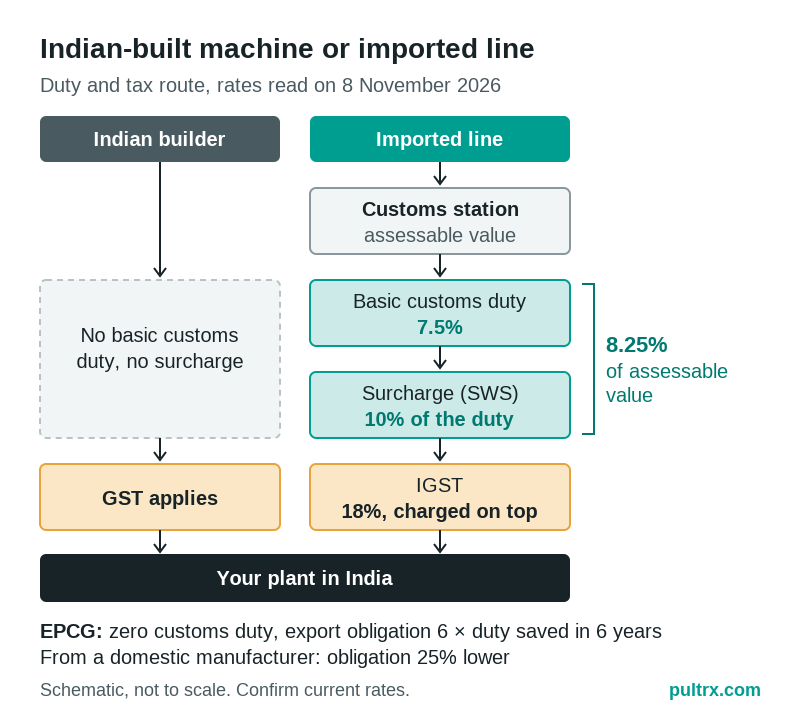
Name the port of discharge in the contract: valuation runs to the customs station of clearance. JNPA at Nhava Sheva states that it handles around 50% of the containerised cargo across India's major ports.
For what sets the machine budget itself, see pultrusion machine price
How does the EPCG scheme work for pultrusion equipment?
The Export Promotion Capital Goods scheme in Chapter 5 of the Foreign Trade Policy 2023 allows capital goods for pre-production, production and post-production at zero customs duty. For physical exports, IGST and compensation cess on those imports are also exempt. Capital goods under the scheme include spares, moulds, dies, jigs, fixtures and tools, so a die set can sit in the same authorisation as the machine.
- Export obligation: six times the duties, taxes and cess saved, fulfilled in six years from the date the authorisation is issued (para 5.01(b)).
- Average export obligation: the obligation is over and above your average exports of the same and similar products in the preceding three licensing years, and the average must be met every financial year (para 5.04(c)).
- Indigenous sourcing: capital goods bought from a domestic manufacturer carry a specific export obligation 25% lower (para 5.04(d)).
- Validity: the authorisation is valid for imports for 24 months from issue and cannot be revalidated (para 5.01(d)).
- Actual user condition: the imported goods stay with the authorisation holder until the export obligation discharge certificate is granted (para 5.03).
EPCG suits a plant that will export pultruded profiles or GFRP bars. If your output is for the Indian market only, plan on paying duty. Either way you need an Importer-Exporter Code from DGFT, which the policy makes mandatory for any import (para 2.05).
What voltage and safety rules apply in India?
India's supply frequency is 50 Hz. The BIS voltage standard IS 12360 notes that 50 Hz is virtually the only frequency used in the country. The nominal three-phase voltage is still in transition on paper. IS 12360 adopted 230/400 V, and Amendment No. 4 of 2011 put the changeover from 240/415 V in abeyance. Both values therefore appear in Indian documents. The Delhi regulator's draft schedule, for example, gives three-phase four-wire supply at 400 V for loads up to 200 kW, with larger loads on 11 kV.
Measure the voltage at your transformer secondary, write it into the order, and ask for motors, heaters, the hydraulic power pack and the control transformer to match it. A pultrx quotation configures the line voltage to the supply stated in the order.
On conformity, the Machinery and Electrical Equipment Safety (Omnibus Technical Regulation) Order, 2024 would have brought listed machinery under BIS certification. After two amendment orders in 2025, the Ministry of Heavy Industries rescinded it with immediate effect on 14 January 2026 (S.O. 239(E)). On 8 November 2026 the withdrawal was still the latest entry on the ministry's machinery page. Imports must still meet the domestic laws, technical specifications and safety norms that apply to Indian-made goods (FTP 2023, para 2.03), so ask your electrical contractor which inspection your state requires before the line is energised.
Status changes
How does IS 18256 affect GFRP rebar line specifications?
Much Indian interest in pultrusion lines comes from GFRP rebar. BIS published IS 18256:2023 for solid round GFRP bars for concrete reinforcement, covering straight bars, cut lengths or coils, and bent bars or stirrups with an external surface enhancement. BIS describes use in low-risk elements such as slab-on-grade, drainage structures, fences and manhole covers, refers road, highway and bridge use to Indian Roads Congress guidance, and requires the engineer in charge to certify that the elements meet serviceability, strength and durability targets.
For a rebar plant the line specification starts from the bar standard: number of strands, surface deformation or sand coating, factory bends and the lot testing your customers will ask for. In India, SVS Hydraulics and Megha Engineering list GFRP rebar machines on their websites.
What a rebar line adds to a profile line is set out in the GFRP rebar line scope guide
What are the steps to import and commission a line?
- 01
Fix the product and output brief
Buyer
Profile drawings or bar sizes, resin system, target output and the standard the product must meet, for example IS 18256 for GFRP bars.
- 02
Choose the duty route
Buyer and customs adviser
Decide between EPCG and a duty-paid import, confirm your IEC, agree the proposed tariff item and apply for an advance ruling if the classification is uncertain.
- 03
Line proposal and quotation
pultrx
Layout, machines, dies, tooling and resin route. The quotation names the equipment builder, the warranty party for each item, the supply voltage and the commissioning scope.
- 04
Factory acceptance trial
Equipment builder and pultrx; buyer or appointed inspector attends
Run your profile on your resin to the agreed pass criteria before the line ships.
- 05
Shipment and customs clearance
Seller and the buyer's customs broker
Bill of lading, commercial invoice cum packing list and bill of entry are the mandatory import documents (FTP 2023, para 2.06(b)); add EPCG papers if used.
- 06
Site preparation
Buyer
Foundations, power at the voltage stated in the order, compressed air, cooling water and resin storage, ready before the line arrives.
- 07
Installation, commissioning and training in India
pultrx commissioning team
At your site, with scope, attendance and duration as agreed in the quotation.
- 08
Site acceptance and handover
Buyer and pultrx
Repeat the trial at your plant and hand over drawings, the spare parts list and the trial record.
Plan FAT, SAT and operator training with the commissioning and training guide
What does pultrx quote for a plant in India?
pultrx is an integrated pultrusion technology provider in Shanghai; its partner factory Henan Zhongsheng makes pultrusion dies and line tooling in Xinxiang, China. For a plant in India, pultrx quotes a complete line: machines from the partner equipment factory named in the quotation, dies and preform tooling from the Henan Zhongsheng factory, formulation and raw-material review, and installation, commissioning and training at your site in India. Everything is scoped in one quotation, which names the builder and the warranty party for each item, and the line voltage is configured to the supply you specify in the order.
If an Indian-built machine fits your profile and budget better, the checklist above still applies. Dies and tooling can also be quoted on their own for a machine bought elsewhere, matched to its clamping area and heating layout.
See what a complete line package covers on the pultrusion production line page
Sources and further reading
- Ashirvad Industries: pultrusion machine product pages (gripper, platen clamping and caterpillar types) and contact page
Reviewed 2026-11-08. AIHP-PNGR 8,000 to 16,000 kgf and AIHP-HGR 10,000 to 20,000 kgf reciprocating models, caterpillar 1,000 to 4,000 kgf, pulling speed 2.4 to 70 m/h, 800 mm stroke, 6 to 9 PID heating zones, gripper versus platen guidance; address Chhatral, Gandhinagar district, Gujarat.
- SVS Hydraulics Pvt. Ltd: pultrusion machines, rebar machines and contact pages
Reviewed 2026-11-08. Pultrusion machines and ancillary items, GFRP rebar straight, mesh and bent lines; states pultrusion machines built since 2002; works at Jeedimetla, Hyderabad. No pull force or speed figures on the pages read.
- Devanshi Hydromatic: pultrusion machine page
Reviewed 2026-11-08. Model DEMHP-PNGR-06, 6,000 kgf pulling capacity, two 500 mm grippers, 700 mm stroke, 800 × 1,000 mm die clamping area, 3 to 4 kW; Vadodara, Gujarat.
- Paradise Industries: pultrusion machine page
Reviewed 2026-11-08. Hydraulic actuating gripper machines, capacity written as 6 to 30 tons, power consumption 8 to 30 hp; Ahmedabad, Gujarat.
- Megha Engineering: FRP/GFRP rebar machine page
Reviewed 2026-11-08. Lists an FRP/GFRP rebar machine without a specification table; Waluj MIDC, Aurangabad, Maharashtra.
- Innovate Materials: company website
Reviewed 2026-11-08. Hyderabad GRP product manufacturer listing pultruded grating, structural profiles and rebar; no machine range on the site. Cited as an example of a profile maker.
- CBIC: Customs Tariff, Section XVI, Chapter 84 (tariff as on 30.06.2024, the chapter file linked from the CBIC tariff index as on 30.06.2025)
Reviewed 2026-11-08. Heading 8477 text and tariff items 8477 10 00 to 8477 90 00, each at a standard rate of 7.5%; heading 8479 items checked at 7.5%; Section XVI Notes 3 and 4 on composite machines and functional units.
- Finance Act, 2018, section 110: Social Welfare Surcharge (text as reproduced by referencer.in)
Sub-section (3): surcharge at ten per cent on the aggregate of duties, taxes and cesses levied under section 12 of the Customs Act. Secondary reproduction; the official India Code copy could not be opened on 2026-11-08.
- Notification No. 9/2025-Integrated Tax (Rate), 17 September 2025, as amended to 30 April 2026 (ICAI GST & Indirect Taxes Committee updated copy)
Schedule II at 18%: entry 462, heading 8477; entry 464, heading 8479. Compiled copy of the gazette notification.
- Jawaharlal Nehru Custom House: Public Notice 132/2017, amendment to Customs Valuation Rules (Notification 91/2017-Customs (N.T.))
Valuation under section 14 of the Customs Act and the 2007 Valuation Rules; transaction value includes costs up to the place of importation, defined as the customs station of clearance.
- CBIC Notification 01/2021-Customs (N.T.): Customs Authority for Advance Rulings Regulations, 2021
Jurisdiction table: the Mumbai authority hears applications from Gujarat, Maharashtra, Telangana, Karnataka, Tamil Nadu and other southern and western states; Delhi hears northern and eastern states and applicants outside India. Copy hosted by ACMA.
- DGFT: Foreign Trade Policy 2023, Chapter 5, EPCG Scheme (revised v1.2.2)
Paras 5.01 (zero duty, IGST exemption for physical exports, capital goods include spares, moulds and dies, export obligation 6 times duty saved in 6 years, 24-month validity), 5.03 actual user condition, 5.04(c) average export obligation, 5.04(d) 25% lower specific obligation for indigenous sourcing.
- DGFT: Foreign Trade Policy 2023, Chapter 2, General provisions regarding imports and exports (revised v1.2.2)
Para 2.03(a) domestic laws and safety norms apply to imports; 2.05 IEC mandatory for any import; 2.06(b) mandatory import documents; 2.31 second-hand capital goods not otherwise listed are Free.
- Ministry of Heavy Industries: Order S.O. 239(E), 14 January 2026, withdrawal of the Machinery and Electrical Equipment Safety (Omnibus Technical Regulation) Order, 2024
Gazette of India, Extraordinary, 16 January 2026: rescinds S.O. 3649(E) of 28 August 2024 with immediate effect.
- Ministry of Heavy Industries: Machinery and electrical equipment notifications page
Checked 2026-11-08: the withdrawal (16-01-2026) is the latest entry, after the Second Amendment Order, 2025 (13-11-2025).
- BIS: IS 12360:1988, Voltage bands for electrical installations including preferred voltages and frequency, with Amendment No. 4 (November 2011)
Foreword 0.11: 50 Hz is virtually the only frequency used in India. Amendment 4: the changeover of system voltage from 240/415 to 230/400 kept in abeyance. Public.Resource.Org copy of the BIS standard.
- Delhi Electricity Regulatory Commission: Draft order on schedule of charges and procedure under the Supply Code Regulations, 2017
Draft. Low tension three-phase four-wire supply at 400 V for loads above 10 kW up to 200 kW/215 kVA; high tension at 11 kV above 100 kW/108 kVA.
- BIS: Standard of the week, IS 18256:2023 Solid round GFRP bars for concrete reinforcement (19 December 2023)
Scope, low-risk applications (slab-on-grade, drainage structures, fences, manhole covers), Indian Roads Congress guidance for roads and bridges, engineer-in-charge certification.
- Jawaharlal Nehru Port Authority: Overview
Around 50% of containerised cargo across India's major ports; five container terminals.
Questions buyers ask
Who are the pultrusion machine manufacturers in India?
Builders with their own product pages include Ashirvad Industries (Chhatral, Gujarat), Devanshi Hydromatic (Vadodara), Paradise Industries (Ahmedabad) and SVS Hydraulics (Hyderabad), with Megha Engineering (Aurangabad) listing a GFRP rebar machine. Marketplace directories list more sellers in Gujarat and Maharashtra. The table in this guide gives only what each builder publishes, as reviewed on 8 November 2026.
What HS code is used to import a pultrusion machine into India?
Heading 8477 is the likely heading, with 8477 59 00 or 8477 80 90 as candidate tariff items and heading 8479 as the usual alternative. Customs assesses your declaration. For certainty before shipment, apply to the Customs Authority for Advance Rulings: Mumbai for applicants in Gujarat, Maharashtra, Telangana and the south, Delhi for the north and east.
What import duty applies to a pultrusion machine in India?
The CBIC tariff (as on 30.06.2024) lists a 7.5% standard rate of basic customs duty for heading 8477 items. Social Welfare Surcharge adds 10% of the customs duty, and IGST is 18% for heading 8477. Exemption notifications, EPCG and later Finance Acts can change what you pay, so confirm the current rates with your customs broker.
Can I import a pultrusion line under EPCG?
If you hold an EPCG authorisation and the goods are not on the scheme's negative list (Appendix 5F), capital goods including spares, moulds and dies enter at zero customs duty against an export obligation of six times the duty saved within six years. Buying from a domestic manufacturer lowers the specific obligation by 25%.
Does a pultrusion machine need BIS certification for import into India?
The Omnibus Technical Regulation Order that would have required BIS certification for listed machinery was rescinded on 14 January 2026. Imports must still meet the domestic laws and safety norms that apply to Indian-made goods. Ask your broker to check whether any component in the bill of materials falls under another order.
Who builds the machines in a pultrx line, and who services them in India?
The machines are built by the specialist equipment builder named in the quotation, which is the warranty party for its machines. Dies and line tooling come from the Henan Zhongsheng factory. The quotation names each party. Installation, commissioning and training take place at your site in India, with scope, attendance and duration agreed in the quotation.
Summary
Should I buy from pultrusion machine manufacturers in India or import a line?
Neither route suits every plant: pultrusion machine manufacturers in India build hydraulic and caterpillar machines in Gujarat, Telangana and Maharashtra, with service, spare parts and rupee pricing in the country, while an imported complete line can put machine, die, preform tooling, resin route and start-up in one contract. Put both offers on one checklist, in the same units.
- Indian builders
- Ashirvad Industries, SVS Hydraulics, Devanshi Hydromatic and Paradise Industries; Megha Engineering lists a GFRP rebar machine
- Tariff heading
- 8477 is the likely heading; 8479 is the usual alternative argument
- Import duty
- 7.5% basic customs duty, 10% Social Welfare Surcharge on that duty, then 18% IGST; confirm current rates
- EPCG
- Zero customs duty against an export obligation of six times the duty saved, within six years
- Electrical supply
- 50 Hz; both 415 V and 400 V appear, so measure at your transformer secondary
- BIS certification
- Omnibus Technical Regulation Order rescinded on 14 January 2026; domestic safety norms still apply
Published by pultrx, an integrated pultrusion technology provider working with Henan Zhongsheng as a partner factory. This is a buyer planning guide; the manufacturer confirms project specifications in writing.
Ready to move from reading to a scoped quotation?
Request a line proposal for a plant in India