
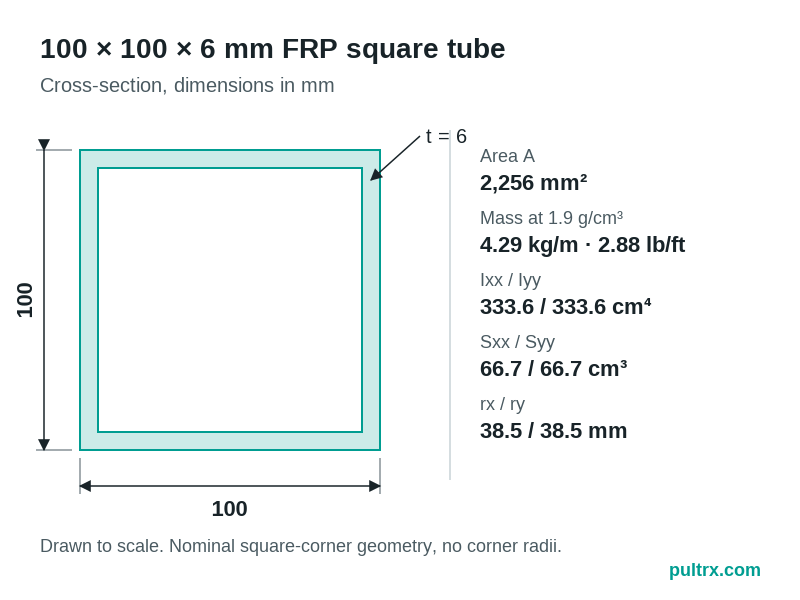
Geometry & mass
What are the nominal section properties and unit weight of 100 × 100 × 6 mm FRP square tube?
Calculated from nominal millimetre dimensions before corner-fillet deductions, alongside equivalent S275 steel and 6063-T6 aluminum masses.
| Property | Metric value | Imperial / engineering note |
|---|---|---|
| Nominal designation | 100 × 100 × 6 mm | Side × side × wall (mm) |
| Inch equivalent | 3.94 × 3.94 × 0.24 in | Converted at 25.4 mm/in |
| Cross-sectional area (A) | 2,256 mm² | 3.50 in² (sharp-corner nominal) |
| FRP unit mass (at 1.9 g/cm³) | 4.29 kg/m | 2.88 lb/ft planning weight |
| Same-size S275 carbon steel mass | 17.71 kg/m | FRP saves 76% deadweight |
| Same-size 6063-T6 aluminum mass | 6.09 kg/m | FRP is 30% lighter than aluminum |
| Major-axis second moment (Ixx) | 333.6 cm⁴ | 8.01 in⁴ |
| Minor-axis second moment (Iyy) | 333.6 cm⁴ | Ratio Ixx / Iyy = 1.00 |
| Elastic section modulus (Sxx / Syy) | 66.7 / 66.7 cm³ | Extreme-fibre bending modulus |
| Radius of gyration (rx / ry) | 38.5 / 38.5 mm | Used for axial column slenderness L/r |
| External perimeter | 400 mm | Surface veil and coating perimeter |
| Tooling status | Existing die (partner factory) | Pultruded to order; no new die charge |
Nominal square-corner area reaches 2,256 mm², putting unit weight at 4.29 kg/m (2.88 lb/ft) at 1.9 g/cm³ against 17.71 kg/m in carbon steel and 6.09 kg/m in structural aluminum; a 6.0 m post weighs just 25.7 kg (56.7 lb). Symmetric bending properties equal Ixx = Iyy = 333.6 cm⁴ and Sxx = Syy = 66.7 cm³.
Radius of gyration rises to rx = ry = 38.5 mm, allowing unbraced column lifts of 3.0 to 3.8 m while keeping KL/rx below 100. Because outer flat-wall ratio reaches b/t = 16.7, check local wall buckling alongside Euler global buckling under high axial compression, or step up to our existing 100 × 100 × 8 mm die (b/t = 12.5) for heavily loaded lower-tier columns.
Preliminary stiffness check
How much does 100 × 100 × 6 mm FRP square tube deflect across typical spans under E17 and E23 grades?
Euler bending estimates about the major axis (Ixx = 333.6 cm⁴) under a 1.5 kN/m uniform line load, comparing EN 13706-2 Grade E17 (17 GPa) and Grade E23 (23 GPa) minimum longitudinal moduli.
| Simple span (L) | Deflection at 1.5 kN/m (E17: 17 GPa) | Deflection at 1.5 kN/m (E23: 23 GPa) | Load for L/180 (E23) | Load for L/240 (E23) |
|---|---|---|---|---|
| 2.0 m (2000 mm) | 5.5 mm (L/363) | 4.1 mm (L/491) | 4.09 kN/m | 3.07 kN/m |
| 3.0 m (3000 mm) | 27.9 mm (L/108) | 20.6 mm (L/145) | 1.21 kN/m | 0.91 kN/m |
| 4.0 m (4000 mm) | 88.2 mm (L/45) | 65.2 mm (L/61) | 0.51 kN/m | 0.38 kN/m |
Supporting a 1.5 kN/m uniform load, simple-span Euler deflection measures 4.1 to 5.5 mm across 2.0 m (L/491 to L/367 for 23 to 17.2 GPa) and 20.6 to 27.6 mm across 3.0 m, climbing to 65.2 to 87.1 mm on an unbraced 4.0 m span. For pedestrian boardwalk stringers and fan-deck headers, 2.0 to 2.8 m bay centers deliver stiff, bounce-free performance.
At a 2.0 m span (span-to-depth ratio 20), web shear deformation adds roughly 8 to 11 percent to Euler bending sag; on shorter 1.4 m transfer headers, shear contribution approaches 16 percent. Seat incoming beams concentrically over column tops or across paired side gussets so eccentric moment does not overstress a single 6 mm face.
Run point loads, cantilevers or shear-corrected Timoshenko checks in the FRP section properties & deflection calculator, and verify material grade testing in EN 13706 & ASTM D3917 profile standards.
Fasteners & mating tolerances
How are base anchors, crush tubes and heavy beam nodes built on 100 × 100 × 6 mm tube?
Use the 88 × 88 mm clear cavity for concealed duplex-stainless (2205) or hot-dip galvanized internal cruciform or box base stubs (84 to 86 mm outer envelope with 5 mm corner bevels, 250 to 300 mm embedment) or external socket shoes (103 mm internal pocket) pinned with two pairs of M16 bolts on a 50 mm face gauge. Two bolts across a 100 mm face leave 25 mm to outer corners, sitting right beside the thick corner radii.
Whenever M16 bolts clamp heavy double-channel girders or diagonal brace gussets across the 100 mm post, fit 88 mm long stainless or thick-wall FRP crush spacers inside the bore to carry bolt preload without dishing the 6 mm walls. On tidal boardwalk piles or splash-zone caps, seal internal plug cavities with closed-cell foam or grout ports so marine water cannot stagnate inside.
| Interface or feature | Drawing & assembly specification |
|---|---|
| Internal clear bore | 88 × 88 mm nominal flat-to-flat; fits 84 to 86 mm fabricated stainless base stubs with 5 mm corner chamfers. |
| Twin-bolt face pattern | 50 mm transverse gauge across the 100 mm face for M16 bolts (17.5 mm holes), leaving 25 mm corner edge distance. |
| Internal crush spacers | 88 mm cut spacer tubes around M16 through-bolts prevent inward flexing of b/t = 16.7 walls under clamping preload. |
| Heavier wall upgrade | 100 × 100 × 8 mm and 100 × 100 × 9 mm also run on existing partner dies when lower-story axial loads govern. |
Shop tooling, diamond blades and bonded-bolted joint layout: how to cut, drill and join fiberglass profiles.
Request a quotation
Get a quotation for 100 × 100 × 6 mm FRP square tube
Send your cut lengths, piece count, resin system and destination port. An engineer in Shanghai reviews the schedule and replies in English.
Prefer email or chat? Write to inquiry@pultrx.com or message Celion on WhatsApp. Drawings can follow by email.
Service environments & resin selection
Where do multi-cell cooling towers and marine structures deploy 100 × 100 × 6 mm tube?
Large industrial cooling towers use 100 × 100 × 6 mm square tube for primary fan-deck columns, wide-bay basin posts and motor-bridge support legs where 75 mm posts would require extra intermediate bracing tiers. Because a 6.0 m column weighs 25.7 kg versus 106 kg in steel, crews erect framing over sensitive basin floors and tidal marshes using light A-frames instead of barge cranes.
Along coastal piers, desalination intake screens, mangrove boardwalks and offshore chemical offloading jetties, vinyl ester 100 × 100 × 6 mm posts and pile caps resist chloride pitting, sulfate attack and marine borers simultaneously. Specify UV-inhibited vinyl ester with synthetic veil for salt-spray zones, and include fire-retardant requirements on your purchase order for petrochemical towers.
Compare adjacent metric dies
Other metric square tube engineering sheets
- 50 × 50 × 5 mm FRP square tubeStandard 50 mm metric hollow box section (40 × 40 mm bore, 1.71 kg/m, Ixx 30.8 cm⁴) for industrial guardrail posts, top rails and treatment-plant barriers.
- 50 × 50 × 6 mm FRP square tubeThick-wall 6 mm metric 50 mm square tube (38 × 38 mm bore, 2.01 kg/m, Ixx 34.7 cm⁴) engineered for bored ladder stringers and high-load chemical stanchions.
- 60 × 60 × 4 mm FRP square tubeHigh-efficiency 60 mm thin-wall square tube (52 × 52 mm bore, 1.70 kg/m, Ixx 47.1 cm⁴) giving 53 percent more stiffness than 50 × 50 × 5 mm at equal mass.
- 75 × 75 × 6 mm FRP square tubePrimary 75 mm metric structural box column (63 × 63 mm bore, 3.15 kg/m, Ixx 132.4 cm⁴) for field-erected cooling towers, stair newels and platform bents.
- 80 × 80 × 5 mm FRP square tubeModular 80 mm metric box section (70 × 70 mm bore, 2.85 kg/m, Ixx 141.2 cm⁴) matching 75 × 75 × 6 mm section modulus at 9.5 percent lower weight.
- 100 × 100 × 8 mm FRP square tubeHeavy-wall 100 × 100 × 8 mm square hollow section (5.59 kg/m, Ixx 418.4 cm⁴) built for cooling tower columns, boardwalk substructure posts and high-bearing bolted joints.
- 150 × 150 × 4.5 mm FRP square tubeWide-profile, thin-wall 150 × 150 × 4.5 mm square hollow section (4.98 kg/m, Ixx 925.0 cm⁴) engineered for RF-transparent radome spaceframes, architectural louvres and long-span light enclosures.
FAQ
What do buyers ask before ordering 100 × 100 × 6 mm FRP square tube?
When should lower-tier columns step up from 100 × 100 × 6 mm to 100 × 100 × 8 mm?
Keep 100 × 100 × 6 mm on upper tiers, walkway bents and flexural headers where global stiffness governs, and switch lower-tier high-load columns to 100 × 100 × 8 mm when local flange buckling (b/t = 16.7 versus 12.5) or M16 pin-bearing shear controls. Because both share an identical 100 × 100 mm outside profile, external gussets and clamps stay unchanged across tiers.
Can 100 × 100 × 6 mm FRP tube replace treated timber or steel on coastal boardwalks?
Yes, paired as two-post bents with twin-channel headers at 2.4 to 3.0 m bay spacing, 100 × 100 × 6 mm posts eliminate creosote/CCA leaching and chloride rust while allowing manual carry-in installation across fragile wetlands. Check uplift and wave-slam shear at pile-to-cap sockets using duplex 2205 stainless hardware.
How close to the end of a 100 × 100 × 6 mm column can M16 base bolts sit?
Maintain at least 45 to 50 mm (roughly 3d) from the sawn tube end to the first M16 bolt centerline so longitudinal shear-out cannot split the unidirectional roving toward the cut edge. Vertical spacing between successive bolt rows along the axis should stay at 65 mm (4d) or greater.
Does Henan Zhongsheng and the partner-factory network cut custom column lengths?
Yes, 100 × 100 × 6 mm is pultruded to order on an existing die and cut to exact project story heights or container-optimized lengths up to 11.8 m. Bundled lots ship with mill identification tags and the dimensional and mechanical inspection records listed on your order schedule.
How do thermal length changes affect long marine utility trestles?
Over a 40 °C seasonal temperature swing, a 30 m continuous FRP trestle stringer shifts by roughly 10 to 13 mm longitudinally. Detail slotted expansion bearings with PTFE or elastomeric slide pads every 18 to 24 m so columns are not pulled out of plumb.