
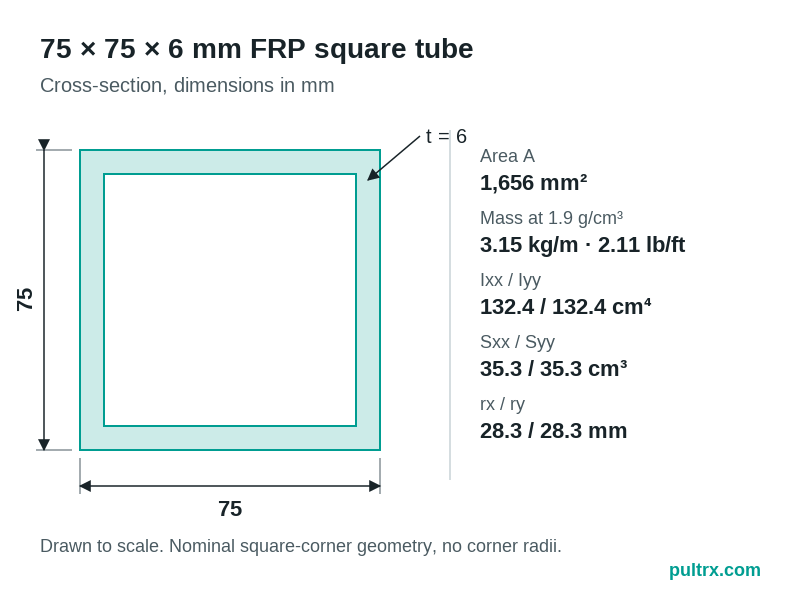
Geometry & mass
What are the nominal section properties and unit weight of 75 × 75 × 6 mm FRP square tube?
Calculated from nominal millimetre dimensions before corner-fillet deductions, alongside equivalent S275 steel and 6063-T6 aluminum masses.
| Property | Metric value | Imperial / engineering note |
|---|---|---|
| Nominal designation | 75 × 75 × 6 mm | Side × side × wall (mm) |
| Inch equivalent | 2.95 × 2.95 × 0.24 in | Converted at 25.4 mm/in |
| Cross-sectional area (A) | 1,656 mm² | 2.57 in² (sharp-corner nominal) |
| FRP unit mass (at 1.9 g/cm³) | 3.15 kg/m | 2.11 lb/ft planning weight |
| Same-size S275 carbon steel mass | 13.00 kg/m | FRP saves 76% deadweight |
| Same-size 6063-T6 aluminum mass | 4.47 kg/m | FRP is 30% lighter than aluminum |
| Major-axis second moment (Ixx) | 132.4 cm⁴ | 3.18 in⁴ |
| Minor-axis second moment (Iyy) | 132.4 cm⁴ | Ratio Ixx / Iyy = 1.00 |
| Elastic section modulus (Sxx / Syy) | 35.3 / 35.3 cm³ | Extreme-fibre bending modulus |
| Radius of gyration (rx / ry) | 28.3 / 28.3 mm | Used for axial column slenderness L/r |
| External perimeter | 300 mm | Surface veil and coating perimeter |
| Tooling status | Existing die (partner factory) | Pultruded to order; no new die charge |
Cross-sectional area is 1,656 mm², producing a nominal mass of 3.15 kg/m (2.11 lb/ft) at 1.9 g/cm³ versus 13.00 kg/m for steel SHS 75×75×6 and 4.47 kg/m for aluminum, cutting crane and manual rigging weight by 76 percent over steel. Symmetric properties reach Ixx = Iyy = 132.4 cm⁴ and Sxx = Syy = 35.3 cm³.
Radius of gyration equals rx = ry = 28.3 mm across all axes, giving predictable bi-axial column stability in braced tower grids without weak-axis penalties. Note that our metric size chart lists both 75 × 75 × 6 mm and 76 × 76 × 6 mm (3 in equivalent) on separate existing dies, so confirm exact external shoe dimensions before fabrication.
Preliminary stiffness check
How much does 75 × 75 × 6 mm FRP square tube deflect across typical spans under E17 and E23 grades?
Euler bending estimates about the major axis (Ixx = 132.4 cm⁴) under a 1.2 kN/m uniform line load, comparing EN 13706-2 Grade E17 (17 GPa) and Grade E23 (23 GPa) minimum longitudinal moduli.
| Simple span (L) | Deflection at 1.2 kN/m (E17: 17 GPa) | Deflection at 1.2 kN/m (E23: 23 GPa) | Load for L/180 (E23) | Load for L/240 (E23) |
|---|---|---|---|---|
| 1.5 m (1500 mm) | 3.5 mm (L/427) | 2.6 mm (L/577) | 3.85 kN/m | 2.89 kN/m |
| 2.2 m (2200 mm) | 16.3 mm (L/135) | 12.0 mm (L/183) | 1.22 kN/m | 0.92 kN/m |
| 3.0 m (3000 mm) | 56.2 mm (L/53) | 41.6 mm (L/72) | 0.48 kN/m | 0.36 kN/m |
Carrying a 1.2 kN/m uniform beam load, mid-span Euler deflection stays low at 2.6 to 3.5 mm over 1.5 m (L/577 to L/432 across 23 to 17.2 GPa) and 12.0 to 16.1 mm at 2.2 m, before rising to 41.6 to 55.6 mm on an unbraced 3.0 m span. Platform stringers and tower lintels typically work on 1.5 to 2.2 m bay modules.
Used as a braced cooling-tower column with horizontal girts and X-braces every 1.8 to 2.2 m vertically, effective slenderness KL/rx sits between 64 and 78, keeping global buckling well below local wall wrinkling thresholds. Center beam reactions concentrically via saddle brackets or double-sided gussets to minimize secondary P-delta moments.
Run point loads, cantilevers or shear-corrected Timoshenko checks in the FRP section properties & deflection calculator, and verify material grade testing in EN 13706 & ASTM D3917 profile standards.
Fasteners & mating tolerances
How are column base shoes, splices and beam seats detailed on 75 × 75 × 6 mm tube?
Anchor column bases inside fabricated 316 or duplex 2205 stainless box shoes (77 to 78 mm internal square pocket, 200 to 250 mm deep) shimmed or epoxy-grouted flush and cross-bolted with two orthogonal M12 or M16 bolts staggered 65 mm vertically so bolt holes never intersect in one plane. Alternatively, telescope a 60 × 60 mm FRP square tube (with 1.5 mm nominal per-side structural adhesive gap) across vertical column splices.
At horizontal beam-to-column nodes, sandwich the 75 mm post between paired 75 × 75 × 8 mm FRP clip angles or 6 mm flat gusset plates using M12 through-bolts fitted with 63 mm internal tubular spacers. Confirm whether hardware is metric 75 mm or imperial 76.2 mm before ordering pre-welded base sockets, since a 75.0 mm tube leaves an extra 1.2 mm gap inside 3-inch boots.
| Interface or feature | Drawing & assembly specification |
|---|---|
| Internal clear bore | 63 × 63 mm nominal flat-to-flat; accepts 60 × 60 mm FRP square tube as an internal bonded column splice core. |
| External pedestal shoe | 77 to 78 mm internal pocket × 220 mm deep stainless socket, cross-pinned with orthogonal M12 or M16 bolts at 65 mm stagger. |
| 75 mm vs 76 mm die check | Confirm 75.0 mm true metric versus 76.2 mm (3 in) mating brackets; both sizes exist on separate partner dies. |
| Beam-seat bearing | Seat double-channel headers on continuous column caps or opposing web gussets to load all vertical walls evenly. |
Shop tooling, diamond blades and bonded-bolted joint layout: how to cut, drill and join fiberglass profiles.
Request a quotation
Get a quotation for 75 × 75 × 6 mm FRP square tube
Send your cut lengths, piece count, resin system and destination port. An engineer in Shanghai reviews the schedule and replies in English.
Prefer email or chat? Write to inquiry@pultrx.com or message Celion on WhatsApp. Drawings can follow by email.
Service environments & resin selection
Where does 75 × 75 × 6 mm square tube serve in cooling towers and platforms?
Counterflow and plume-abated cooling towers erect multi-level structural grids on 1.8 × 1.8 m or 2.0 × 2.0 m bays using 75 × 75 × 6 mm vertical posts tied together with 75 × 75 × 6 mm diagonal angles and twin-channel headers. Industrial access fabricators also specify it for stair-tower corner columns, heavy mezzanine newel posts and cantilevered gate hinge pillars.
Fire-retardant isophthalic polyester (typically formulated for ASTM E84 Class 1 / Flame Spread Index 25 or project equivalents) is standard across power-plant and petrochemical cooling towers, while vinyl ester handles brackish or seawater makeup cycles. When multi-tier towers exceed 8 to 10 m height or bay spans push toward 3.0 m, step primary columns up to 100 × 100 × 6 mm square tube.
Compare adjacent metric dies
Other metric square tube engineering sheets
- 50 × 50 × 5 mm FRP square tubeStandard 50 mm metric hollow box section (40 × 40 mm bore, 1.71 kg/m, Ixx 30.8 cm⁴) for industrial guardrail posts, top rails and treatment-plant barriers.
- 50 × 50 × 6 mm FRP square tubeThick-wall 6 mm metric 50 mm square tube (38 × 38 mm bore, 2.01 kg/m, Ixx 34.7 cm⁴) engineered for bored ladder stringers and high-load chemical stanchions.
- 60 × 60 × 4 mm FRP square tubeHigh-efficiency 60 mm thin-wall square tube (52 × 52 mm bore, 1.70 kg/m, Ixx 47.1 cm⁴) giving 53 percent more stiffness than 50 × 50 × 5 mm at equal mass.
- 80 × 80 × 5 mm FRP square tubeModular 80 mm metric box section (70 × 70 mm bore, 2.85 kg/m, Ixx 141.2 cm⁴) matching 75 × 75 × 6 mm section modulus at 9.5 percent lower weight.
- 100 × 100 × 6 mm FRP square tubeHeavy 100 mm metric box column and header (88 × 88 mm bore, 4.29 kg/m, Ixx 333.6 cm⁴) offering 2.52 times the stiffness of 75 × 75 × 6 mm square tube.
- 100 × 100 × 8 mm FRP square tubeHeavy-wall 100 × 100 × 8 mm square hollow section (5.59 kg/m, Ixx 418.4 cm⁴) built for cooling tower columns, boardwalk substructure posts and high-bearing bolted joints.
- 150 × 150 × 4.5 mm FRP square tubeWide-profile, thin-wall 150 × 150 × 4.5 mm square hollow section (4.98 kg/m, Ixx 925.0 cm⁴) engineered for RF-transparent radome spaceframes, architectural louvres and long-span light enclosures.
FAQ
What do buyers ask before ordering 75 × 75 × 6 mm FRP square tube?
What is the practical difference between 75 × 75 × 6 mm and 76 × 76 × 6 mm FRP tube?
Mechanically, 76 × 76 × 6 mm adds roughly 4 percent more bending inertia and mimics 3 × 3 × 1/4 in imperial steel sockets, whereas 75 × 75 × 6 mm matches true metric modular drawings and European/Asian anchor shoes. Because our partner factories hold existing dies for both, order whichever matches your fabricated steel hardware pockets.
Can column splices be placed mid-story in a multi-level cooling tower?
Place splices 300 to 450 mm above a horizontal girt-and-brace node where column bending moment is minimal, using a 500 mm long bonded and cross-bolted 60 × 60 mm internal FRP sleeve plus external fishplates if uplift tension occurs. End-mill or precision-saw abutting 75 mm column ends square so axial compression bears directly wall-to-wall.
Why stagger orthogonal M12 or M16 bolts vertically inside a baseplate socket?
Passing two perpendicular bolts at the exact same elevation forces one bolt to miss the centerline or intersect the other, removing four holes from a single cross-section plane. Separating the east-west bolt and north-south bolt by 60 to 75 mm vertically preserves net column area and lets both bolts sit dead-center on the 75 mm faces.
How much can one worker lift when handling 6 m cooling-tower posts?
A 6.0 m stick of 75 × 75 × 6 mm FRP square tube weighs roughly 18.9 kg (41.7 lb), compared with 78 kg in carbon steel. That fourfold weight reduction speeds upper-deck erection inside confined tower cells without heavy crane picks.
How should axial column allowable loads be determined for final engineering sign-off?
Combine Euler global buckling (using project longitudinal modulus and unbraced lift length), shear-flexibility interaction and local flange buckling with appropriate composite safety and environmental knockdown factors (such as ASCE Pre-Standard for Pultruded FRP Structures or Eurocode CEN/TS 19101). Lot coupon properties for your specified resin system are confirmed on the order schedule.