
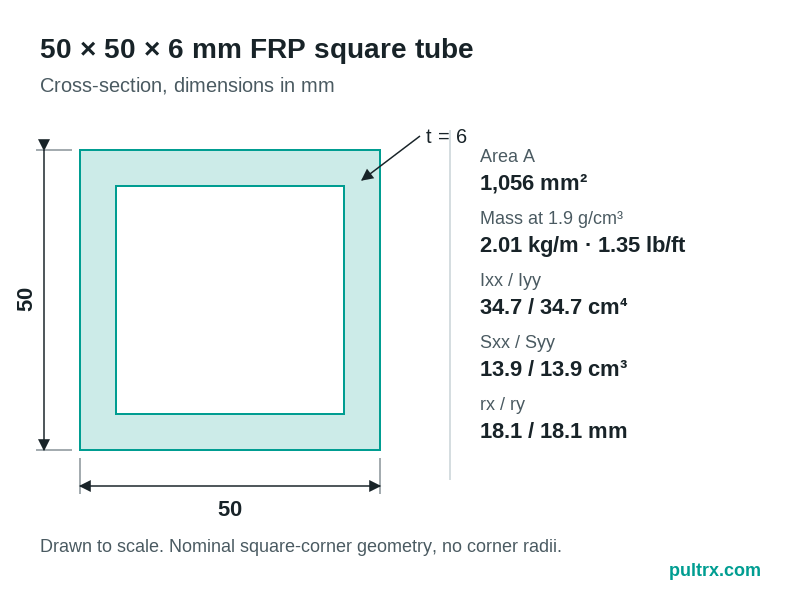
Geometry & mass
What are the nominal section properties and unit weight of 50 × 50 × 6 mm FRP square tube?
Calculated from nominal millimetre dimensions before corner-fillet deductions, alongside equivalent S275 steel and 6063-T6 aluminum masses.
| Property | Metric value | Imperial / engineering note |
|---|---|---|
| Nominal designation | 50 × 50 × 6 mm | Side × side × wall (mm) |
| Inch equivalent | 1.97 × 1.97 × 0.24 in | Converted at 25.4 mm/in |
| Cross-sectional area (A) | 1,056 mm² | 1.64 in² (sharp-corner nominal) |
| FRP unit mass (at 1.9 g/cm³) | 2.01 kg/m | 1.35 lb/ft planning weight |
| Same-size S275 carbon steel mass | 8.29 kg/m | FRP saves 76% deadweight |
| Same-size 6063-T6 aluminum mass | 2.85 kg/m | FRP is 30% lighter than aluminum |
| Major-axis second moment (Ixx) | 34.7 cm⁴ | 0.83 in⁴ |
| Minor-axis second moment (Iyy) | 34.7 cm⁴ | Ratio Ixx / Iyy = 1.00 |
| Elastic section modulus (Sxx / Syy) | 13.9 / 13.9 cm³ | Extreme-fibre bending modulus |
| Radius of gyration (rx / ry) | 18.1 / 18.1 mm | Used for axial column slenderness L/r |
| External perimeter | 200 mm | Surface veil and coating perimeter |
| Tooling status | Existing die (partner factory) | Pultruded to order; no new die charge |
Calculated at 1.9 g/cm³ on square-corner geometry, area equals 1,056 mm² and mass is 2.01 kg/m (1.35 lb/ft) versus 8.29 kg/m in steel and 2.85 kg/m in aluminum. Section inertia increases to Ixx = Iyy = 34.7 cm⁴ (+12.7 percent over the 5 mm wall) with elastic section modulus Sxx = Syy = 13.9 cm³.
Radius of gyration sits at rx = ry = 18.1 mm, and the stocky 8.3 outer width-to-thickness ratio gives high resistance to local side-wall crushing and splitting around bored penetrations. Two opposed 6 mm webs provide 12 mm of combined composite bearing thickness for cross-pins and fluted ladder rungs.
Preliminary stiffness check
How much does 50 × 50 × 6 mm FRP square tube deflect across typical spans under E17 and E23 grades?
Euler bending estimates about the major axis (Ixx = 34.7 cm⁴) under a 1 kN/m uniform line load, comparing EN 13706-2 Grade E17 (17 GPa) and Grade E23 (23 GPa) minimum longitudinal moduli.
| Simple span (L) | Deflection at 1 kN/m (E17: 17 GPa) | Deflection at 1 kN/m (E23: 23 GPa) | Load for L/180 (E23) | Load for L/240 (E23) |
|---|---|---|---|---|
| 1.0 m (1000 mm) | 2.2 mm (L/453) | 1.6 mm (L/613) | 3.41 kN/m | 2.55 kN/m |
| 1.5 m (1500 mm) | 11.2 mm (L/134) | 8.3 mm (L/182) | 1.01 kN/m | 0.76 kN/m |
| 2.0 m (2000 mm) | 35.3 mm (L/57) | 26.1 mm (L/77) | 0.43 kN/m | 0.32 kN/m |
Evaluated under a heavier 1.0 kN/m reference line load, mid-span Euler deflection runs 1.6 to 2.2 mm at 1.0 m and 8.3 to 11.0 mm at 1.5 m (L/182 to L/136 across 23 to 17.2 GPa), reaching 26.1 to 34.9 mm at 2.0 m. At identical 0.8 kN/m loading, it trims deflection by roughly 11 percent relative to 50 × 50 × 5 mm.
On vertical access ladder stringers tied back to tank walls with stand-off brackets every 1.5 to 2.0 m, axial slenderness L/rx stays between 83 and 110 while twin stringers share climber loads. Keep stand-off bracket pitch closer near top cage transitions where cantilevered hoop weight adds eccentric moment.
Run point loads, cantilevers or shear-corrected Timoshenko checks in the FRP section properties & deflection calculator, and verify material grade testing in EN 13706 & ASTM D3917 profile standards.
Fasteners & mating tolerances
How do ladder rung penetrations and 38 mm internal plugs fit 50 × 50 × 6 mm tube?
When boring vertical ladder stringers on the neutral axis (25 mm centerline) to accept 25 to 30 mm fluted FRP rungs, a 28 to 30.5 mm hole still leaves 10 to 11 mm of unbroken flange+corner roving top and bottom, backed by 6 mm wall bearing against rung collars and structural epoxy fillets. Always step-drill with carbide or diamond hole saws on a rigid backing jig to prevent exit-side delamination.
Take care on splice drawings: internal clear opening shrinks from 40 × 40 mm (on 5 mm wall) down to 38 × 38 mm here. Solid splice bars or stainless baseplate spigots machined for 50 × 50 × 5 mm will jam at the mouth; specify 36.0 to 36.8 mm square plugs with 3.5 mm corner chamfers for 50 × 50 × 6 mm posts.
| Interface or feature | Drawing & assembly specification |
|---|---|
| Clear internal bore | 38 × 38 mm nominal flat-to-flat; machine internal splice spigots to 36 to 36.8 mm square with 3.5 mm corner bevels. |
| Ladder rung boring | 26 to 30 mm centerline holes at 280 to 300 mm pitch leave two 6 mm bearing walls for bonded and pinned rungs. |
| External hardware match | 50.0 × 50.0 mm outside profile accepts the exact same external saddle brackets and elbows as 50 × 50 × 5 mm. |
| Side-mount stanchions | Twin M12 bolts at 90 mm vertical centers with internal crush bushes transfer cantilevered post moments cleanly. |
Shop tooling, diamond blades and bonded-bolted joint layout: how to cut, drill and join fiberglass profiles.
Request a quotation
Get a quotation for 50 × 50 × 6 mm FRP square tube
Send your cut lengths, piece count, resin system and destination port. An engineer in Shanghai reviews the schedule and replies in English.
Prefer email or chat? Write to inquiry@pultrx.com or message Celion on WhatsApp. Drawings can follow by email.
Service environments & resin selection
Where do chemical plants and ladder builders prefer 50 × 50 × 6 mm over 5 mm wall?
Fixed vertical access ladders into underground sumps, brine storage tanks and cooling-tower basins use 50 × 50 × 6 mm square tube for twin stringers because bored rung sockets retain thicker shear ligaments and higher impact toughness. Around sulfuric acid dilution skids, electroplating lines and hydrochloric pickling baths, it serves as heavy-duty stanchion posts and compact instrument stands.
Specify vinyl ester resin with synthetic veil whenever splash or vapor contains strong mineral acids, caustic soda or hypochlorite oxidizers, and coat bored rung sockets thoroughly during assembly bonding. If horizontal beam stiffness rather than hole-bearing wall thickness is the bottleneck, 60 × 60 × 4 mm delivers 36 percent higher Ixx (47.1 cm⁴) at 15 percent less weight.
Compare adjacent metric dies
Other metric square tube engineering sheets
- 50 × 50 × 5 mm FRP square tubeStandard 50 mm metric hollow box section (40 × 40 mm bore, 1.71 kg/m, Ixx 30.8 cm⁴) for industrial guardrail posts, top rails and treatment-plant barriers.
- 60 × 60 × 4 mm FRP square tubeHigh-efficiency 60 mm thin-wall square tube (52 × 52 mm bore, 1.70 kg/m, Ixx 47.1 cm⁴) giving 53 percent more stiffness than 50 × 50 × 5 mm at equal mass.
- 75 × 75 × 6 mm FRP square tubePrimary 75 mm metric structural box column (63 × 63 mm bore, 3.15 kg/m, Ixx 132.4 cm⁴) for field-erected cooling towers, stair newels and platform bents.
- 80 × 80 × 5 mm FRP square tubeModular 80 mm metric box section (70 × 70 mm bore, 2.85 kg/m, Ixx 141.2 cm⁴) matching 75 × 75 × 6 mm section modulus at 9.5 percent lower weight.
- 100 × 100 × 6 mm FRP square tubeHeavy 100 mm metric box column and header (88 × 88 mm bore, 4.29 kg/m, Ixx 333.6 cm⁴) offering 2.52 times the stiffness of 75 × 75 × 6 mm square tube.
- 100 × 100 × 8 mm FRP square tubeHeavy-wall 100 × 100 × 8 mm square hollow section (5.59 kg/m, Ixx 418.4 cm⁴) built for cooling tower columns, boardwalk substructure posts and high-bearing bolted joints.
- 150 × 150 × 4.5 mm FRP square tubeWide-profile, thin-wall 150 × 150 × 4.5 mm square hollow section (4.98 kg/m, Ixx 925.0 cm⁴) engineered for RF-transparent radome spaceframes, architectural louvres and long-span light enclosures.
FAQ
What do buyers ask before ordering 50 × 50 × 6 mm FRP square tube?
Can 50 × 50 × 6 mm posts and 50 × 50 × 5 mm rails share one guardrail system?
Yes, pairing 50 × 50 × 6 mm vertical posts with lighter 50 × 50 × 5 mm horizontal top and knee rails is a common weight-saving detail because both share an identical 50 × 50 mm outside dimension for external tees and elbows. Simply mark the two wall thicknesses separately on your bill of materials so 36.5 mm base spigots go to the 6 mm posts.
What maximum hole diameter is practical through the centerline of a 50 × 50 × 6 mm stile?
Rung penetrations of 25 to 30 mm centered at 25 mm from either outer face are standard practice when a snug-fitting FRP rung is bonded and mechanically pinned inside the hole, restoring local compressive continuity. Unfilled open holes for bolts or conduit should stay at or below 17.5 mm (M16) so net tension flanges remain generous.
Does thicker 50 × 50 × 8 mm metric square tube exist if 6 mm is still tight?
Yes, our partner-factory die list also includes 50 × 50 × 8 mm (34 × 34 mm bore) for extreme shock-loaded bumpers, heavy insulation spacers and thick-wall machined bushings. For nearly all platform posts and ladder stringers, 6 mm wall satisfies bearing checks with lower mass.
How should ladder wall stand-off brackets attach to 50 × 50 × 6 mm stringers?
Wrap an FRP or 316 stainless U-clip around three faces of the 50 mm stringer rather than relying on a single-face shear bolt, and pass M10 or M12 bolts midway between rung holes (at least 100 mm clear of rung centers). That keeps fastener stress concentrations away from bored rung sockets.
Are non-conductive ladder stiles safe near energized busbars and switchgear?
Unpigmented or carbon-free E-glass pultruded profiles offer high dielectric resistance when clean and dry; avoid conductive carbon-black pigments on electrical-clearance structures and specify high-visibility yellow or orange resin. Request dielectric proof-test details on your order schedule whenever utility live-line rules apply.