
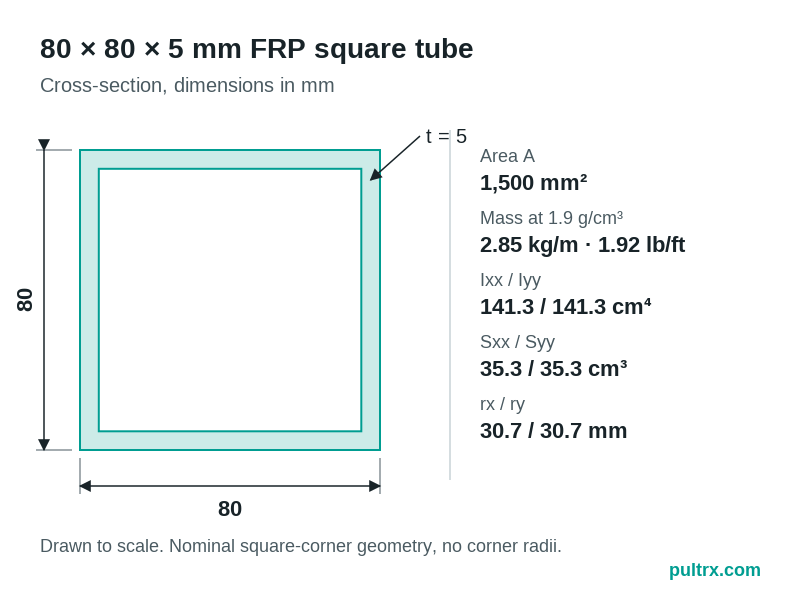
Geometry & mass
What are the nominal section properties and unit weight of 80 × 80 × 5 mm FRP square tube?
Calculated from nominal millimetre dimensions before corner-fillet deductions, alongside equivalent S275 steel and 6063-T6 aluminum masses.
| Property | Metric value | Imperial / engineering note |
|---|---|---|
| Nominal designation | 80 × 80 × 5 mm | Side × side × wall (mm) |
| Inch equivalent | 3.15 × 3.15 × 0.20 in | Converted at 25.4 mm/in |
| Cross-sectional area (A) | 1,500 mm² | 2.33 in² (sharp-corner nominal) |
| FRP unit mass (at 1.9 g/cm³) | 2.85 kg/m | 1.92 lb/ft planning weight |
| Same-size S275 carbon steel mass | 11.78 kg/m | FRP saves 76% deadweight |
| Same-size 6063-T6 aluminum mass | 4.05 kg/m | FRP is 30% lighter than aluminum |
| Major-axis second moment (Ixx) | 141.3 cm⁴ | 3.39 in⁴ |
| Minor-axis second moment (Iyy) | 141.3 cm⁴ | Ratio Ixx / Iyy = 1.00 |
| Elastic section modulus (Sxx / Syy) | 35.3 / 35.3 cm³ | Extreme-fibre bending modulus |
| Radius of gyration (rx / ry) | 30.7 / 30.7 mm | Used for axial column slenderness L/r |
| External perimeter | 320 mm | Surface veil and coating perimeter |
| Tooling status | Existing die (partner factory) | Pultruded to order; no new die charge |
At 1.9 g/cm³ on square-corner geometry, cross-sectional area equals 1,500 mm² and mass is 2.85 kg/m (1.92 lb/ft), compared with 11.77 kg/m in steel SHS 80×80×5 and 4.05 kg/m in aluminum. Symmetric axes yield Ixx = Iyy = 141.2 cm⁴ and elastic section modulus Sxx = Syy = 35.3 cm³.
Radius of gyration reaches rx = ry = 30.7 mm (+8.5 percent over 75 × 75 × 6 mm), improving long-column Euler stability per kilogram of material. Because the flat-wall slenderness ratio rises to b/t = 16.0, distribute concentrated pile-cap or saddle reactions across the full 80 mm width.
Preliminary stiffness check
How much does 80 × 80 × 5 mm FRP square tube deflect across typical spans under E17 and E23 grades?
Euler bending estimates about the major axis (Ixx = 141.3 cm⁴) under a 1.2 kN/m uniform line load, comparing EN 13706-2 Grade E17 (17 GPa) and Grade E23 (23 GPa) minimum longitudinal moduli.
| Simple span (L) | Deflection at 1.2 kN/m (E17: 17 GPa) | Deflection at 1.2 kN/m (E23: 23 GPa) | Load for L/180 (E23) | Load for L/240 (E23) |
|---|---|---|---|---|
| 1.5 m (1500 mm) | 3.3 mm (L/455) | 2.4 mm (L/616) | 4.11 kN/m | 3.08 kN/m |
| 2.2 m (2200 mm) | 15.2 mm (L/144) | 11.3 mm (L/195) | 1.30 kN/m | 0.98 kN/m |
| 3.0 m (3000 mm) | 52.7 mm (L/57) | 39.0 mm (L/77) | 0.51 kN/m | 0.39 kN/m |
Under a 1.2 kN/m uniform load, simple-span Euler deflection runs 2.4 to 3.3 mm at 1.5 m (L/616 to L/461 across 23 to 17.2 GPa) and 11.3 to 15.1 mm at 2.2 m (L/195 to L/146), reaching 39.0 to 52.1 mm at 3.0 m. Running solar purlins continuously over three or more 2.2 m support posts cuts peak mid-bay sag by more than half compared with simple-span sticks.
Over continuous interior supports where negative bending puts the bottom 5 mm face into compression right at the support saddle, fit a 100 to 120 mm long flat bearing pad so edge contact cannot crease the compressed wall. In high-wind coastal PV arrays, closed box torsion resists eccentric single-portrait panel uplift twist far better than open C-purlins.
Run point loads, cantilevers or shear-corrected Timoshenko checks in the FRP section properties & deflection calculator, and verify material grade testing in EN 13706 & ASTM D3917 profile standards.
Fasteners & mating tolerances
How do 70 mm telescopic splices and 80 mm modular brackets fit this profile?
The 70 × 70 mm nominal internal cavity pairs with 70 × 70 × 4 mm pultruded square tube (also an existing metric die in our partner network) as an inline telescopic purlin splice once outer parting flash and corners are lightly dressed for internal fillet clearance. Place purlin splices near quarter-span inflection points (roughly 0.21L from interior supports) on multi-span solar rails to keep splice bending moments minimal.
External 80 mm frame nodes use twin M10 or M12 bolts on a 45 to 50 mm transverse gauge across the 80 mm face (leaving 15 to 17.5 mm to outer corners, where corner roving reinforces the 5 mm webs) or wrap-around U-bolt saddle clamps over pile heads. Avoid single centered bolts tightened directly onto unsupported 80 mm flat centers without wide backing plates or internal sleeves.
| Interface or feature | Drawing & assembly specification |
|---|---|
| Internal clear bore | 70 × 70 mm nominal flat-to-flat; pairs with 70 × 70 × 4 mm metric tube for dressed + bonded inline splices. |
| Modular grid alignment | 80.0 × 80.0 mm outer profile matches standard 40 / 80 mm metric enclosure, gasket and panel modular pitches. |
| Saddle clamp seat | Use 80 mm wide × 100 mm long flat bearing saddles over support posts to engage both 5 mm vertical webs. |
| Twin-bolt face gauge | 45 to 50 mm transverse spacing across the 80 mm face places M10 or M12 bolts close to stiff box corners. |
Shop tooling, diamond blades and bonded-bolted joint layout: how to cut, drill and join fiberglass profiles.
Request a quotation
Get a quotation for 80 × 80 × 5 mm FRP square tube
Send your cut lengths, piece count, resin system and destination port. An engineer in Shanghai reviews the schedule and replies in English.
Prefer email or chat? Write to inquiry@pultrx.com or message Celion on WhatsApp. Drawings can follow by email.
Service environments & resin selection
Where does 80 × 80 × 5 mm tube outperform metal in PV mounting and AHU frames?
Ground-mount solar farms on saline soils, wastewater lagoon floating/over-basin PV canopies and chemical-plant rooftops specify 80 × 80 × 5 mm FRP square tube as continuous purlins and rafters where zinc-magnesium coated steel corrodes within years and anodized aluminum pits against wet alkaline dust. Zero grounding-bond jumpers are needed on the non-conductive FRP frame itself, simplifying module ground routing.
HVAC and cleanroom builders also construct large air-handling unit (AHU) penthouses and dehumidifier casings from 80 mm FRP box tubes to eliminate cold-bridge condensation without complex plastic thermal-break strips inside aluminum extrusions. Choose UV-stabilized isophthalic polyester for 25-year solar array exposures or fire-retardant resin for indoor mechanical rooms.
Compare adjacent metric dies
Other metric square tube engineering sheets
- 50 × 50 × 5 mm FRP square tubeStandard 50 mm metric hollow box section (40 × 40 mm bore, 1.71 kg/m, Ixx 30.8 cm⁴) for industrial guardrail posts, top rails and treatment-plant barriers.
- 50 × 50 × 6 mm FRP square tubeThick-wall 6 mm metric 50 mm square tube (38 × 38 mm bore, 2.01 kg/m, Ixx 34.7 cm⁴) engineered for bored ladder stringers and high-load chemical stanchions.
- 60 × 60 × 4 mm FRP square tubeHigh-efficiency 60 mm thin-wall square tube (52 × 52 mm bore, 1.70 kg/m, Ixx 47.1 cm⁴) giving 53 percent more stiffness than 50 × 50 × 5 mm at equal mass.
- 75 × 75 × 6 mm FRP square tubePrimary 75 mm metric structural box column (63 × 63 mm bore, 3.15 kg/m, Ixx 132.4 cm⁴) for field-erected cooling towers, stair newels and platform bents.
- 100 × 100 × 6 mm FRP square tubeHeavy 100 mm metric box column and header (88 × 88 mm bore, 4.29 kg/m, Ixx 333.6 cm⁴) offering 2.52 times the stiffness of 75 × 75 × 6 mm square tube.
- 100 × 100 × 8 mm FRP square tubeHeavy-wall 100 × 100 × 8 mm square hollow section (5.59 kg/m, Ixx 418.4 cm⁴) built for cooling tower columns, boardwalk substructure posts and high-bearing bolted joints.
- 150 × 150 × 4.5 mm FRP square tubeWide-profile, thin-wall 150 × 150 × 4.5 mm square hollow section (4.98 kg/m, Ixx 925.0 cm⁴) engineered for RF-transparent radome spaceframes, architectural louvres and long-span light enclosures.
FAQ
What do buyers ask before ordering 80 × 80 × 5 mm FRP square tube?
Should I specify 80 × 80 × 5 mm or 75 × 75 × 6 mm for a 2.2 m beam span?
For continuous purlins, modular 80 mm casings and corrosion-prone solar racks, 80 × 80 × 5 mm gives 6.6 percent lower deflection while saving 0.30 kg/m across long runs. Choose 75 × 75 × 6 mm (or 80 × 80 × 6 mm, also on an existing partner die) when heavy pin-connected column cleats or high local bearing pressures govern.
How should solar PV module clamps attach to an 80 × 80 × 5 mm FRP purlin?
Instead of relying on single-wall sheet screws under 25-year cyclic wind flutter, use wrap-around stainless saddle clamps, hooked J-bolts under the bottom face, or M8/M10 through-bolts with wide backing washers along the 80 mm flanges. Isolate anodized aluminum module frames from stainless hardware with EPDM or nylon washers where salt fog is heavy.
Where along a continuous solar table should 6 m purlins be spliced?
Offset splices roughly 400 to 500 mm away from interior pile posts (near the contraflexure zone of a 2.0 to 2.4 m bay) rather than directly over the post or at mid-span. A 400 mm internal 70 mm FRP sleeve bonded and pinned with two M10 bolts per side transfers shear cleanly across that low-moment point.
Does 80 × 80 × 6 mm exist if a project needs a 6 mm wall on an 80 mm grid?
Yes, our partner-factory metric size chart carries 80 × 80 × 3 mm, 4 mm, 5 mm and 6 mm on existing dies so wall thickness can scale with wind zone without changing 80 mm clamp tooling. Specify the wall thickness per wind-load zone on your order schedule.
Why do HVAC builders replace thermally broken aluminum penthouses with 80 mm FRP tube?
Pultruded fiberglass conducts heat at roughly 0.3 to 0.4 W/(m·K) throughout the entire wall section, eliminating cold spots at corner cast joints and fastener paths that cause casing sweat in chilled-water AHUs. At 2.85 kg/m, rooftop rigging weight remains lighter than aluminum subframes.