
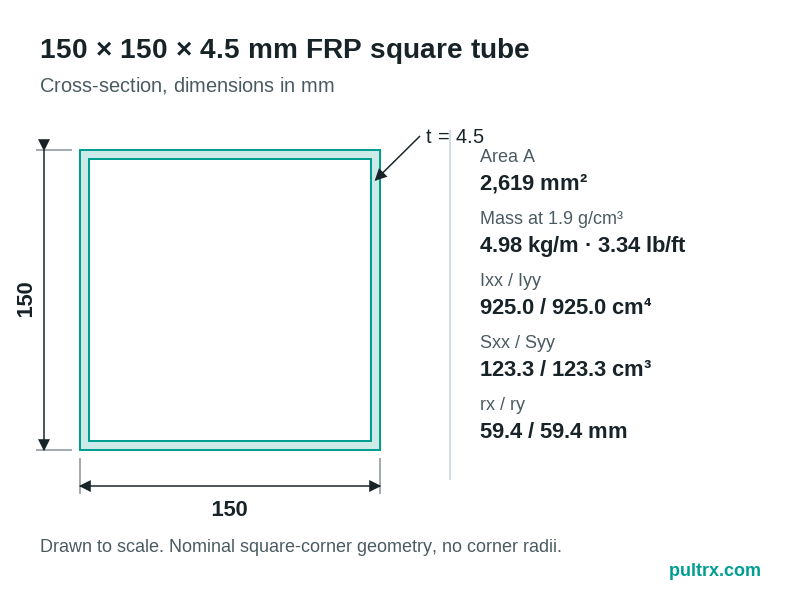
Geometry & mass
What are the nominal section properties and unit weight of 150 × 150 × 4.5 mm FRP square tube?
Calculated from nominal millimetre dimensions before corner-fillet deductions, alongside equivalent S275 steel and 6063-T6 aluminum masses.
| Property | Metric value | Imperial / engineering note |
|---|---|---|
| Nominal designation | 150 × 150 × 4.5 mm | Side × side × wall (mm) |
| Inch equivalent | 5.91 × 5.91 × 0.18 in | Converted at 25.4 mm/in |
| Cross-sectional area (A) | 2,619 mm² | 4.06 in² (sharp-corner nominal) |
| FRP unit mass (at 1.9 g/cm³) | 4.98 kg/m | 3.34 lb/ft planning weight |
| Same-size S275 carbon steel mass | 20.56 kg/m | FRP saves 76% deadweight |
| Same-size 6063-T6 aluminum mass | 7.07 kg/m | FRP is 30% lighter than aluminum |
| Major-axis second moment (Ixx) | 925.0 cm⁴ | 22.22 in⁴ |
| Minor-axis second moment (Iyy) | 925.0 cm⁴ | Ratio Ixx / Iyy = 1.00 |
| Elastic section modulus (Sxx / Syy) | 123.3 / 123.3 cm³ | Extreme-fibre bending modulus |
| Radius of gyration (rx / ry) | 59.4 / 59.4 mm | Used for axial column slenderness L/r |
| External perimeter | 600 mm | Surface veil and coating perimeter |
| Tooling status | Existing die (partner factory) | Pultruded to order; no new die charge |
Weighing 4.98 kg/m (3.34 lb/ft) at 1.9 g/cm³, this section is 11 percent lighter than a 100 × 100 × 8 mm FRP tube (5.59 kg/m) while delivering 2.21 times the bending moment of inertia (925.0 vs 418.4 cm⁴); equivalent steel and aluminum sections weigh 20.56 kg/m and 7.07 kg/m.
Symmetric elastic section moduli of Sxx = Syy = 123.3 cm³ and large radii of gyration (59.4 mm) suit long unbraced struts under wind pressure, provided connections spread local forces across the 4.5 mm wall.
Preliminary stiffness check
How much does 150 × 150 × 4.5 mm FRP square tube deflect across typical spans under E17 and E23 grades?
Euler bending estimates about the major axis (Ixx = 925.0 cm⁴) under a 1.8 kN/m uniform line load, comparing EN 13706-2 Grade E17 (17 GPa) and Grade E23 (23 GPa) minimum longitudinal moduli.
| Simple span (L) | Deflection at 1.8 kN/m (E17: 17 GPa) | Deflection at 1.8 kN/m (E23: 23 GPa) | Load for L/180 (E23) | Load for L/240 (E23) |
|---|---|---|---|---|
| 2.5 m (2500 mm) | 5.8 mm (L/429) | 4.3 mm (L/581) | 5.81 kN/m | 4.36 kN/m |
| 3.5 m (3500 mm) | 22.4 mm (L/156) | 16.5 mm (L/212) | 2.12 kN/m | 1.59 kN/m |
| 4.5 m (4500 mm) | 61.1 mm (L/74) | 45.2 mm (L/100) | 1.00 kN/m | 0.75 kN/m |
Across simple spans of 2.5 m, 3.5 m and 4.5 m under a 1.8 kN/m line load at 23 GPa modulus, Euler mid-span deflection measures approximately 4.3 mm (L/581), 16.5 mm (L/212) and 45.2 mm (L/100).
Flat clear wall width divided by wall thickness reaches b/t = 141 / 4.5 = 31.3, meaning local plate wrinkling of the compression flange or web crippling over narrow supports governs strength well before material rupture stress is approached.
Avoid resting the 150 mm bottom face on narrow knife-edge seats; provide at least 100 mm flat bearing length or insert a bonded internal stiffening block directly above reaction pads.
Run point loads, cantilevers or shear-corrected Timoshenko checks in the FRP section properties & deflection calculator, and verify material grade testing in EN 13706 & ASTM D3917 profile standards.
Fasteners & mating tolerances
How do you prevent local wall crushing when clamping or bolting 150 × 150 × 4.5 mm tube?
With a 4.5 mm wall spanning 141 mm between corners, flat faces flex inward if U-bolts or through-bolts are tightened directly against bare faces. Use wrap-around saddle plates that transfer load into the stiff vertical side walls, or bond 140 × 140 mm closed-cell structural core plugs or FRP box inserts inside bolt zones.
For RF-transparent telecom enclosures where metallic bolts are prohibited, join members with bonded FRP corner gussets and nylon or pultruded fiberglass threaded studs placed at least 30 mm inside the corner tangent.
| Interface or feature | Drawing & assembly specification |
|---|---|
| External cross-section | 150 × 150 mm square face; broad flat web accepts architectural louvre mullions, curtain-wall gaskets and wide saddle clamps. |
| Internal clear cavity | 141 × 141 mm open duct; accommodates multi-cable RF coax bundles, drainage risers or bonded structural foam/FRP bearing plugs. |
| Wall slenderness ratio | Clear flat b/t of 31.3 (overall B/t of 33.3); verify local buckling under combined axial compression and bending. |
| Fastener detailing | M10 or M12 bolts paired with 50 mm square backing plates or full-width clamping straps; avoid isolated small washers on mid-face holes. |
Shop tooling, diamond blades and bonded-bolted joint layout: how to cut, drill and join fiberglass profiles.
Request a quotation
Get a quotation for 150 × 150 × 4.5 mm FRP square tube
Send your cut lengths, piece count, resin system and destination port. An engineer in Shanghai reviews the schedule and replies in English.
Prefer email or chat? Write to inquiry@pultrx.com or message Celion on WhatsApp. Drawings can follow by email.
Service environments & resin selection
Which projects benefit from a 150 × 150 × 4.5 mm thin-wall FRP box section?
Cellular rooftop screening walls, airport radar housings and architectural sunshade grilles favor the 150 × 150 × 4.5 mm profile because its thin 4.5 mm E-glass wall minimizes radio-frequency attenuation while presenting a crisp, wide visual sightline that resists wind flutter across 3.5 to 4.5 m spans. Aliphatic polyurethane topcoats or UV-stabilized polyester veils maintain facade color stability outdoors.
Within our partner factories' existing-die lineup, buyers needing an even lighter architectural sleeve can step down to 150 × 150 × 3.5 mm or scale up to 200 × 200 × 4 mm for oversized louvres. Conversely, if heavy point loads or concentrated crane-rail brackets are present, step down in width to thicker-walled 127 × 127 × 6 mm or 100 × 100 × 8 mm square tubes.
Compare adjacent metric dies
Other metric square tube engineering sheets
- 50 × 50 × 5 mm FRP square tubeStandard 50 mm metric hollow box section (40 × 40 mm bore, 1.71 kg/m, Ixx 30.8 cm⁴) for industrial guardrail posts, top rails and treatment-plant barriers.
- 50 × 50 × 6 mm FRP square tubeThick-wall 6 mm metric 50 mm square tube (38 × 38 mm bore, 2.01 kg/m, Ixx 34.7 cm⁴) engineered for bored ladder stringers and high-load chemical stanchions.
- 60 × 60 × 4 mm FRP square tubeHigh-efficiency 60 mm thin-wall square tube (52 × 52 mm bore, 1.70 kg/m, Ixx 47.1 cm⁴) giving 53 percent more stiffness than 50 × 50 × 5 mm at equal mass.
- 75 × 75 × 6 mm FRP square tubePrimary 75 mm metric structural box column (63 × 63 mm bore, 3.15 kg/m, Ixx 132.4 cm⁴) for field-erected cooling towers, stair newels and platform bents.
- 80 × 80 × 5 mm FRP square tubeModular 80 mm metric box section (70 × 70 mm bore, 2.85 kg/m, Ixx 141.2 cm⁴) matching 75 × 75 × 6 mm section modulus at 9.5 percent lower weight.
- 100 × 100 × 6 mm FRP square tubeHeavy 100 mm metric box column and header (88 × 88 mm bore, 4.29 kg/m, Ixx 333.6 cm⁴) offering 2.52 times the stiffness of 75 × 75 × 6 mm square tube.
- 100 × 100 × 8 mm FRP square tubeHeavy-wall 100 × 100 × 8 mm square hollow section (5.59 kg/m, Ixx 418.4 cm⁴) built for cooling tower columns, boardwalk substructure posts and high-bearing bolted joints.
FAQ
What do buyers ask before ordering 150 × 150 × 4.5 mm FRP square tube?
Why does 150 × 150 × 4.5 mm have lower weight yet double the stiffness of 100 × 100 × 8 mm?
Bending inertia scales with the cube of section depth, so expanding the outer envelope from 100 mm to 150 mm multiplies geometric stiffness far faster than thinning the wall from 8 mm to 4.5 mm reduces cross-sectional area. The trade-off is higher local wall slenderness (b/t = 31.3), which shifts design attention toward bearing pads and local buckling.
Is 4.5 mm wall thickness suitable for 5G and radar radome frames?
Thin E-glass walls around 4.5 mm introduce lower phase shift and insertion loss at gigahertz frequencies than thick 8 to 10 mm structural sections while still bracing panel seams against storm gusts. Remove carbon-black pigments and conductive metallic fasteners inside the aperture zone when ordering radome-grade runs.
Can utilities or cables run inside the 141 × 141 mm hollow core?
Yes, the 141 × 141 mm interior acts as a clean non-conductive raceway for fiber-optic trunks, antenna feeder cables or rooftop solar DC wiring. Deburr any entry cutouts with diamond hole saws and fit rubber grommets where conductors exit the 4.5 mm wall.
How is 150 × 150 × 4.5 mm packed to prevent crushing during container transit?
Wide thin-walled box profiles are timber-crated with intermediate spreader battens so steel strapping bands never bear directly on unbraced 150 mm faces. End caps or temporary internal cross-braces can be specified on your section drawing when ocean freight stacks multiple bundles.
Is an existing die available for 150 × 150 × 4.5 mm without tooling charges?
Yes, 150 × 150 × 4.5 mm is produced on an existing die in our partner-factory network with zero die-sinking fee. Share required cut lengths, color RAL target and resin grade so production scheduling and minimum run quantities can be confirmed.