
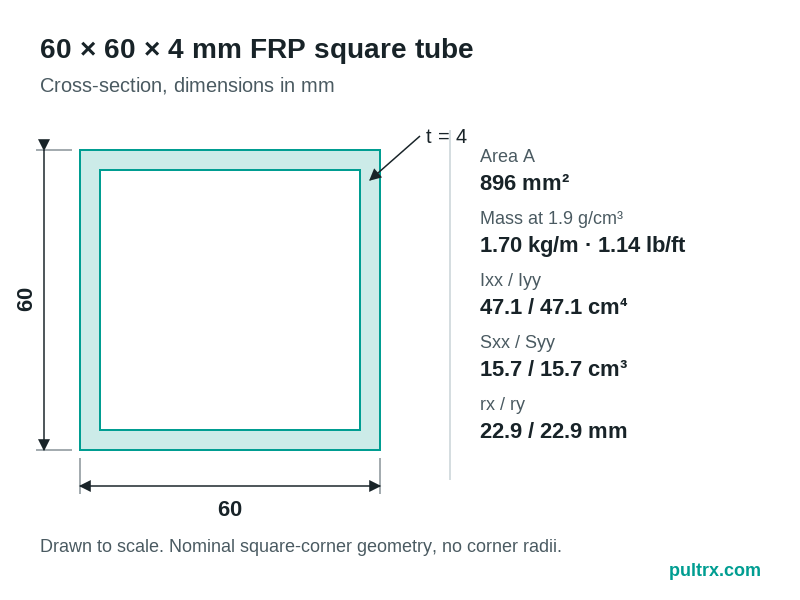
Geometry & mass
What are the nominal section properties and unit weight of 60 × 60 × 4 mm FRP square tube?
Calculated from nominal millimetre dimensions before corner-fillet deductions, alongside equivalent S275 steel and 6063-T6 aluminum masses.
| Property | Metric value | Imperial / engineering note |
|---|---|---|
| Nominal designation | 60 × 60 × 4 mm | Side × side × wall (mm) |
| Inch equivalent | 2.36 × 2.36 × 0.16 in | Converted at 25.4 mm/in |
| Cross-sectional area (A) | 896 mm² | 1.39 in² (sharp-corner nominal) |
| FRP unit mass (at 1.9 g/cm³) | 1.70 kg/m | 1.14 lb/ft planning weight |
| Same-size S275 carbon steel mass | 7.03 kg/m | FRP saves 76% deadweight |
| Same-size 6063-T6 aluminum mass | 2.42 kg/m | FRP is 30% lighter than aluminum |
| Major-axis second moment (Ixx) | 47.1 cm⁴ | 1.13 in⁴ |
| Minor-axis second moment (Iyy) | 47.1 cm⁴ | Ratio Ixx / Iyy = 1.00 |
| Elastic section modulus (Sxx / Syy) | 15.7 / 15.7 cm³ | Extreme-fibre bending modulus |
| Radius of gyration (rx / ry) | 22.9 / 22.9 mm | Used for axial column slenderness L/r |
| External perimeter | 240 mm | Surface veil and coating perimeter |
| Tooling status | Existing die (partner factory) | Pultruded to order; no new die charge |
Square-corner area measures 896 mm², translating to 1.70 kg/m (1.14 lb/ft) at 1.9 g/cm³ compared with 7.03 kg/m for steel SHS 60×60×4 and 2.42 kg/m for aluminum. Placing material on a 60 mm perimeter pushes Ixx = Iyy to 47.1 cm⁴ and section modulus Sxx = Syy to 15.7 cm³.
Radius of gyration expands to rx = ry = 22.9 mm (+24 percent over 50 × 50 × 5 mm), cutting Euler column buckling slenderness over medium cabinet heights. Simultaneously, the outer flat-wall ratio increases to b/t = 15.0, so concentrated clamp jaws and point bearings must spread load across the full 60 mm face.
Preliminary stiffness check
How much does 60 × 60 × 4 mm FRP square tube deflect across typical spans under E17 and E23 grades?
Euler bending estimates about the major axis (Ixx = 47.1 cm⁴) under a 0.8 kN/m uniform line load, comparing EN 13706-2 Grade E17 (17 GPa) and Grade E23 (23 GPa) minimum longitudinal moduli.
| Simple span (L) | Deflection at 0.8 kN/m (E17: 17 GPa) | Deflection at 0.8 kN/m (E23: 23 GPa) | Load for L/180 (E23) | Load for L/240 (E23) |
|---|---|---|---|---|
| 1.2 m (1200 mm) | 2.7 mm (L/445) | 2.0 mm (L/601) | 2.67 kN/m | 2.00 kN/m |
| 1.8 m (1800 mm) | 13.7 mm (L/132) | 10.1 mm (L/178) | 0.79 kN/m | 0.59 kN/m |
| 2.4 m (2400 mm) | 43.2 mm (L/56) | 31.9 mm (L/75) | 0.33 kN/m | 0.25 kN/m |
Under a 0.8 kN/m uniform line load, mid-span Euler deflection holds at 2.0 to 2.7 mm across 1.2 m (L/602 to L/450 for 23 to 17.2 GPa) and 10.1 to 13.5 mm at 1.8 m, reaching 31.9 to 42.7 mm over 2.4 m. For lightweight acoustic roofs, radome panels and safety screens, spans of 1.4 to 1.8 m balance low frame weight with tidy deflection.
Because web walls are 4 mm thick, check local web crippling and top-flange indentation whenever point loads sit mid-span without stiffener pads. Full-width elastomer or FRP bearing shims at end supports engage the vertical side webs directly instead of bending the bottom horizontal wall.
Run point loads, cantilevers or shear-corrected Timoshenko checks in the FRP section properties & deflection calculator, and verify material grade testing in EN 13706 & ASTM D3917 profile standards.
Fasteners & mating tolerances
How should joints be detailed in a 4 mm wall 60 × 60 mm FRP square tube?
Protect the 4 mm wall from point crushing and fastener pull-through: use external wrap-around saddle brackets, corner gusset plates bonded and riveted near the stiff corner radii, or internal telescopic sleeves. Notice that 50 × 50 × 5 mm or 50 × 50 × 6 mm square tube slides inside the 52 × 52 mm nominal bore with roughly 1.0 mm radial clearance per face once internal corner fillets are checked, forming an ideal bonded splice core.
Where M8 or M10 through-bolts cross the hollow section, insert a 52 mm cut tubular spacer bush and fit 24 to 30 mm OD flat washers outside so clamping force passes straight through the bush. In outdoor high-voltage yards, plug open ends and seal drilled holes completely so rainwater or condensation cannot bridge interior surfaces.
| Interface or feature | Drawing & assembly specification |
|---|---|
| Internal clear bore | 52 × 52 mm nominal flat-to-flat; accepts 50 × 50 mm FRP square tube as a bonded telescopic splice sleeve after corner fillet check. |
| Through-bolt sleeve | Fit 52 mm long internal compression tubes on M8 or M10 bolts to prevent inward bowing of 4 mm faces. |
| Panel fixing | Bond and blind-rivet or bolt cladding strips along two lines 15 mm in from outer corners rather than mid-wall. |
| Dielectric sealing | Closed bonded end caps plus resin-sealed fastener holes prevent internal moisture condensation in substation yards. |
Shop tooling, diamond blades and bonded-bolted joint layout: how to cut, drill and join fiberglass profiles.
Request a quotation
Get a quotation for 60 × 60 × 4 mm FRP square tube
Send your cut lengths, piece count, resin system and destination port. An engineer in Shanghai reviews the schedule and replies in English.
Prefer email or chat? Write to inquiry@pultrx.com or message Celion on WhatsApp. Drawings can follow by email.
Service environments & resin selection
Why choose 60 × 60 × 4 mm tube for enclosures and electrical utility frames?
Original-equipment builders assemble 60 × 60 × 4 mm square tube into removable acoustic blower hoods, analyzer walk-in cabinets, cleanroom air-shower skeletons and telecom antenna radome frames where metallic framing would distort electromagnetic fields or add excessive lifting weight. Two technicians can lift an entire 3 × 2 m welded-equivalent bolted wall panel by hand.
Substation and rail-traction engineers specify it for live-zone perimeter safety fences, transformer oil-bund walkways, disconnect-switch operating rods/guides and secondary cable support gantries. Request carbon-free UV-inhibited isophthalic polyester or fire-retardant halogen-free formulations when dielectric creepage and low smoke toxicity govern.
Compare adjacent metric dies
Other metric square tube engineering sheets
- 50 × 50 × 5 mm FRP square tubeStandard 50 mm metric hollow box section (40 × 40 mm bore, 1.71 kg/m, Ixx 30.8 cm⁴) for industrial guardrail posts, top rails and treatment-plant barriers.
- 50 × 50 × 6 mm FRP square tubeThick-wall 6 mm metric 50 mm square tube (38 × 38 mm bore, 2.01 kg/m, Ixx 34.7 cm⁴) engineered for bored ladder stringers and high-load chemical stanchions.
- 75 × 75 × 6 mm FRP square tubePrimary 75 mm metric structural box column (63 × 63 mm bore, 3.15 kg/m, Ixx 132.4 cm⁴) for field-erected cooling towers, stair newels and platform bents.
- 80 × 80 × 5 mm FRP square tubeModular 80 mm metric box section (70 × 70 mm bore, 2.85 kg/m, Ixx 141.2 cm⁴) matching 75 × 75 × 6 mm section modulus at 9.5 percent lower weight.
- 100 × 100 × 6 mm FRP square tubeHeavy 100 mm metric box column and header (88 × 88 mm bore, 4.29 kg/m, Ixx 333.6 cm⁴) offering 2.52 times the stiffness of 75 × 75 × 6 mm square tube.
- 100 × 100 × 8 mm FRP square tubeHeavy-wall 100 × 100 × 8 mm square hollow section (5.59 kg/m, Ixx 418.4 cm⁴) built for cooling tower columns, boardwalk substructure posts and high-bearing bolted joints.
- 150 × 150 × 4.5 mm FRP square tubeWide-profile, thin-wall 150 × 150 × 4.5 mm square hollow section (4.98 kg/m, Ixx 925.0 cm⁴) engineered for RF-transparent radome spaceframes, architectural louvres and long-span light enclosures.
FAQ
What do buyers ask before ordering 60 × 60 × 4 mm FRP square tube?
Does 50 × 50 mm FRP square tube telescope neatly inside 60 × 60 × 4 mm?
Nom-to-nom, a 50.0 mm outer tube leaves 1.0 mm per side inside a 52.0 mm clear bore, which is an ideal structural epoxy or methacrylate bondline thickness. Always test-fit a short sample or bevel the 50 mm sleeve's outer corners slightly so they clear the internal fillet radius of the 60 mm die.
When is 50 × 50 × 5 mm better than 60 × 60 × 4 mm despite lower stiffness?
Pick 50 × 50 × 5 mm (or 50 × 50 × 6 mm) when heavy side-impact blows, high bolt-bearing shear or standard 50 mm handrail fittings govern the design. Choose 60 × 60 × 4 mm whenever frame stiffness-to-weight ratio over 1.2 to 2.0 m spans matters more than wall pin-bearing capacity.
Is 60 × 60 × 4 mm FRP tube transparent to radar and 5G cellular frequencies?
E-glass reinforced polyester or vinyl ester free of metallic fillers and carbon-black pigment exhibits low dielectric loss across VHF, UHF and microwave bands, making it standard framing for rooftop cellular concealment screens and marine radar masts. Use non-metallic FRP threaded rods and nuts or nylon hardware in the active aperture zone.
How do you prevent moisture wicking inside outdoor substation frames?
Seal every sawn end with catalyzed resin before bonding molded or plate end caps in place, and bed bolt shanks in neutral-cure silicone or polyurethane sealant at installation. Keeping the 52 × 52 mm core dry maintains surface and volume resistivity in wet fog or coastal salt mist.
Are thicker 63 mm or 70 mm metric square tubes available if 4 mm wall is thin?
Yes, our partner-factory network holds existing dies for 63 × 63 × 5 mm, 63 × 63 × 6 mm and 75 × 75 × 6 mm square tubes when heavier bolted joints are needed. Your section drawing and load summary allow quick side-by-side comparison before ordering.