
Technical review: Yunkun Gong, Pultrusion Engineer, pultrx
What counts as a pultrusion defect?
A defect is any departure from the drawing, the agreed appearance or the agreed properties. ASTM publishes a terminology standard for pultruded products (D3918), a practice for classifying visual defects (D4385) and a specification for dimensional tolerances (D3917). D4385 is written as a guide for contracts, drawings, specifications and inspection, with quality grades. D3917 covers cross sections, straightness, twist, flatness, angularity and camber for standard shapes. Custom shapes may carry their own tolerances.
For the scope of the visual defect practice, see ASTM D4385: classifying visual defects in pultruded products
For the dimensional criteria, see ASTM D3917-23: dimensional tolerance of pultruded shapes
Which defects are acceptable, and on which faces, is a contract question: put the standard edition, the grade and any bonded, painted or outdoor face on the drawing. This page covers causes in conventional thermoset pultrusion of glass fiber (glass fibre) profiles, also called FRP, GRP or GFRP, cured in a heated steel die (mould).
For terms such as wet-out, veil, mandrel and exotherm, see the pultrusion glossary
Pultrusion defect diagnostic matrix
Use the matrix to choose the first check. The sections below name the sources. A likely cause stays a hypothesis until a controlled comparison supports it.
| Defect | What you see | Likely causes | What to check first |
|---|---|---|---|
| Blisters | Raised rounded spots; a cut may show a hollow | Too little heat for the line speed and die length | Actual die temperatures and line speed when blisters began |
| Fiber prominence, fiber bloom | Fibers visible or felt at the surface | Veil or mat missing or out of place; UV damage in service | Veil coverage on every face; exposure and coating |
| Surface cracks, crazing | Hairline cracks or a fine crack network | Cure shrinkage, residual stress, local pull-force peaks | Shrinkage control, resin-rich areas, pull-force log |
| Sloughing, scaling | Torn or flaky patches; resin dust | Resin sticking and slipping on the die wall | Internal release, die surface, pull-force spikes |
| Color streaks | Streaks or mottling along the length | Pigment or filler separation in the mix | Pigment batch, mixing record, filler settling |
| Voids, porosity | Pores in a cut section; pinholes | Air in the mix, poor wet-out, incomplete cure | Cut sections; de-aeration, bath temperature, viscosity |
| Delamination | Layers separating at a cut end or hole | Force peaks at the solid transition; residual stress; voids | Sections along the length; pull-force trace |
| Dry fiber | White or dull dry strands | Viscosity too high for the fiber pack; poor wetting | Resin temperature and viscosity, time in the resin |
| Undercure | Section not fully solid; low Tg in tests | Too little heat for the speed and section | Tg or degree of cure on identified samples |
| Too-fast cure | Rigid, but lower strength than expected | Rapid cure raising residual thermal stress | Die temperature profile against test results |
| Longitudinal cracks | Cracks along the length, surface or core | Temperature, cure and residual stress in thick sections | Thickness, recent speed changes, crack position |
| Bow, camber | Profile curves along its length | Shrinkage after the die, uneven temperature, cure degree | Straightness by the agreed method |
| Twist | Profile rotates about its axis | Hypothesis: uneven cure and shrinkage across the section | Twist by the agreed method; zone temperatures |
| Wall-thickness drift | Wall changes over a run or around a cell | Floating mandrel movement; die wear | Mandrel centering; die dimensions |
| Pull-force rise | Rising trend or peaks in the puller log | Compaction, viscous drag and friction shifting | Pull force aligned with temperature, speed, batch |
| Die buildup, jams | Deposits on the die; profile will not move | Sticking in the die; build-up or early cure at the entrance | Die surface, entrance cooling, resin pickup |
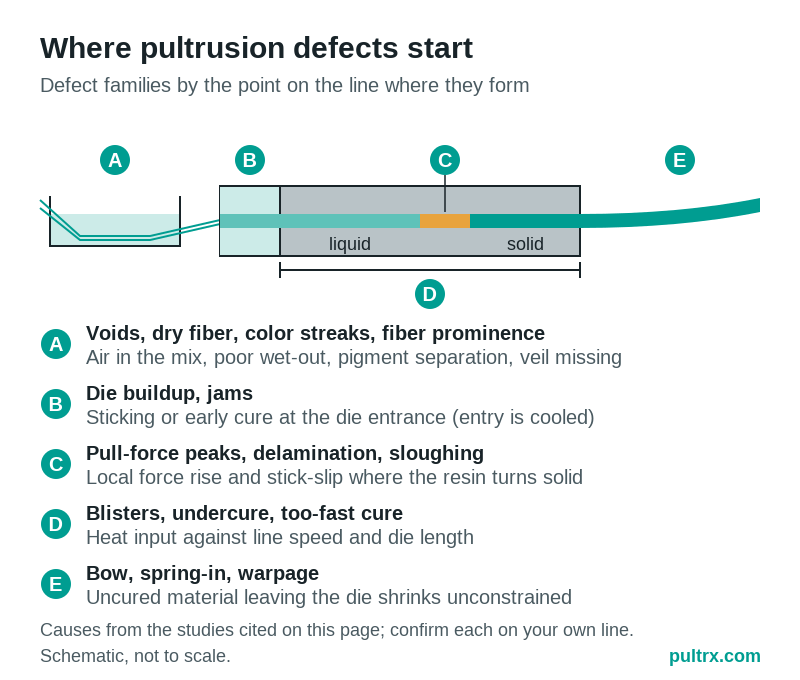
What causes surface defects on pultruded profiles?
What causes blisters on a pultruded profile?
Li, Ding, Xu, Lee and Engelen studied blister formation in vinyl ester pultrusion and call it a major concern. For a given die and resin system, low die temperature and a higher pulling speed led to blisters, and longer dies prevented them. They set out process windows for 4 mm and 6 mm thick composites and suggest optimizing heater power input in high-speed pultrusion. A companion paper relates die length and line speed to blister formation by simulation.
For the blister study, see Li et al. (2002), heat transfer, curing and the quality of pultruded composites
Those windows belong to one resin, die and thickness. On your line, ask first: did actual die temperatures hold at setpoint when the blisters started, especially after a speed increase? Cut through a blister and record whether it is hollow, how deep it sits and where it is in the section.
Why do glass fibers show at the surface (fiber prominence or fiber bloom)?
The European Pultrusion Technology Association (EPTA) notes that surface mats largely determine weatherability, UV resistance and colorfastness, because profiles are usually not painted. On a new profile, first check that the specified veil or mat is present and covers every face.
Surface mats, resin shrinkage and phenolic cure are described in EPTA: raw materials
Fiber bloom can also develop in service. Keller and co-authors inspected a footbridge built from partly adhesively bonded pultruded GFRP profiles after 17 years in an Alpine climate: UV exposure had uncovered fibers, letting moisture in by wicking and speeding strength loss. They recommend an appropriate coating for pultruded GFRP in harsh environments. For outdoor parts, specify veil, surface resin and coating together with the exposure.
For the field inspection, see Keller et al. (2016), natural weathering of pultruded GFRP structures
What causes surface cracks and crazing?
Thermoset resins shrink as they cure. EPTA describes methacrylate resins as low-shrinkage, with a good surface and no exothermic cracks, which ties shrinkage and exotherm to cracking. BYK notes that suitable fillers reduce shrinkage. Force is the other driver: in glass/epoxy injection pultrusion trials, Tucci et al. conclude that excessive localized forces can cause surface wear and transverse cracks a few tens of micrometers below the surface.
Check whether the cracks sit in resin-rich areas, whether the formulation changed (filler load or a shrinkage-control additive), and whether the pull-force log shows peaks at the same time.
For the force analysis and cross-sections, see Tucci et al. (2024), injection pultrusion of glass-reinforced epoxy
What causes sloughing and scaling?
Sloughing is surface material torn away in the die, leaving a rough or flaky face. Batch and Macosko applied models of resin pressure and pulling force to surface defects including sloughing, surface roughness and surface shear. Tucci et al. found resin powder on one profile and attributed it to stick-slip where the resin turns solid, which eroded the surface. EPTA states that curing produces high friction along the mould wall, that the die interior is often polished and chrome plated for low friction and good surface quality, and that release agents in the matrix reduce friction.
First checks: internal release grade, dosage and mixing order; the die surface at the next stop; and whether pull-force spikes line up with the rough lengths.
For die pressure and surface defects, see Batch and Macosko (1990), pressure, pulling force and sloughing
Die surface finish and plating are described in EPTA: equipment
Why does the color streak or vary?
EPTA notes that homogeneous pigmentation of pultruded profiles is possible only to a limited extent and that glass has no pigment tolerance. BYK describes anti-separation additives that improve color homogeneity and dispersing additives that stop fillers settling. Check the pigment paste batch, the mixing record, how long each mix sat in the bath and whether filler settled. Agree a color reference and inspection lighting.
Pigmentation limits are listed in EPTA: design parameters
What causes internal defects such as voids and delamination?
Internal defects need a cut section: take it at a known position and time, polish and photograph it at a known magnification, and keep it with its record.
Voids and porosity
Freed's thesis on low-void pultrusion notes that voids reduce interlaminar shear strength, act as fracture sites and leave the part open to contaminants. BYK states that air bubbles in the resin can develop into pinholes and porosity. Borges et al. examined how resin bath temperature, through viscosity, affected wet-out, cure position in the die and void formation in pultruded rods. EPTA warns that water released during phenolic cure creates a danger of cracks and pores.
No single setting removes voids. Freed's model of one process found that void formation was suppressed at the highest pull speed that kept the exotherm inside the die, while moderate die temperature variation had a negligible effect. Tucci et al. saw voids of about 100 to 500 µm in their least-cured run. These are example results from specific studies and do not set any line. Check mix preparation and de-aeration, resin temperature and viscosity, whether voids sit in mat layers or roving bundles, and cure evidence for the same samples.
For the void model, see Freed (2002), modeling pultrusion for low void fraction
For bath temperature, wet-out and voids, see Borges et al. (2015), bath temperature and pultruded rod properties
Delamination
Delamination is a separation between layers, often found at a cut end or after drilling. In one of Tucci et al.'s runs the core was solid, but large delamination cracks ran near and parallel to the surfaces, which the authors linked to a local force increase during the solid transition. Yuksel, Baran, Ersoy and Akkerman note that process-induced stresses exist particularly in thick parts, and estimated a tensile residual stress at the core of a thick unidirectional glass/polyester profile.
Compare the delaminated position with the layup (mat to roving, veil to mat) and the pull-force trace for that length, and check for porosity at the same place.
For the residual stress measurement, see Yuksel et al. (2018), residual stresses in a thick pultruded profile
Dry fiber and poor wet-out
Dry fiber is reinforcement the resin did not fully surround. BYK describes fiber wetting additives that give impregnation with no dry spots and no air entrapment. Chem-Trend states that internal releases generally lower resin viscosity, which helps fibers soak through, and that viscosity also affects pull force, line speed and surface finish. Check the resin temperature and the viscosity of the mix at that temperature, the time the reinforcement spends in the resin, and whether roving and mat grades are approved for the resin.
For air release, dispersing and wetting additives, see BYK: additives for pultrusion (TS-A 11)
For mixing order and screening tests, use the pultrusion resin formulation guide
Undercure and overcure
A profile that is rigid at the die exit is not proven to be fully cured. Chaparala et al. ran an industrial vinyl ester trial with the die set in turn at 80, 100, 120 and 140 °C. At 80 °C no solid product formed. Predicted degree of cure rose with temperature, yet mechanical results were highest at 120 °C. The authors attribute the lower results at 140 °C to residual thermal stress from rapid cure. Tg rose only slightly and did not track strength. These values come from a single trial and are not settings for any line.
Safonov et al. list the conditions for a faster line on large glass/epoxy rods as no thermal degradation, enough cooling before cut-off, a high degree of polymerization and no cracks. Check the die temperature log against sensor positions, then measure cure on identified samples by the agreed method. Chem-Trend names Tg of the cured resin by DSC as a good indicator of mechanical properties.
For the screening test order, see Chem-Trend: gel time, viscosity and Tg tests
For the die temperature trial, see Chaparala et al. (2023), curing of vinyl ester in industrial pultrusion
Longitudinal cracks
Safonov et al. report that pultruding large-diameter glass fiber/epoxy rods at high pulling speed is often accompanied by surface cracks that cause rejection, and used simulations of temperature, degree of polymerization and residual stress to find the causes and optimize the temperature settings. Yuksel et al. did not study cracking, but the tensile core stress they estimated in a thick profile acts across the fibers. Our reading is that this is one reason to check the cure profile when longitudinal cracks appear in thick sections. For phenolic profiles, EPTA's warning on water release applies.
Record where the crack sits (surface, mid-wall or core), the section thickness and any speed or temperature change before it appeared.
For the crack modeling study, see Safonov et al. (2020), cracking during pultrusion of large-size profiles
Why does a pultruded profile bow, twist or drift in wall thickness?
Vedernikov et al. state that cure-induced deformations are inevitable in pultruded profiles: spring-in in curved elements, warpage in flat ones. They list anisotropy, chemical and thermal shrinkage, nonuniform temperature and degree of cure as the main causes of spring-in. In their glass/vinyl ester L-profiles pulled at 200, 400 and 600 mm/min, spring-in grew with speed, which their model attributed to more uncured material leaving the die and shrinking unconstrained. In simulation, a post-die cooling tool or a lower-shrinkage resin, for example with low-profile additives, held spring-in at higher speeds.
For the spring-in study, see Vedernikov et al. (2021), spring-in of pultruded L-profiles at different speeds
Bow and camber
Measure straightness by the method in the specification. ASTM D3917 covers straightness and camber for standard shapes. Compare the bow with the speed and die temperature records for that length. A bow that always runs toward one face suggests an asymmetry across the section in heating, cure or shrinkage.
Twist
We did not find an open study on twist itself. Treat uneven cure and shrinkage across the section as a hypothesis, test it with temperature records by zone and face, and measure twist by the agreed method on lengths conditioned the same way.
Wall-thickness drift
In hollow profiles the mandrel floats in the die, and EPTA advises minding the wall-thickness variation this causes and avoiding abrupt changes in wall thickness. Drift that grows over a campaign can come from die wear, which Chem-Trend notes can be assessed with precise measurement equipment. Check mandrel centering, measure the wall at fixed positions and compare die dimensions with the die acceptance record.
For line measurements, see Chem-Trend: pull force, line speed and die wear measurement
For mandrels and die acceptance, see the pultrusion die design guide
What do pull-force rise, die buildup and jams tell you?
Pull-force rise
Tucci et al. split pull force into bulk compaction where the fiber pack enters the tapered cavity, viscous drag where the resin is still liquid, and friction after it turns solid. In their trials, solid friction was negligible because chemical shrinkage reduced contact pressure, and the largest peaks sat near the liquid-to-solid transition. Chem-Trend notes that pull force can be logged in real time through the puller PLC. Line the trend up with die temperatures, speed, resin batch and reinforcement changes, and note whether it was a step or a slow drift.
For how temperature, speed and pull force relate, see the pultrusion process parameters guide
Die buildup
Buildup is cured resin or filler stuck to the die wall, where it adds friction and marks the profile. BYK describes internal release agents and lubricants as reducing die friction to keep the process continuous. Photograph the die surface at planned stops, note where deposits sit relative to the heating zones, and review release dosage and mixing before changing temperatures.
For planned stops and records, see the pultrusion machine maintenance guide
Jams
EPTA describes cooling sections in the die feed zone to avoid premature curing. After a jam, follow the site's isolation procedure, keep the material from the entrance where it can be removed safely, and record the last speed, temperatures, pull force and mix age.
Feed-zone cooling and die friction are described in EPTA: technical principles
How should you record evidence when asking for help?
This minimum record lets an engineer separate material, tooling, process and downstream causes. Keep setpoints, measured values and test results in separate fields.
- 01
Photographs
Every affected face with a scale and a label: profile, die, date, time, position. Add a good length under the same lighting.
- 02
Cut sections
Polished sections at the defect and at a good position, with a scale and the face that was up in the die marked. Keep the samples.
- 03
Pull-force log
The puller log from the last good run to the defect, with time stamps, line speed and stops; the raw trend where the PLC records it.
- 04
Die temperature log
Setpoints and actual readings per zone with sensor positions, plus any heater or thermocouple replacement.
- 05
Resin batch and mix record
Resin, initiator or hardener, filler, internal release, pigment and reinforcement grades with batch numbers, recipe revision, mixing order and when each mix was used.
- 06
Change log
Every change before the defect appeared: material lot, die repair, guide or veil change, speed or temperature change, shift.
Record first, then change one thing
Where pultrx fits
pultrx is an integrated pultrusion technology provider in Shanghai that supplies complete pultrusion production systems and equipment, and pultruded FRP profiles, to buyers outside China. Technical services such as commissioning, training and defect review are scoped per quotation, which states the inputs, the format (remote review or site visit), the trial rounds and who is responsible for each corrective action.
On a new line, defect prevention starts before shipment: the factory acceptance test and start-up trials first prove the die, resin route and settings on your profile. Agree how defects are recorded and judged in those trials, using the evidence list above.
For an existing line, see the scope of pultrusion troubleshooting and on-site technical support
For a new line, plan start-up trials under commissioning and training
To write defect criteria into equipment acceptance, use the pultrusion line FAT checklist
For the reinforcement and resin side of a review, see the pultrusion raw materials guide
Sources and further reading
- Li, Ding, Xu, Lee and Engelen (2002), Polymer Composites 23(5): Influence of heat transfer and curing on the quality of pultruded composites. I: Experimental
Reviewed 2026-11-14 (abstract). Supports: blister formation as a major concern; low die temperature and higher pulling speed lead to blisters for a given die and resin; longer dies prevent them; process windows for 4 mm and 6 mm vinyl ester composites; heater power input to be optimized in high-speed pultrusion. Does not give settings for other resins or dies.
- Ding, Li and Lee (2002), Polymer Composites 23(5): Influence of heat transfer and curing on the quality of pultruded composites. II: Modeling and simulation
Reviewed 2026-11-14 (abstract). Supports: heat-transfer model of die block and heaters; processing window relating die length and line speed to blister formation. No transferable settings.
- Tucci, Esperto, Pasquino and Carlone (2024), Polymers 16(12):1642: Injection Pultrusion of Glass-Reinforced Epoxy: Cure Kinetics, Rheology, and Force Analysis
Reviewed 2026-11-14 (full text via Europe PMC, PMC11207252). Supports: pull force split into compaction, viscous drag and solid friction; friction negligible in their trials because of chemical shrinkage; peaks near the solid transition; voids of 100 to 500 µm in the least-cured run; delamination cracks near the surface linked to a local force increase; resin powder from stick-slip; excessive localized forces causing surface wear and sub-surface transverse cracks. Specific to one epoxy system and die.
- Chaparala et al. (2023), Polymers 15(18):3808: Characterisation of Curing of Vinyl Ester Resin in an Industrial Pultrusion Process: Influence of Die Temperature
Reviewed 2026-11-14 (full text via Europe PMC, PMC10535391). Supports: die set at 80, 100, 120 and 140 °C at constant speed; no solid product at 80 °C; predicted cure rising with temperature; highest mechanical results at 120 °C; lower results at 140 °C attributed to residual thermal stress from rapid cure; Tg rising only slightly. Degree of cure is model-predicted; one resin, die and speed. Reports no observed voids or cracks.
- Vedernikov, Safonov, Tucci, Carlone and Akhatov (2021), Polymers 13(16):2748: Modeling Spring-In of L-Shaped Structural Profiles Pultruded at Different Pulling Speeds
Reviewed 2026-11-14 (full-text PDF). Supports: cure-induced deformations inevitable; spring-in in curved and warpage in flat elements; causes (anisotropy, chemical and thermal shrinkage, nonuniform temperature, degree of cure); higher spring-in at higher speeds from more uncured material at die exit; post-die cooling tool or lower-shrinkage resin, low-profile additives. Does not study twist.
- Safonov et al. (2020), Composite Structures 235:111801: Modeling of cracking during pultrusion of large-size profiles
Reviewed 2026-11-14 (abstract via British Library record). Supports: surface cracks in large-diameter glass/epoxy rods at high pulling speed that cause rejection; simulation of temperature, degree of polymerization and residual stress; conditions of no thermal degradation, cooling before cut-off, high degree of polymerization and no cracks. Full text not reviewed.
- Yuksel, Baran, Ersoy and Akkerman (2018), ESAFORM 2018, AIP Conf. Proc. 1960: Analysis of residual transverse stresses in a thick UD glass/polyester pultruded profile
Reviewed 2026-11-14 (abstract). Supports: process-induced stresses exist particularly in thick parts; tensile residual stress estimated at the core of a 20 × 20 mm profile. Does not itself report cracking; the link to cracks is an inference stated as such on the page.
- Freed (2002), M.S. thesis, West Virginia University: Modeling the pultrusion process to obtain low void fraction composites
Reviewed 2026-11-14 (abstract). Supports: voids lower interlaminar shear strength and create fracture sites; model conclusions on speed, exotherm position and die temperature for the process modeled. No transferable settings.
- Borges, Ferreira, Andrade and Prevedello (2015), Journal of Reinforced Plastics and Composites 34(15): The influence of bath temperature on the properties of pultruded glass fiber reinforced rods
Reviewed 2026-11-14 (abstract via OpenAlex). Supports: resin viscosity effect on wet-out, cure position and void formation; properties correlated with void content. Full text not reviewed.
- Batch and Macosko (1990), ASME HTD 132: Analysis of pressure, pulling force, and sloughing in pultrusion
Reviewed 2026-11-14 (abstract). Supports: pressure and pulling-force models applied to sloughing, surface roughness and surface shear. Conclusions on release agents not reviewed.
- Keller, Theodorou, Vassilopoulos and De Castro (2016), Journal of Composites for Construction 20(1): Effect of Natural Weathering on Durability of Pultruded Glass Fiber-Reinforced Bridge and Building Structures
Reviewed 2026-11-14 (abstract). Supports: fiber blooming from UV exposure, moisture ingress by wicking, strength loss on a 17-year-old footbridge; coating recommendation for harsh environments. Does not name a coating.
- EPTA: 2. Technical principles
Reviewed 2026-11-14. Supports: release agents in the matrix reduce friction; high friction along the mould wall during cure; cure proceeds from the die wall inward; feed-zone cooling to avoid premature curing.
- EPTA: 3. Equipment
Reviewed 2026-11-14. Supports: die interior frequently polished and chrome plated for low friction and good surface quality. Does not cover die wear.
- EPTA: 4. Raw materials
Reviewed 2026-11-14. Supports: surface mats determine weatherability, UV resistance and colorfastness; continuous filament mats for low roughness and porosity; methacrylate low shrinkage with no exothermic cracks; phenolic water release with danger of cracks and pores.
- EPTA: 5. Design parameters
Reviewed 2026-11-14. Supports: homogeneous pigmentation only to a limited extent; glass has no pigment tolerance; floating mandrel and wall-thickness tolerance; avoiding abrupt wall-thickness changes. No tolerance values are used on this page.
- BYK: Additives for pultrusion (TS-A 11, 02/2026)
Reviewed 2026-11-14. Supports: air bubbles developing into pinholes and porosity; air release additives; anti-separation additives improving color homogeneity; dispersing additives against filler sedimentation; fillers reducing shrinkage; internal release reducing die friction; fiber wetting additives giving impregnation without dry spots. Product claims are the supplier's own.
- Chem-Trend FAQ: What tests are appropriate to ensure acceptable performance on the pultrusion line?
Reviewed 2026-11-14. Supports: pull force logged in real time through the puller PLC; die wear assessed with precise measurement equipment.
- Chem-Trend FAQ: What tests are appropriate to ensure compatibility and good performance of the internal mold release in advance of a production trial?
Reviewed 2026-11-14. Supports: test order gel time, viscosity, Tg by DSC; internal release lowering viscosity and aiding wet-out; viscosity affecting pull force, line speed and surface finish; Tg as an indicator of mechanical properties.
- ASTM D4385: Standard Practice for Classifying Visual Defects in Thermosetting Reinforced Plastic Pultruded Products
Reviewed 2026-11-14 (scope page, D4385-10; a 2019 edition exists). Supports: practice defines possible defects as a guide for contracts, drawings, specifications and inspection, with quality grades. Defect definitions and grade limits not reproduced.
- ASTM D3917-23: Standard Specification for Dimensional Tolerance of Thermosetting Glass-Reinforced Plastic Pultruded Shapes
Reviewed 2026-11-14 (scope page). Supports: tolerances for cross sections, width or diameter, straightness, twist, flatness, angularity and camber of standard shapes; custom shapes may differ. No tolerance values reproduced.
- ASTM D3918: Standard Terminology Relating to Reinforced Plastic Pultruded Products
Reviewed 2026-11-14 (scope page, historical edition). Supports only the existence of a pultrusion terminology standard; definitions not reproduced.
Questions buyers ask
What types of pultrusion defects are there?
Surface defects such as blisters, fiber bloom, cracks and sloughing; internal defects such as voids, delamination, dry fiber and undercure; and shape defects such as bow, twist and wall-thickness drift. Pull-force rise, die buildup and jams are process symptoms that can come first.
What causes blisters in pultrusion?
Li et al. report that, for a given die and vinyl ester resin system, low die temperature and higher pulling speed led to blisters and longer dies prevented them. Check whether actual die temperatures held at setpoint when the blisters started, and cut through a blister to see whether it is hollow.
Are surface defects on a pultruded profile only cosmetic?
Not always. On the footbridge Keller et al. inspected, fiber bloom from UV exposure let moisture in and sped up strength loss. Agree which defects are acceptable on which faces, for example by naming an ASTM D4385 grade.
Does a higher die temperature always give a better cure?
No. In Chaparala et al.'s vinyl ester trial, predicted cure rose with die temperature, but mechanical results were highest at 120 °C and lower at 140 °C, which the authors attribute to residual thermal stress from rapid cure. The values come from one trial and are not settings.
What should I send when asking for help with a pultrusion defect?
Labeled photographs, polished cut sections, the pull-force log, the die temperature log with setpoints and actual readings, the resin batch and mix record, and recent changes.
Can pultrx review defects on our existing line?
Defect review on an existing line is one of the pultrx technical service work packages. Machine access, the cooperation of the original equipment supplier, remote or site format, trial rounds and support hours are agreed in the quotation.
Summary
What causes pultrusion defects?
Pultrusion defects come from how heat, resin, reinforcement and friction interact in and after the die: cure that is incomplete or too fast, trapped air or poor wet-out, resin sticking to the die wall, and shrinkage and residual stress. Diagnose from evidence first: photographs, cut sections, the pull-force log, the die temperature log and the resin batch record.
- Blisters
- Linked by Li et al. to low die temperature and higher pulling speed for a given die and resin; longer dies prevented them
- Voids and porosity
- Air in the mix, poor wet-out and incomplete cure are reported causes
- Bow and spring-in
- Chemical and thermal shrinkage, uneven temperature and degree of cure distort the profile
- Pull-force rise
- A symptom to line up with temperature, speed and material records before assigning a cause
- Evidence to send
- Photographs, cut sections, pull-force log, die temperature log, resin batch and mix record
- pultrx services
- Commissioning, training and defect review are scoped per quotation
Published by pultrx, an integrated pultrusion technology provider working with Henan Zhongsheng as a partner factory. This is a buyer planning guide; the manufacturer confirms project specifications in writing.
Ready to move from reading to a scoped quotation?
Scope a defect review for your line