
Technical review: Yunkun Gong, Pultrusion Engineer, pultrx
What is carbon fiber pultrusion?
Pultrusion pulls continuous reinforcement through an impregnation stage and a heated die, where the resin cures and the section takes its final shape. EPTA, the European pultrusion association, describes dies heated up to 160 °C depending on the resin, a cooled entry section to stop early cure, cure progressing from the die walls toward the center, and speeds of 0.02 to 3.0 m/min in typical thermoset pultrusion. These are general process figures. None describes a particular carbon profile.
Die temperature, cure direction and speed range are from EPTA: technical principles of pultrusion
In carbon fiber pultrusion the longitudinal reinforcement is carbon tow instead of glass roving. The carbon profiles in the producer data cited here are unidirectional: the fiber runs along the length. Zoltek, a carbon fiber producer, lists its PX35 pultruded profiles as plates, rods, tubes or custom shapes, typically made with epoxy or vinyl ester, for uses including wind blade spar caps, infrastructure, offshore drilling and mining.
Product forms, resins and listed uses come from the Zoltek PX35 pultruded profiles data sheet
For each station of a pultrusion line, read the pultrusion process guide
What changes on the line when carbon replaces glass?
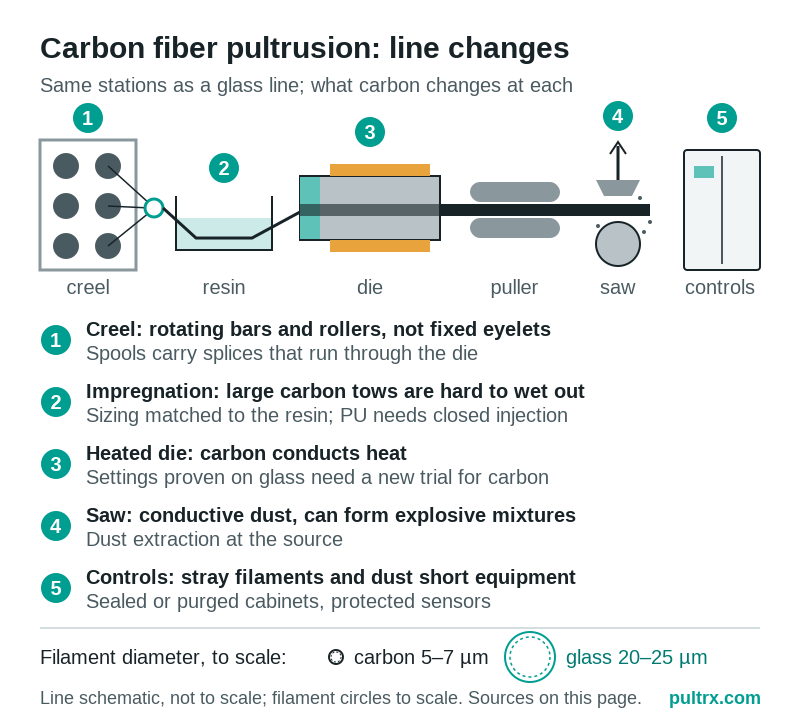
A carbon line has the same stations as a fiberglass line: creel, impregnation, preforming guides, heated die, puller and cut-off saw. EPTA describes the die as high-alloy steel, about 0.75 to 1.5 m long, built in sections and often polished and chrome plated inside. What changes is how each station treats the fiber and what it must protect.
Station list and die construction follow EPTA: pultrusion equipment
| Station | What changes with carbon | What to ask the equipment builder |
|---|---|---|
| Creel and tow path | Toray recommends guiding carbon tows over rotating bars and rollers instead of stationary eyelets, pins or bars | Guide type at each contact point, tension control, and how tow splices pass through the die |
| Impregnation | Carbon filaments are 5 to 7 µm across against 20 to 25 µm for glass, which Dow says makes large carbon tows hard to wet out | Open bath or closed injection, and how wet-out will be checked in the trial |
| Fiber sizing and resin | Each carbon sizing is published as compatible with named resin families | Sizing type of the fiber and the resin it was qualified with |
| Heated die | Carbon conducts heat; Toray publishes a thermal conductivity for T300 fiber | Zone layout, entry cooling, thermocouple positions and the trial record |
| Saw and finishing | Cutting dust is electrically conductive and can form an explosive mixture in air | Dust extraction at the saw and enclosure of electrical parts |
| Controls and cabinets | Stray filaments and dust can short-circuit electrical equipment | Sealed or purged cabinets and protected sensors near the fiber path |
Creel, tow handling and broken filaments
The spool format sets the creel. As published examples, Toray lists T300 fiber in 1K, 3K and 6K tows, and Zoltek lists PX35 as a 50K tow on 1,500 m or 3,000 m spools. Zoltek's tow data sheet permits two splices per 1,500 m spool and five per 3,000 m spool, so a long run carries splices through the die. Agree with the builder how a splice is detected and what happens to the section around it.
Handling carbon tow generates broken filaments (often called fuzz) and dust. Toray advises rotating guides, and goggles, face masks, gloves and protective clothing wherever dust or broken filaments are generated in significant amounts. Zoltek notes that the PX35 sizing should be used within 24 months of manufacture, which matters when fiber is bought in bulk for a new line.
Guide type and protective equipment advice are from Toray Composite Materials America: safety and handling
Tow size, spool lengths, splices and sizing storage life are in the Zoltek PX35 continuous tow data sheet
Fiber sizing and resin compatibility
Sizing is the coating the fiber producer applies to the carbon surface, and producers publish which resin families each sizing suits. The Toray T300 data sheet lists two sizing types as epoxy compatible and a third as compatible with epoxy, phenolic, polyester and vinyl ester. Zoltek sells PX35-1 as an epoxy multi-compatible tow and PX35-7 as a vinyl ester compatible tow.
In Zoltek's own comparison, unidirectional panels made with a standard vinyl ester resin had 22% higher interlaminar shear strength and 84% higher transverse flexural strength with the vinyl ester compatible tow. Zoltek treats both tests as indicators of fiber to resin adhesion. The panels were filament wound, so take the result as a reason to match sizing to resin and do not quote it as a pultrusion value.
Tow sizes and sizing compatibility for T300 are listed in the Toray T300 data sheet
The sizing comparison and its test conditions are in the Zoltek PX35 vinyl ester compatible tow data sheet
Resin systems: epoxy, vinyl ester and polyurethane
Zoltek states that its pultruded carbon profiles are typically epoxy or vinyl ester. CompositesWorld reported in 2018 that Zoltek's carbon spar cap plate is made with vinyl ester, epoxy or polyurethane depending on the customer. Dow, a polyurethane resin producer, notes that epoxy and vinyl ester can run in a conventional open bath, while polyurethane needs closed injection because its two components react as soon as they are mixed. The impregnation route is a resin decision first and an equipment decision second.
Filament diameters, tow wet-out and open bath versus closed injection are from Dow: new generation of wind blades
For pot life, cure package and the formulation record, see the pultrusion resin formulation guide
For buying and checking fiber, resin and additives, see the pultrusion raw materials guide
Die heating and heat transfer
Carbon conducts heat as well as electricity: Toray publishes a thermal conductivity of 0.105 J/cm·s·°C for T300 fiber. Do not assume that die zone settings proven on a fiberglass product will cure a carbon section of the same shape. Ask the die maker for the zone layout, entry cooling and thermocouple positions, and plan a trial that records die temperatures, line speed and pull force for your section and resin.
Thermal history also shapes the part. Researchers at Aarhus University and the Technical University of Denmark explain that resin shrinkage during cure, the profile's thermal history and mismatched properties within the layup build up process-induced stresses and distortion, seen as curing cracks and warpage. Their test case is glass/epoxy. The mechanism applies to thermoset pultrusion generally, and the numbers do not transfer.
The link between thermal history, shrinkage and distortion is described by Sandberg, Spangenberg and Hattel (ECCM20, 2022)
Cracks, warpage and dry fiber are covered in the pultrusion defects guide
Cutting, dust and electrical protection
Zoltek's safety data sheet for PX35 pultruded profiles states that the product and its dust are electrically conductive, that cutting and grinding dust can short-circuit electrical equipment, and that fine dust can form an explosive mixture with air. It asks for local exhaust at the dust source, protection of nearby electrical equipment, enclosures, circuits and power tools, and a respirator where extraction is not enough. It also warns that carbon composite coils are under tension and that banding should not be cut without coil release controls.
Toray adds that electrical equipment should be isolated from stray filaments and that computing equipment should be enclosed with pressurized purge air. A plant converting from glass should put saw extraction, cabinet protection and housekeeping on the equipment list.
Conductive dust, explosion risk and coil tension are stated in the Zoltek PX35 pultruded profile safety data sheet
Creels, guides, resin baths and cut-off saws are described under pultrusion line tooling
Pullers, die tables and controls are covered under pultrusion machines
How do pultruded carbon fiber profiles compare with fiberglass profiles?
The fiberglass column is EPTA's general table for glass reinforced (GRP or GFRP) profiles, whose values EPTA says depend on the laminate structure. The carbon column is Zoltek's data for unidirectional PX35 plate. Architectures and tests differ, so read the table for orders of magnitude and questions to ask, never as design values.
| Property | Fiberglass profiles (EPTA) | Carbon pultruded plate (Zoltek PX35) | What to request |
|---|---|---|---|
| Filament diameter | 20 to 25 µm (Dow) | 5 to 7 µm (Dow); 7.2 µm for PX35 | Fiber grade and tow size on the certificate |
| Density | 1.65 to 2.15 g/cm³ | 1.6 g/cm³ | Measured density of the supplied lot |
| Longitudinal tensile strength | 430 / 900 N/mm² (two values as published) | 2,350 MPa epoxy, 2,100 MPa vinyl ester (3.2 mm plate, 62% fiber volume) | Tests on the supplied section, method named |
| Longitudinal stiffness | Flexural modulus 17,500 / 25,000 N/mm² | Tensile modulus 140 GPa; flexural modulus 152 to 170 GPa (brochure) | Modulus in the direction and test your design uses |
| Transverse strength | Tensile 60 / 200 N/mm² | Transverse flexural 55 to 108 MPa (brochure, 5 mm profiles) | Transverse data wherever bolts or clamps act across the fiber |
| Electrical behavior | Not stated by EPTA; test for the duty | Profile and dust conductive (Zoltek safety data sheet) | No insulating claim for carbon |
The fiberglass column is from EPTA: properties of pultruded profiles
Flexural and transverse values by fiber volume and resin are in the Zoltek PX35 pultrusion brochure
Directional properties
A unidirectional carbon profile is very strong along its length and much weaker across it. The Toray T300 data sheet gives 1,820 MPa at 0° and 76 MPa at 90° tensile strength for a T300/epoxy composite at 60% fiber volume. Zoltek's brochure lists transverse flexural strengths of 55 to 108 MPa for 5 mm profiles. Design holes, bolts, clamps and bonded joints with transverse and shear values, and ask for them in the RFQ.
Sandia National Laboratories reports that pultruded Zoltek PX35 coupons were nonlinear in tension and compression, with tangent modulus varying by roughly minus 30% to plus 20% up to failure, and that modeling this reduced the predicted buckling load factor of a 100 m reference blade. State which modulus your design uses.
Nonlinear behavior of pultruded PX35 coupons is reported by Clarke, Ennis, Miller and Samborsky (Sandia, SAND2022-3804C)
Why does carbon fiber corrode aluminum and steel?
A NASA technical paper notes that graphite acts electrochemically like a noble metal, so it is expected to be the cathode when coupled to most metals. In its 3.5% salt water tests, bare 6061-T6 aluminum and D6AC steel coupled to graphite-epoxy corroded severely, while Inconel 718 was relatively unaffected. It cites earlier work in which Ti-6Al-4V titanium fasteners showed no visible corrosion against graphite-epoxy after 500 hours of salt spray, while unprotected aluminum and cadmium plated steel fasteners corroded much faster than they did in aluminum.
Moisture and salt make it fast. A TWI literature review notes that metal to carbon composite joints corrode rapidly once paint is breached and an electrolyte such as moisture or road salt water reaches the joint. Idaho National Laboratory reports that both carbon core conductors it tested separate carbon from the aluminum strands with a protective layer: glass fiber in one, PEEK in the other. Measures in the cited sources include:
- An insulating layer between carbon and metal, such as glass fiber or a polymer coating (INL).
- Sealants and paint that keep the electrolyte out of the joint, and barrier coatings that block electrical contact (TWI).
- Fastener alloys tested against carbon composite, such as titanium alloy (NASA).
- An epoxy coating system on the aluminum, with the graphite-epoxy fully coated, which gave satisfactory protection in NASA's tests.
Name in the RFQ the metals the profile will touch, the environment, and whether isolation belongs to the profile or the assembly. A profile with a glass surface layer is a different product from an all-carbon profile. Ask for the layer thickness to be stated and inspected.
The noble behavior of graphite and the salt water results are from NASA Technical Paper 2236 (Danford and Higgins, 1983)
The role of electrolytes and barrier coatings is summarized in the TWI review of fastener coatings in dissimilar joints
Glass fiber and PEEK barriers in carbon core conductors are described by Idaho National Laboratory: advanced conductor testing
Is pultruded carbon fiber electrically insulating?
No. Carbon fiber conducts electricity, and so does a pultruded carbon profile. As published examples, Toray lists an electrical resistivity of 1.7 × 10⁻³ Ω·cm for T300 fiber and Zoltek lists 0.00155 Ω·cm for PX35 fiber. Zoltek's safety data sheet for its pultruded profiles asks users to protect equipment and prevent the potential for electrical shock. Do not carry a fiberglass insulation assumption over to carbon. If the profile sits near live conductors, state the electrical requirement and let the designer decide whether carbon, glass or a glass covered hybrid fits.
Why FRP is not automatically an insulator is also covered in the pultrusion vs extrusion guide
What is pultruded carbon fiber used for?
Wind turbine blade spar caps
The use most documented in the sources cited here is the spar cap, the main load-carrying strip along a wind turbine blade. CompositesWorld reported in 2018 that pultruded carbon plate is supplied as a unidirectional laminate stacked in the spar cap mold, that a peel ply applied during pultrusion is removed before stacking, and that the plate's properties are fixed before blade infusion, leaving less process variation to control. For Zoltek's plate it gave thicknesses of 3 to 6 mm and widths of 75 to 300 mm, with void content below 1% and fiber volume of 58 to 70%.
Dow states that pultrusion gives higher fiber content and better fiber alignment than prepreg for this use, and Sandia researchers note that stiffer materials such as carbon are becoming necessary as blades get longer.
Plate format, peel ply, stacking and example dimensions are from CompositesWorld (LeGault, 2018): wind blade spar caps
Composite core conductors
Overhead conductors with a carbon composite core are a second documented use and a specialized line: the core is wound onto a reel, must meet conductor core standards and must be separated from the aluminum strands.
Standards, stations, take-up reels and core tests are in the composite core conductor production line guide
Structural strengthening strips
Sika's data sheet for CarboDur S describes a pultruded carbon laminate bonded with epoxy adhesive to strengthen concrete, timber and masonry. As published examples, it lists 50, 80 and 100 mm widths at 1.41 mm thickness, lengths up to 250 m, fiber volume above 68% and a glass transition temperature of 100 °C, and says the product may only be used by experienced professionals.
The strip format and its published values are in the Sika CarboDur S product data sheet (December 2025)
Dies for flat strips are described under flat strip and deck board dies
Rods, tubes and custom shapes
Zoltek publishes rod data on a 6.4 mm diameter rod and lists tubes and custom shapes beside plates. Round sections use the same die logic as fiberglass rods and tubes. Sizing, heat transfer, dust and metal contact are what change.
Round section tooling is described under tube and rod dies
What to specify in a carbon fiber pultrusion RFQ
The first table is for a buyer of pultruded carbon fiber profiles, the second for a plant buying a carbon line or die. The test methods named are those in the cited producers' data sheets. Use the methods your design code or customer requires.
| Item | What to state | Why it matters |
|---|---|---|
| Drawing | Section, tolerances, length, quantity and revision | Die design and quotation start from it |
| Fiber | Fiber grade and tow size, or ask for a proposal; sizing matched to the resin | Sizing compatibility is published by resin family |
| Resin and heat | Epoxy, vinyl ester or polyurethane; required service temperature or Tg | Resin sets the impregnation route; Tg limits service temperature |
| Fiber volume | Target fiber volume fraction and how it is measured | Published carbon data are given at stated fiber volumes |
| Properties and tests | Each property with direction and method, e.g. tensile ISO 527, compression ISO 14126, interlaminar shear ISO 14130, flexural ASTM D6272, transverse flexural ASTM D790 (as in Zoltek's brochure) | Longitudinal and transverse values differ by an order of magnitude |
| Surface | Peel ply or other preparation if the profile will be bonded or infused | Spar cap plates carry a peel ply removed before stacking |
| Delivery form | Straight lengths or coils, coil diameter, banding and packing | Composite coils are under tension |
| Metal contact | Metals in contact, environment, isolation layer, grounding | Carbon is conductive and cathodic to aluminum and steel |
| Machining | Holes, cut ends, edge sealing and who does them | Cutting dust is conductive; transverse strength governs holes |
| Documents | Fiber certificate of conformance, lot traceability, test reports | Data sheet values are not a warranty |
| Item | What to state | Why it matters |
|---|---|---|
| Product range | Sections, fiber grades, tow sizes, resins and fiber volumes | Creel, impregnation and die follow from these |
| Creel and guides | Tow count, spool format, rotating guides, tension control, splice handling | Toray recommends rotating guides; spools contain splices |
| Impregnation | Open bath or closed injection, and the wet-out check | Polyurethane needs closed injection; large tows are hard to wet out |
| Die thermal design | Zone layout, entry cooling, thermocouples, trial record | Settings proven on glass need a new trial for carbon |
| Dust and electrical | Saw extraction, sealed or purged cabinets, protected sensors | Carbon dust shorts equipment and can form explosive mixtures |
| Fiber supply | Fiber source, storage and any export or import licensing | Toray's T300 data sheet warns its technical data may be subject to US export restrictions |
| Acceptance trial | Section, resin, speed, die temperatures, pull force, sample tests | Output and quality are known only from a recorded trial |
Where pultrx fits
pultrx is an integrated pultrusion technology provider in Shanghai that supplies complete pultrusion production systems and equipment, and pultruded FRP profiles, to buyers outside China. Carbon lines, dies and profiles are quoted per drawing and brief. Whether a carbon profile can be produced, and by which partner, is stated in the quotation, with the maker and warranty party of every machine and die. No carbon profile, carbon line, stock, price or production record is listed on this site.
For a new line, start with the scope of complete pultrusion production systems
For a profile to your drawing, use custom FRP profiles
Sources and further reading
- EPTA: Technical principles of pultrusion
Supports die temperature up to 160 °C depending on resin, cooled die entry, cure from the die wall inward and the 0.02 to 3.0 m/min thermoset speed range. Does not mention carbon fiber.
- EPTA: Equipment
Supports the station list and die construction (high-alloy steel, about 0.75 to 1.5 m, sectioned, often polished and chrome plated). Not carbon specific.
- EPTA: Properties
Source of the fiberglass column. GRP only; test conditions not stated; not design values.
- Toray: TORAYCA T300 data sheet
Supports tow sizes, sizing compatibility, 0° and 90° composite tensile values, thermal conductivity, electrical resistivity and the export restriction warning. Lot averages for reference; not a specification of any fiber pultrx would source.
- Toray Composite Materials America: Safety and handling
Supports rotating guides, conductive fibers and dust, isolation of electrical equipment, purged computing equipment and protective equipment. Not pultrusion specific.
- Zoltek: PX35 continuous tow data sheet
Supports 50K tow, spool lengths, permitted splices, fiber diameter, resistivity and sizing storage life. Producer data, not a warranty.
- Zoltek: PX35 vinyl ester compatible tow data sheet
Supports the PX35-1 / PX35-7 sizing split and the 22% ILSS and 84% transverse flexural results. Filament wound panels, not pultruded profiles.
- Zoltek: PX35 pultruded profiles data sheet
Supports product forms, epoxy and vinyl ester resins, listed uses and the plate and rod values. Zoltek's own products only.
- Zoltek: PX35 pultrusion brochure (2019)
Supports flexural modulus, transverse flexural strength and the test methods named. Typical data on 5 mm profiles; not specifications.
- Zoltek: PX35 pultruded profile safety data sheet (2021)
Supports conductive product and dust, short-circuit and explosion risk, coil tension and exposure controls. Zoltek's product only.
- Dow: New generation of wind blades
Supports filament diameters, difficulty wetting out 24K and 50K carbon tows, open bath versus closed injection, and pultrusion versus prepreg for spar caps. A resin producer's page; its product comparisons are not used.
- CompositesWorld (M. LeGault, 2018): Wind blade spar caps, pultruded to perfection?
Supports plate format, resin options, peel ply, stacking and example plate dimensions, void content and fiber volume. 2018 reporting; capacity and market share figures not used.
- Sandia National Laboratories (Clarke, Ennis, Miller, Samborsky): Accurate modeling of material nonlinearities in a wind turbine spar cap, SAND2022-3804C
Supports nonlinear behavior of pultruded PX35 coupons, the tangent modulus range, the buckling result and the need for stiffer materials in longer blades. One material, one reference blade.
- Sandberg, Spangenberg and Hattel (ECCM20, 2022): simulating process-induced stresses and shape distortions in thermoset pultrusion
Supports the link between cure shrinkage, thermal history, layup mismatch, curing cracks and warpage. Glass/epoxy test case; no settings transferred.
- NASA Technical Paper 2236 (Danford and Higgins, 1983): galvanic coupling between D6AC steel, 6061-T6 aluminum, Inconel 718 and graphite-epoxy
Supports graphite as a noble cathode, severe corrosion of bare aluminum and steel in 3.5% NaCl, Inconel compatibility, cited titanium fastener results and epoxy coating protection. Aerospace test conditions, not a design rule.
- TWI: Novel mechanical fastener coatings for corrosion protection in dissimilar material joints (review 32893/1/2020)
Supports the role of moisture and road salt and the use of barrier coatings and sealants. Does not rank metals or explain the mechanism.
- Idaho National Laboratory: Advanced conductor testing, galvanic corrosion chapter
Supports glass fiber and PEEK layers as barriers between carbon cores and aluminum strands. Overhead conductors only.
- Sika: CarboDur S product data sheet (December 2025, version 08.01)
Supports the strengthening strip format, dimensions, length, fiber volume and Tg quoted. Sika's product only; not structural design guidance.
Questions buyers ask
How is carbon fiber pultrusion different from fiberglass pultrusion?
The line stations are the same. Carbon changes tow handling (rotating guides, splices on spools), the sizing and resin pairing, die heating, dust control and electrical protection, and the profile conducts electricity and is cathodic to aluminum and steel.
Which resins are used for pultruded carbon fiber?
In the producer data cited here, epoxy or vinyl ester, with polyurethane also reported for spar cap plate. Epoxy and vinyl ester can run in an open bath. Polyurethane needs closed injection. The fiber sizing must suit the resin.
Is a pultruded carbon fiber profile electrically insulating?
No. Carbon fiber, the profile and its cutting dust are electrically conductive. Do not use a carbon profile where the part must insulate.
Can carbon fiber profiles touch aluminum or steel?
Only with design measures. Carbon is cathodic to aluminum and steel, which corrode when an electrolyte such as salt water is present. Published measures include glass fiber or polymer isolation layers, sealants and barrier coatings, and tested fastener alloys.
What are pultruded carbon fiber plates used for?
Mainly wind turbine blade spar caps, where pre-cured plates are stacked and infused. Thin carbon laminates are also bonded to concrete, timber and masonry as strengthening strips, and carbon cores are pultruded for overhead conductors.
Does pultrx supply carbon fiber profiles or carbon pultrusion lines?
Carbon lines, dies and profiles are quoted per drawing and brief. Whether a carbon profile can be produced, and by which partner, is stated in the quotation. No carbon stock, price, lead time or production record is published.
Summary
What is carbon fiber pultrusion?
Carbon fiber pultrusion is the continuous pulling of carbon tows through resin impregnation and a heated die to make constant-section profiles. Compared with glass, it needs rotating tow guides, a fiber sizing matched to the resin, protection from conductive dust, and design measures where carbon touches aluminum or steel. The profile conducts electricity.
- Typical product forms
- Flat plates and strips, rods, tubes and custom shapes
- Resin families in published sources
- Epoxy and vinyl ester; polyurethane needs closed injection
- Fiber sizing
- Chosen for the resin; producers publish which resins each sizing suits
- Electrical
- Carbon fiber, the profile and its dust are electrically conductive
- Metal contact
- Carbon is cathodic to aluminum and steel; isolate and seal the joint
- Most documented use
- Pre-cured plates stacked into wind turbine blade spar caps
Published by pultrx, an integrated pultrusion technology provider working with Henan Zhongsheng as a partner factory. This is a buyer planning guide; the manufacturer confirms project specifications in writing.
Ready to move from reading to a scoped quotation?
Send a carbon profile drawing or a carbon line brief