
Technical review: Yunkun Gong, Pultrusion Engineer, pultrx
Production line stations
EPTA (the European Pultrusion Technology Association) describes line equipment as creels and suspensions for mats, impregnating units, guide elements that feed the reinforcement into the die, take-off elements and sawing devices. Pultrex adds infra-red ovens, infeed and preforming frames and a flying cut-off saw to its turnkey scope. List each station as its own row, even when the machine builder supplies several of them as one package.
| Item | Job | What to specify |
|---|---|---|
| Roving creel | Holds roving packages and pays off each end at a set tension | Number of packages, package type, guide eyes per end, a tension setting that can be read and repeated (Pultrex uses a linear scale) |
| Mat and veil stands | Unwind mat, veil and fabric rolls into the preform | Roll widths and diameters you buy; Pultrex states mat stands are generally installation specific |
| Mat and veil slitter | Cuts rolls into the strip widths the preform needs | Roll size and core diameter, strip widths, speed and width readout (Pultrex publishes 76 and 102 mm cores and a digital cut width display) |
| Infra-red ovens | Heat material on the line where the process calls for it | Position on the line and the material heated; Pultrex lists infra-red ovens in its turnkey scope |
| Impregnation | Wets the reinforcement in an open bath or a closed injection box | Resin route, bath or box design, temperature control, metering for two-component systems |
| Infeed and preforming frames | Place each roving, mat and veil before the die entry | Designed with the die; mounting on the die table |
| Die station and heating | Shapes and cures the profile | Platen length, heating zones, entry and exit cooling |
| Puller | Pulls the cured profile at constant speed | Pull force, clamping method, speed stability under load |
| Flying cut-off saw | Cuts lengths without stopping the line | Clamping, cut-length setting, blade, guarding and dust extraction connection |
Compare pull force, working window and puller types on the pultrusion machines
Line tooling package for each die
Tooling changes with every profile, so list it per die. Pultrex lists its tooling package as profile design and analysis, die, mandrels, mandrel supports, roving guide plates, mat and multiaxial preformers, die and mandrel heating, puller pads and saw guides. Order the set together so the interfaces are drawn once.
| Item | Job | What to specify |
|---|---|---|
| Profile design and analysis | Confirms the section can be pulled and sets the reinforcement schedule | Profile drawing, tolerances, resin route, fiber content target |
| Die | Forms the cross-section and carries the heat | Steel, length, plating, number of cavities, split lines |
| Mandrels and mandrel supports | Form the cavity of hollow sections and hold the mandrel in position | Mandrel length, support method, heating where needed |
| Roving guide plates | Position each roving end on the way into the die | Hole pattern from the reinforcement schedule, plate material |
| Mat and multiaxial preformers | Fold mat and fabric around the section step by step | Stages, fabric widths, overlap positions |
| Die and mandrel heating | Heats each zone of the die and any heated mandrel | Heater type, zones, thermocouple positions |
| Puller pads | Grip the profile without crushing it | Pad shape matched to the section, pad material |
| Saw guides | Support the profile at the cut | Guide shape matched to the section |
See creels, ovens, preform guides and cut-off options on pultrusion line tooling
Browse die families and their acceptance checks under pultrusion dies
Pultrusion resin mixing room
Pultrex states that resin mixing requirements vary with the scale and complexity of each installation, and publishes a typical list for a new, medium to large installation. The table groups that list by job.
| Item | Job | What to specify |
|---|---|---|
| Resin mixing machine, stand and mixing tanks | Mix batches of resin, filler and additives | Batch size, mixer type, tank volume, cleaning access |
| Small mixer | Mix small and trial batches | Batch size and mixing head |
| Industrial and small scales | Weigh resin, filler and additives to the formulation sheet | Capacity and resolution for each scale, calibration record |
| Catalyst dispenser | Meters initiator into the mix | Dose range and the initiator grades it will handle |
| Filler bins | Store and dispense mineral fillers | Bin volume and how fillers are fed to the mixer |
| Barrel lifter, forklift barrel attachment, barrel trolley, stands, taps and bung remover | Move, stand and open drums | Drum sizes and weights used by your suppliers |
| Resin trolleys and small transfer trolleys | Carry mixed resin to the line | Volume and route to each line |
| Resin transfer pumps and piping | Move resin between containers, tanks and lines | Resin viscosity range, flow, materials compatible with the resin |
| Acetone taps and solvent recovery unit | Supply cleaning solvent and recover used solvent | Solvent used for cleaning and the volume per day |
Storage needs its own review. Nouryon's data sheet for a pultrusion peroxide initiator gives a maximum storage temperature of 10 °C and says: never weigh out in the storage room, and avoid contact with accelerators. A 1988 OSHA interpretation letter on polyester resin storage refers inspectors to current consensus standards and safety data sheets (SDS), and says the inhibitor must be kept at an acceptable level. Check each grade's SDS before sizing cold storage or separate rooms.
For what each resin route puts into the mix, read pultrusion resin formulation
Pultrusion quality control lab
Pultrex describes a resin reactivity analyser used to measure incoming raw materials and production resin mixes, which it calls information that must form part of any well organised quality assurance system. Its other laboratory items are listed below. EPTA lists ISO 178, ISO 527, ISO 604 and ISO 1183 among quality standards for profiles. Decide which tests run in house.
| Item | Job | What to specify |
|---|---|---|
| Resin reactivity (gel time) analyser | Gel time and exotherm of incoming resin lots and production mixes | Method: ASTM D7029 covers UP and vinyl ester reactivity, with ISO 584 noted as similar; Chem-Trend recommends SPI gel time in a heated water bath |
| Brookfield viscometer | Viscosity of resin and mixes | Spindles and temperature control for your viscosity range; Chem-Trend lists viscosity after gel time |
| Barcol hardness tester | Hardness of cured profiles on the production floor | ASTM D2583 covers the Barcol impressor and calls it suitable for production control |
| Muffle furnace | Burn-off of cured samples for resin content | ASTM D2584 treats ignition loss as resin content within its limits; chamber size and temperature |
| Laboratory oven, precision scales, lab shear mixer | Condition samples, weigh accurately, mix test batches | Temperature range, scale resolution, mixer size |
| Small diamond cut-off saw | Cut specimens from profiles | Maximum section size |
| Tensiometer and precision measuring equipment | Mechanical and dimensional checks | The tests and tolerances your product standard asks for |
| Infra-red thermometer | Spot temperatures at the die and on the profile | Range and emissivity setting |
| Fume cupboard | Handle resin and solvent samples under extraction | Sample volumes and the solvents used |
Chem-Trend also recommends glass transition temperature (Tg) of the cured resin by differential scanning calorimetry (DSC). If no DSC is planned in house, name the outside laboratory in the quality plan.
Process data acquisition
Pultrex lists an online data acquisition system with graphical displays in its turnkey scope, and offers its reactivity analyser with an option to log the temperature profile of the die and of the product as it moves through the die. Strongwell's PULSTAR brochure describes in-line transducers that monitor pull force, with trend graphs for pull speed and pull force. Write the data scope into the quotation as a list of signals.
- Signals logged: pull force, line speed, each die zone temperature, cut count and alarms
- Through-die temperature runs, if you plan them, and the probe that travels with the profile
- Storage period, export format and who owns the data
- Which screens the operator sees and which records the process engineer reviews
Output handling, cutting and secondary machining
Pultrex states that take-off tables are generally specific to each installation. Its design uses a motorised roller conveyor with rubber drive rollers and pneumatic flippers that move product into an output bin, powered by and interfaced to the machine. After the bin, EPTA notes that profiles are treated mainly with diamond-studded tools for drilling, sawing, milling and grinding.
| Item | Job | What to specify |
|---|---|---|
| Take-off table | Carries cut lengths away from the saw | Maximum cut length, profile weight per meter, interface with the machine |
| Flippers and output bin | Move lengths off the conveyor and hold them for the next operation | Bin capacity, compressed air supply for pneumatic flippers |
| Stacker or coiler | Stack, bundle or coil product | Product mix: straight lengths, bundles or coiled rod |
| Secondary machining | Drill, cut, mill or grind profiles after the line | Operations, tooling (diamond-studded per EPTA), dust extraction at each station |
| Inspection and packing area | Check, mark and pack finished lengths | Marking content, packing method, space for held stock |
Utilities and environment
Size utilities from the approved layout. List these items because each one is bought, installed and accepted:
- Dust extraction: Pultrex encloses its saw so the extraction works efficiently. OSHA lists plastics among materials that can be explosible in dust form, so ask the extraction supplier to assess the cutting and machining dust.
- Styrene and solvent vapor: Pultrex lists a gas level detector for styrene and acetone. OSHA notes that styrene exposure may affect the central nervous system. In the US, OSHA Table Z-2 lists styrene at 100 ppm as an 8-hour average. In Great Britain, HSE publishes limits in EH40/2005. Use the limits that apply at your site.
- Compressed air: pneumatic flippers (Pultrex) and pneumatic saw clamping (Strongwell) need a supply at each point of use.
- Cooling: Strongwell lists die entrance and exit cooling and a water-cooled hydraulic system as machine options. Confirm which apply to the quoted line.
For layout, delivery route, utility schedule and readiness gate, use the pultrusion line site requirements
People and skills
Pultrex lists "man power requirements" in its turnkey scope, and Strongwell's start-up service instructs staff in machine operation and maintenance. Name the people for each room early, so they attend acceptance tests and training.
- Line operators: creel loading, impregnation, saw and take-off
- Process technologist: die set-up, heating profiles, pull speed and formulation records
- Resin room operator: weighing, mixing, drum handling and solvent recovery
- QC technician: gel time, viscosity, hardness, burn-off and dimensional checks
- Maintenance technician: puller, heaters, controls, pneumatics and extraction
- Safety and environment lead: SDS review, vapor monitoring and dust controls
For roles by milestone and the timeline, see how to start a pultrusion factory
How to scope the list into one quotation
A pultrx project review confirms the supported systems and the specialist work required, then turns the list into quotation lines. Each line states who supplies the item (machines come from specialist equipment builders named in each quotation), whether it is included, quoted separately or supplied by the buyer, and how it is accepted.
Planning questions for a first line
- Which profiles and resin route launch the plant, and how many dies does that need?
- Which lab tests must run in house from the first lot, and which can an outside laboratory cover?
- Does one mixing setup serve the launch, or does each resin route need its own?
- Which output steps (stacking, machining, packing) does the first customer require?
Questions to revisit as output grows
- When does a second line need its own creel, mixing capacity or take-off?
- When does drum handling move to transfer pumps and piping?
- Which tests move from the outside laboratory to the plant?
- Does the layout reserve space and utilities for the added equipment?
- 01
Send the inputs
Buyer
Profile drawings, resin route, planned output, building drawing and the product standard. Mark any equipment you already own.
- 02
Mark every row
Buyer and pultrx
For each item in the tables above, record supplier, included, quoted separately or buyer-supplied.
- 03
Fix the interfaces
pultrx with the equipment builder
Die to machine, injection box to die, take-off to machine, extraction to saw. Each interface has one owner and one drawing.
- 04
Define acceptance per item
Buyer and pultrx
State the evidence: factory acceptance test, site acceptance test, calibration record for lab instruments, or a functional check at commissioning.
- 05
Check layout and utilities
Buyer site team
Place every row on the layout and in the utility schedule. Local designers confirm building and environmental approvals.
- 06
Approve the quotation revision
Buyer
The approved list becomes the delivery checklist for FAT, shipment and commissioning.
See how the scope is confirmed item by item for a pultrusion production line
Inputs, deliverables and acceptance for production layout and factory planning
Sources and further reading
- Pultrex: Pultrusion machines (turnkey scope)
Reviewed 2026-11-08. Says Pultrex can supply basic machines through to complete turnkey systems and lists profile evaluation, machine recommendation, die and infeed design, resin mixing equipment, raw material specifications and recommended suppliers, man power requirements, creel and mat/veil supports, infra-red ovens, infeed and preforming frames, die and preforming tooling, a machine with flying cut-off saw, online data acquisition with graphical displays, take-off tables, laboratory and test equipment, commissioning and training, and technology/know-how. Also states that its saw cutting system is totally enclosed for an efficient dust extraction system.
- Pultrex: Resin mixing equipment
Reviewed 2026-11-08. States that resin mixing requirements vary with the scale and complexity of each installation and gives a typical list for a new, medium to large installation: mixing machine and stand, mixing tanks, industrial and small scales, catalyst dispenser, small mixer, filler bins, resin trolley, barrel handling items, transfer trolleys, transfer pumps and piping, acetone taps and a solvent recovery unit.
- Pultrex: Laboratory equipment
Reviewed 2026-11-08. Describes a resin reactivity analyser used to measure the reactivity of incoming raw materials and resin mixes, with an option to log the temperature profile of the die and of the product through the die. Lists other laboratory items: Barcol hardness tester, muffle furnace, laboratory oven, fume cupboard, precision scales, infra-red thermometer, Brookfield viscometer, small lab shear mixer, small diamond cut-off saw, gas level detector for styrene and acetone, tensiometer and precision measuring equipment.
- Pultrex: Take-off tables
Reviewed 2026-11-08. States that take-off tables are generally specific to each installation, built around a motorised roller conveyor with rubber drive rollers, with pneumatic flippers that transfer product into an output bin, and can be powered by and interfaced to the pultrusion machine.
- Pultrex: Mat and veil slitters
Reviewed 2026-11-08. Published specification of a manual roll slitting machine: mandrels for 76 mm and 102 mm cores, roll size 620 mm x 2000 mm, variable roll speed 0 to 75 rpm, digital cut width display.
- Pultrex: Creels and mat stands
Reviewed 2026-11-08. Describes a creel rack with individual guide eyes per roving and adjustable interlocking-rod tensioners with a linear scale, and states that mat stands are generally installation specific.
- Pultrex: Pultrusion tooling
Reviewed 2026-11-08. Lists a turnkey tooling package: profile design and analysis, die, mandrels, mandrel supports, roving guide plates, mat/multiaxial preformers, die and mandrel heating, puller pads and saw guides.
- EPTA: 3. Equipment
Reviewed 2026-11-08. Lists creels and suspensions for two-dimensional reinforcements, impregnating units, guide elements, take-off elements and sawing devices, and states that plant know-how is reflected in equipment design and layout.
- EPTA: 8. Standardisation
Reviewed 2026-11-08. Lists EN 13706 and ISO 178, ISO 527, ISO 604 and ISO 1183 among standards for manufacture, quality determination and quality assurance of pultruded profiles.
- EPTA: 9. Fabrication
Reviewed 2026-11-08. States that profiles are treated primarily using diamond-studded tools and lists drilling, sawing, milling, grinding, bonding, coating and screwing.
- Strongwell: PULSTAR pultrusion machines and tooling (brochure)
Reviewed 2026-11-08. States that in-line transducers monitor pull force for data display with trend graphs for pull speed and pull force; describes a flying cut-off saw with pneumatic clamping and a roll-off table; lists die entrance and exit auxiliary cooling and a water-cooled hydraulic system as options; offers plant layout recommendations and start-up services that instruct staff in machine operation and maintenance.
- ASTM D2583: Indentation hardness of rigid plastics by means of a Barcol impressor
Scope page reviewed 2026-11-08. Covers indentation hardness of reinforced and nonreinforced rigid plastics with a Barcol impressor, and states the impressor is portable and suitable for production control.
- ASTM D2584: Ignition loss of cured reinforced resins
Scope page reviewed 2026-11-08. Covers ignition loss of cured reinforced resins, considered the resin content within the limits of the method.
- ASTM D7029/D7029M: Reactivity of unsaturated polyesters and vinyl esters at 180 °F (82.2 °C)
Scope page reviewed 2026-11-08. Gelation and exotherm curve of UP and vinyl ester resins after mixing with initiator, used to measure the reactivity of different resin lots. Notes that ISO 584 is similar.
- Chem-Trend FAQ: What tests are appropriate to ensure compatibility of the internal mold release before a production trial?
Reviewed 2026-11-08. Recommends gel time first (SPI gel time in a heated water bath, with ASTM D7029 or ISO 584 referenced for method details), then viscosity with a viscometer, and Tg of the cured resin by DSC.
- Nouryon: Trigonox 161-C65 product data sheet
Reviewed 2026-11-08. Peroxide initiator with pultrusion among its applications. Gives a maximum storage temperature of 10 °C and an SADT of 40 °C, and states: never weigh out in the storage room; avoid contact with accelerators. Refers users to the SDS.
- OSHA interpretation letter (1988-05-12): Application of 29 CFR 1910.106 and/or NFPA 30-1987 to flammable liquid storage and dispensing operations of polyester resin
Reviewed 2026-11-08. Directs reference to current consensus standards and safety data sheets for polyester resin storage, and states that the inhibitor must be kept at an acceptable level.
- OSHA: 29 CFR 1910.1000 Table Z-2
Reviewed 2026-11-08. Lists styrene at 100 ppm (8-hour TWA), 200 ppm (acceptable ceiling) and 600 ppm (maximum peak, 5 minutes in any 3 hours).
- OSHA: Styrene overview
Reviewed 2026-11-08. States that health effects from styrene exposure may involve the central nervous system.
- OSHA: Combustible dust, an explosion hazard
Reviewed 2026-11-08. States that any combustible material can burn rapidly when finely divided and lists plastics among materials that can be explosible in dust form.
- HSE: EH40/2005 Workplace exposure limits
Reviewed 2026-11-08. HSE's list of workplace exposure limits for use with COSHH in Great Britain. Limits for individual substances were not copied from this page.
Questions buyers ask
What equipment does a pultrusion plant need besides the machine?
Pultrex's turnkey list includes creels and mat supports, infeed and preforming frames, die and preforming tooling, resin mixing equipment, online data acquisition, take-off tables, laboratory and test equipment, commissioning and training. Add dust extraction, vapor monitoring, compressed air and cooling from the site review.
What goes in a pultrusion resin mixing room?
Pultrex's typical list for a medium to large installation covers a mixing machine and tanks, industrial and small scales, a catalyst dispenser, filler bins, drum handling, transfer pumps and piping, acetone taps and a solvent recovery unit. Pultrex states that requirements vary with the scale and complexity of each installation.
What does a pultrusion quality control lab test?
Pultrex lists a resin reactivity analyser for incoming materials and mixes, a Brookfield viscometer, a Barcol hardness tester, a muffle furnace, precision scales and measuring equipment. ASTM D7029, D2583 and D2584 describe gel time, Barcol hardness and ignition loss methods.
Do we need to monitor styrene in the plant?
Pultrex lists a gas level detector for styrene and acetone among laboratory items, and OSHA and HSE publish workplace exposure limits. Which limits apply and how you monitor depends on your resin, your site and local law. Review the SDS with your local safety adviser.
Can pultrx quote the whole list in one quotation?
The project review turns the list into quotation lines. Each line names the supplier, says whether it is included, quoted separately or supplied by the buyer, and states how it is accepted. The turnkey scope page lists building, utilities and raw materials as quoted separately or by the buyer.
Summary
What is on a pultrusion plant equipment list?
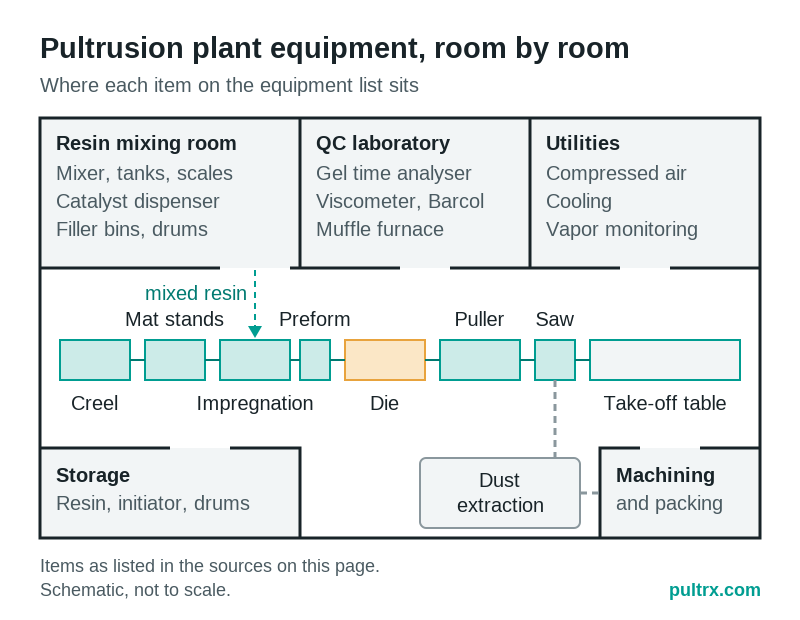
A pultrusion plant equipment list covers the production line from creel to flying saw, the tooling package for each die, the resin mixing room, the quality-control laboratory, process data acquisition, output handling, utilities and staff roles. Pultrex, a UK machine builder, lists sixteen items in a turnkey scope. Treat each item as a quotation line with a named supplier, inclusion status and acceptance check.
- Line stations
- Roving creel, mat and veil stands, impregnation, preforming frames, die station, puller, flying cut-off saw
- Tooling per die
- Die, mandrels and supports, roving guide plates, preformers, heating, puller pads, saw guides
- Resin room
- Mixing machine and tanks, scales, catalyst dispenser, filler bins, drum handling, transfer pumps
- QC lab
- Resin reactivity analyzer, Brookfield viscometer, Barcol hardness tester, muffle furnace, precision scales
- Utilities
- Dust extraction, styrene and solvent vapor monitoring, compressed air and cooling
- Quotation
- Each line names the supplier, whether the item is included, and how it is accepted
Published by pultrx, an integrated pultrusion technology provider working with Henan Zhongsheng as a partner factory. This is a buyer planning guide; the manufacturer confirms project specifications in writing.
Ready to move from reading to a scoped quotation?
Request a plant equipment review