
Technical review: Yunkun Gong, Pultrusion Engineer, pultrx
Why does resin mixing sit in its own room off the pultrusion line?
On an open-bath line running unsaturated polyester or vinyl ester, a batch holds liquid resin, powdered mineral filler such as calcium carbonate or aluminum trihydrate (ATH), internal mold release, color paste and organic peroxide initiators. Weighing fine filler creates dust, open resin gives off styrene vapor, and organic peroxides have strict storage temperature and segregation rules. Keeping weighing and high-shear dispersion in a ventilated mixing room away from heated dies and electrical cabinets keeps dust out of roving creels and keeps raw initiators away from heat sources.
Two-component polyurethane (PU) pultrusion follows a different route. Because PU reacts rapidly once polyol and isocyanate meet, a metering machine pumps the two components directly into a closed injection box at the die entrance instead of mixing open tubs in a batch room.
If your formulation uses two-component PU rather than batch-mixed polyester, vinyl ester or epoxy, see polyurethane resin injection systems
What equipment goes into a pultrusion resin mixing station?
A working resin room pairs one or two mixers with enough mobile vessels, scales and drum tools that an operator never waits for an empty tub while a line bath runs low. Pultrex Limited (an unrelated UK machine builder, reviewed 2026-11-18) publishes a nineteen-item list for medium-to-large installations covering the mixer, stand, tanks, two scale sizes, catalyst dispenser, small mixer, filler bins, barrel handling, transfer pumps and solvent recovery. Grouping those items by task makes it easier to size a room for one line or ten:
| Station group | Typical items on the floor | What decides the specification |
|---|---|---|
| Primary dispersion | High-shear Cowles-blade disperser on a hydraulic or mechanical lift stand; small bench mixer for color or additive pre-blends | Batch volume, peak paste viscosity with filler, impeller diameter, motor power and explosion-protection rating |
| Mixing vessels | Wheeled stainless or mild-steel mixing tubs with close-fitting split or shaft-sealed lids and bottom drain valves | Consumption per hour at the line bath, pot life of the catalyzed mix, and tub swap cleaning routine |
| Weighing & dosing | Platform scale for resin and filler; gram-resolution bench scale for initiators and liquid additives; graduated catalyst dispenser | Smallest initiator charge in grams, largest batch mass in kg, and recipe logging requirements |
| Drum & filler handling | Forklift barrel attachment or drum lifter, barrel stands, grounding clips, bung wrench, brass or stainless drum taps, covered filler bins with scoops | Whether resin arrives in 200 L drums or 1,000 L IBC totes, and number of filler grades |
| Line delivery | Manual resin transfer trolleys for 1 to 3 lines, or diaphragm/progressive-cavity transfer pumps and cleanable hoses for larger plants | Distance to the resin baths, paste abrasiveness (ATH wears gear pumps), and changeover frequency |
| Cleaning & recovery | Covered wash pails, scraper tools, closed wipe bins, and a solvent distillation recovery unit where solvent is used | Local fire and VOC rules, and whether uncured paste is wiped with non-HAP cleaners before cure |
How does a high-shear disperser wet out filler without trapping air?
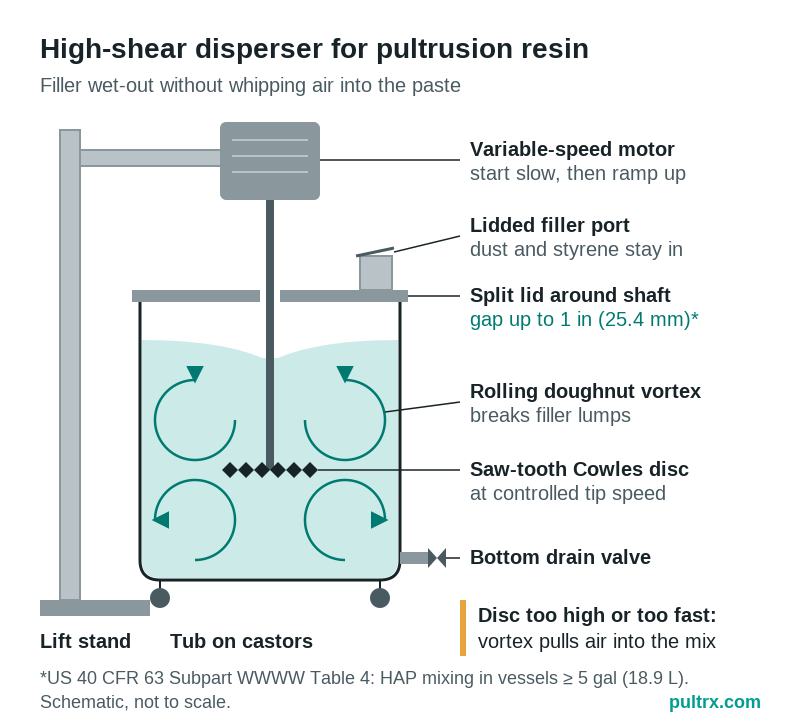
A simple paddle stirrer folds liquid over itself and leaves dry filler agglomerates intact. Those lumps settle in the resin bath, strip off at the squeeze bushings or travel into the die as chalky spots and voids. A saw-tooth Cowles-type disperser disc running at controlled tip speed creates a rolling doughnut vortex that breaks up calcium carbonate, clay or ATH agglomerates and coats each particle with resin.
- Variable-frequency speed control: start slow while adding dry powder so dust does not billow out, ramp up to disperse filler and pigment, then slow down before adding temperature-sensitive initiators.
- Temperature rise during mixing: high shear puts mechanical energy into viscous paste. Check batch temperature with a probe before adding low-temperature peroxides so premature gelation cannot start in the tub.
- Impeller depth and vortex control: if the disc sits too high or spins too fast at low fill level, the vortex reaches the hub and pulls air bubbles into the mix, feeding porosity straight to the wet-out bath.
- Top-fill and lidded feeding: adding filler through a lidded chute or split cover keeps powder and styrene inside the vessel rather than across the room.
What cover and emission rules apply to composite resin mixing?
Even in countries with different national codes, US EPA work-practice standards under 40 CFR Part 63, Subpart WWWW give a clear engineering checklist for styrene-bearing polyester and vinyl ester mixing. Under 40 CFR 63.5935, mixing means blending hazardous-air-pollutant (HAP) materials in vessels of 5.00 gallons (18.9 liters) or larger. Table 4 to Subpart WWWW sets out concrete shop rules for covered facilities:
- Mixer covers (Table 4, Item 6): use mixer covers with no visible gaps, except gaps up to 1 inch (25.4 mm) around mixer shafts and required instruments, unless emissions are routed to a 95% efficient control device.
- Closed vents during mixing (Table 4, Item 7 and Item 8): keep mixer covers and vents closed while mixing is occurring, opening them only while adding materials, changing covers or venting as required for safety.
- Closed storage containers (Table 4, Item 3): keep drums, totes and holding tanks of HAP-containing resin closed except while adding or removing material.
- Cleaning solvents (Table 4, Item 2): do not use HAP-containing cleaning solvents for routine wipe-down; non-HAP emulsifiers or cleaners are standard for uncured resin on tubs, blades and baths.
Beyond styrene control, ask your local fire and electrical engineer to classify the mixing and storage area for flammable vapor ventilation, static bonding and grounding of drums and mixers, and separate ventilated storage for organic peroxide catalysts away from promoters or accelerators.
Should you transfer mixed resin by trolley or by pump?
Wheeled tubs and transfer trolleys
- Fits plants running one to four lines or frequent color and resin changes
- No hoses, valves or pump chambers filled with catalyzed paste to flush when a line stops
- Each tub carries a batch ticket with time mixed, formulation code and operator initials
Pumped transfer to the bath
- Fits long runs of one formulation feeding large structural or multi-line baths
- Needs abrasion-resistant pump parts when pumping ATH or silica-filled paste
- Requires a strict flushing and pot-life procedure so resin never gels inside pipes
To match batch size and delivery to open dipping vs straight-through baths, review pultrusion resin baths and wet-out tooling
What should you specify when ordering resin mixing equipment?
- Resin families and filler loading: polyester, vinyl ester, phenolic or epoxy, plus filler type and maximum paste viscosity.
- Batch size range in liters or kilograms, based on hourly line pull rate and target pot life in your summer shop temperature.
- Plant power supply (voltage, frequency, 3-phase) and any local explosion-proof motor and switchgear classification (such as ATEX or Class I Div 1/2).
- Vessel count, lid design (split cover with shaft seal and feed port), bottom outlet size and mobile castor frame.
- Scale capacities and resolutions for both bulk resin/filler and gram-level peroxide/additive weighing.
Sources and further reading
- US EPA: 40 CFR Part 63, Subpart WWWW, National Emissions Standards for Hazardous Air Pollutants: Reinforced Plastic Composites Production
Read on ecfr.gov 2026-11-18. Section 63.5935 defines mixing at vessels of 5.00 gallons (18.9 liters) or larger; Table 4 Items 2, 3, 6, 7 and 8 set work-practice rules for mixer covers, closed vents during mixing, covered storage and non-HAP cleaning solvents.
- Pultrex Limited: Resin mixing equipment for medium to large pultrusion installations
Reviewed 2026-11-18. Published nineteen-item equipment list for a medium-to-large pultrusion mixing room, from the mixing machine and stand to scales, catalyst dispenser, filler bins, barrel handling, transfer pumps and solvent recovery. Pultrex Limited (UK) is unrelated to pultrx.
- Strongwell: PULSTAR pultrusion machinery brochure
Describes open dipping and straight-through resin baths fed with mixed thermoset resin at the wet-out station.
Questions buyers ask
How big should a batch resin mixer be for a pultrusion line?
Size the mixing vessel from hourly resin consumption and catalyzed pot life, never from drum size alone. A batch has to be consumed in the line bath with a comfortable margin before viscosity climbs in warm weather. Running two smaller wheeled tubs in rotation is safer than mixing one oversized batch that starts to gel.
Why do pultrusion mixers use a high-shear Cowles blade instead of a paddle?
Powdered fillers such as calcium carbonate, clay and aluminum trihydrate form dry clumps in liquid resin. A saw-tooth disperser blade creates high local shear to break agglomerates and wet every particle, whereas a slow paddle leaves lumps that cause voids or strip off at the preform guides.
Can I use acetone or styrene to wash resin mixing tubs?
Check your national VOC and fire regulations first. In the United States, EPA 40 CFR Part 63 Subpart WWWW Table 4 bars HAP-containing cleaning solvents for routine equipment cleaning, so plants scrape tubs down and wash uncured paste with low-VOC, non-HAP resin cleaners instead of styrene.
Why should peroxide initiators never be pre-mixed directly with cobalt promoters?
Mixing organic peroxide initiators directly with metal promoters or accelerators causes a violent exothermic decomposition and fire hazard. Pre-promoted resins already contain the promoter, or promoters are thoroughly dispersed into the bulk resin first before the weighed peroxide charge is added last.
Does polyurethane pultrusion use the same batch mixing room?
No. Two-component polyurethane systems react too quickly for open tubs and baths. Instead, a two-component metering and mixing unit pumps polyol and isocyanate at controlled ratio directly into a closed injection box mounted at the die entrance.
Summary
What resin mixing equipment does a pultrusion plant need?
An open-bath pultrusion plant needs a variable-speed high-shear disperser on a lift stand, lidded mixing vessels sized to line consumption and pot life, platform scales for resin and filler plus precision scales for initiators and additives, drum lifters and transfer trolleys or pumps, and closed cleaning and storage containers.
- Core mixer
- Variable-speed high-shear disperser on a stand, with closed-lid operation to limit styrene loss and air entrapment
- Weighing
- Industrial floor or bench scale for base resin and filler, separate small scale for initiators, release agents and pigments
- Handling
- Drum lifters, barrel stands and taps, filler bins, mixing tanks on castors, and transfer trolleys or pumps to the bath
- US emission rule
- 40 CFR Part 63 Subpart WWWW Table 4 requires mixer covers with no visible gaps (up to 1 in around shafts) on HAP mixing ≥ 5 gal
- PU exception
- Two-component polyurethane pultrusion meters A and B streams inline at an injection box rather than mixing open batches
Published by pultrx, an integrated pultrusion technology provider working with Henan Zhongsheng as a partner factory. This is a buyer planning guide; the manufacturer confirms project specifications in writing.
Ready to move from reading to a scoped quotation?
Scope your line and mixing room with pultrx