Technical review: Yunkun Gong, Pultrusion Engineer, pultrx
This is orientation for plant managers and project engineers, not legal advice. Electrical acceptance in the US and Canada is decided by the authority having jurisdiction (AHJ) at your site, under the code editions it enforces. Confirm every point with your electrical engineer, your inspector and your insurer before you sign a purchase contract.
How do North American voltage and frequency affect the line?
North American utilities supply 60 Hz. A US utility's standard three-phase services include 208/120 V and 480/277 V wye (Liberty Utilities, 2025). In Canada, Toronto Hydro offers 120/208 V and 347/600 V three-phase, four-wire supplies (Toronto Hydro, 2025). China supplies 220/380 V at 50 Hz, so a line built for the Chinese grid is designed for 380 V three-phase at 50 Hz. Ask your utility which service your building has before you send an RFQ. Utility guides ask for the same before equipment is bought.
Frequency changes motor speed. Synchronous speed equals 120 × frequency ÷ number of poles (NEMA). A 4-pole motor therefore runs at 1,500 rpm synchronous on 50 Hz and 1,800 rpm on 60 Hz, 20 percent faster. Any motor connected directly to the supply, such as a hydraulic pump motor or a fan, turns faster by the same ratio. Motors fed from a variable-frequency or servo drive run at the frequency the drive sets.
Voltage changes heater output. A resistance heater's actual power equals its rated power × (applied voltage)² ÷ (rated voltage)² (Tutco). A die heater rated for 380 V and connected to 480 V would put out about 1.6 times its rated power, and Tutco advises against running a heater above its rated voltage. Specify heater voltage per heating zone, together with the control voltage.
A transformer can match voltage but cannot change frequency. Converting 60 Hz to 50 Hz needs an active device such as a frequency converter, a drive or a motor-generator set (Schneider Electric). There are two ways to plan the supply: order every motor, heater and drive for your plant's voltage at 60 Hz, or accept a step-down transformer and confirm, item by item, that each component is rated for 60 Hz. Write the chosen route into the quotation.
How do NEC, NFPA 79 and UL 508A apply in the US?
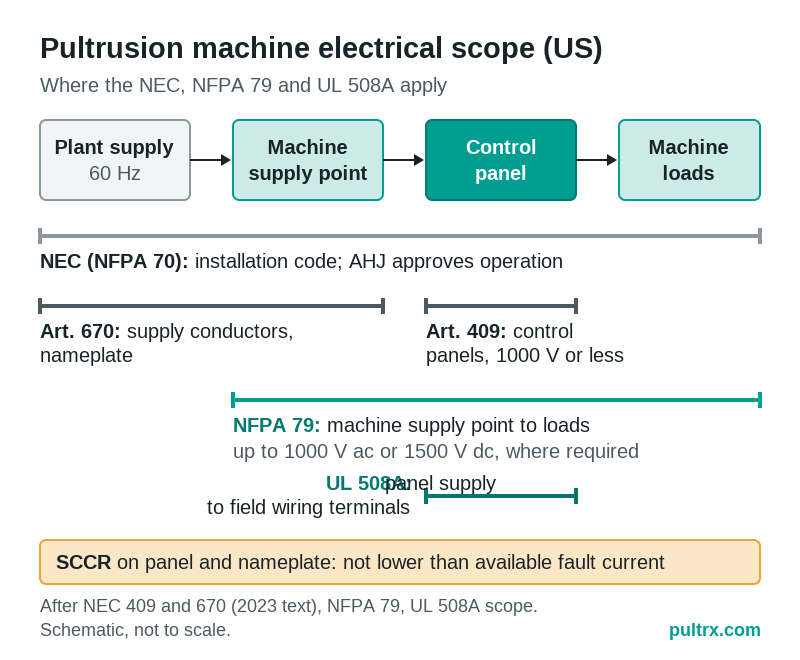
The National Electrical Code (NFPA 70) is the installation code, and electrical equipment may not be put into operation without the AHJ's approval (Siemens white paper, 2018). Two NEC articles bear directly on a pultrusion line. In the 2023 NEC text, Article 409 covers industrial control panels for general use at 1000 V or less, and its informational note points to UL 508A. Article 670 covers the nameplate data, overvoltage protection and the size and overcurrent protection of supply conductors for industrial machinery, and points to NFPA 79 for further information (NFPA 70 first-draft reports, CMP-11 and CMP-12). The 2026 revision cycle changed some of this wording, for example overvoltage to surge protection in 670.1, so check the article and section numbers against the NEC edition your AHJ enforces.
NFPA 79, the Electrical Standard for Industrial Machinery, covers the electrical and electronic equipment of industrial machines up to 1000 V ac or 1500 V dc, starting at the machine's supply circuit terminals. The latest edition is 2024, which replaced 2021 (Intertek, Oct 2025). NFPA 79 is not adopted by states the way the NEC is, so whether it applies is driven by the user of the machine or the local jurisdiction (UL). If your company or insurer requires NFPA 79, put it in the RFQ.
NFPA 79 (the machine)
- Starts at the point where the supply connects to the machine (Siemens).
- Ends at the loads in the machine (Siemens).
- Up to 1000 V ac or 1500 V dc; 2024 is the latest edition (Intertek).
- Applies where the user or jurisdiction requires it (UL).
UL 508A (the control panel)
- Starts at the supply point of the control panel (Siemens).
- Ends at the field wiring terminals to the machine (Siemens).
- Industrial control panels for general industrial use at 1000 V or less, in ordinary locations under NFPA 70 (UL 508A scope).
- A panel assembled from UL Recognized Components is not, for that reason, a UL Listed panel (UL).
Short-circuit current rating (SCCR)
NEC 409.110 (2023 text) requires an industrial control panel to be marked with, among other items, the manufacturer, the supply voltage, number of phases, frequency and full-load current for each incoming supply, its short-circuit current rating, the wiring diagram or its number, and an enclosure type number. The SCCR comes from a listed and labeled assembly or from an approved method, with UL 508A Supplement SB given as an example. Panels containing only control circuit components are exempt (NFPA 70, CMP-11 report). The machine nameplate under 670.3(A) also carries the SCCR and the electrical diagram number (IAEI, 2012; EC&M, 2019).
The rating matters at installation: a panel or machine may not be installed where the available fault current exceeds its marked SCCR (NEC 409.22 and 670.5, IAEI 2012), and under 670.5(B) of the 2023 NEC industrial machinery must be field marked with the available fault current and the date of the calculation. Give the supplier the available fault current at the connection point, from your electrical engineer, so the panel is designed for it.
Listing, field evaluation and OSHA approval
OSHA accepts electrical equipment only if it is approved (29 CFR 1910.303(a)). Under the definitions in 1910.399, acceptable equipment is accepted, certified, listed or labeled by a nationally recognized testing laboratory (NRTL); or, where no NRTL covers it, inspected by a government authority; or, for custom-made equipment, determined safe by its manufacturer on test data that the employer keeps and makes available. OSHA's current NRTL list includes CSA Group Testing and Certification Inc., Intertek Testing Services NA, Inc. and UL LLC, among others.
At the first-draft stage of the 2026 revision cycle, the code-making panel declined a public input to require listing of industrial machinery, citing insufficient substantiation and a lack of product standards (NFPA 70, CMP-12 report). Where the NEC does not require listing, jurisdictions may still require evaluation by a testing laboratory or a registered or licensed electrical engineer (UL), and an AHJ may require a field evaluation before the equipment is energized (UL field evaluation services). Ask your AHJ early which evidence it expects for an imported line.
Lockout and machine guarding (OSHA)
29 CFR 1910.147 covers servicing and maintenance where unexpected energization, start-up or release of stored energy could injure employees. After 2 January 1990, whenever new machines are installed, their energy isolating devices must be designed to accept a lockout device (1910.147(c)(2)(iii)). An energy isolating device physically prevents the transmission or release of energy. Push buttons and selector switches do not count. For a pultrusion line, list every isolation point in the quotation: the electrical disconnects, the hydraulic power unit and, where fitted, compressed air.
29 CFR 1910.212 requires guarding against hazards such as the point of operation, ingoing nip points, rotating parts, flying chips and sparks, with guards affixed to the machine where possible. On a pultrusion line, look first at the pinch points at the puller clamps or belts and at the cut-off saw. Ask which guards and interlocks are supplied and which the buyer adds on site.
What approval does a pultrusion machine need in Canada?
Rule 2-024 of the Canadian Electrical Code, Part I (CSA C22.1) requires electrical equipment to be approved, and Section 0 defines approved as certified by a certification body accredited by the Standards Council of Canada. Each province and territory adopts the code under its own legislation and on its own timetable (UL/ULC, 2017). British Columbia, for example, adopted CSA C22.1-24, the 26th edition, effective 4 March 2025 with no deviations (Technical Safety BC).
- British Columbia: electrical equipment must bear the mark of an SCC-accredited certification agency, or an approval label such as the SPE1000 model code field approval (Electrical Safety Regulation s. 21(1), Technical Safety BC bulletin B-E3 071019 3).
- Ontario: equipment must be approved by an accredited certification or evaluation agency before it is used, sold, displayed or advertised (ESA). CE and FCC marks are not recognized for electrical safety (ESA, Nov 2025).
- Ontario field approval: an agency can field-evaluate unapproved equipment and attach a label, but the approval covers only that piece of equipment in that location (ESA, Nov 2025). A panel-only label does not cover equipment connected to the panel (ESA).
- Control panels: CSA C22.2 No. 286 covers industrial control panels and assemblies for non-hazardous locations under the Canadian Electrical Code, Part I (IAEI, 2015).
In Ontario, a factory may need a pre-start health and safety review (PSR) under section 7 of Regulation 851 when new apparatus or protective elements are installed and an item in the section 7 table applies. Item 2 covers safeguarding devices that signal a machine to stop and interlocked barrier guards, and the reviewer must be an engineer. An exemption is possible where the machine and its guards were made to current applicable standards. The Ontario guideline lists CSA Z432, Safeguarding of Machinery, among the supporting standards. For a machine with an EU declaration under Directive 2006/42/EC, the guideline asks that the declaration state which standards were used; one that does not cite them is not acceptable.
A CE marking does not replace North American approval
Buyer checklist for the RFQ
| Item | What to specify in the RFQ | What the quotation states |
|---|---|---|
| Supply | Nominal voltage, phases and 60 Hz, from your utility | Voltage and frequency each motor, heater and drive is built for |
| Available fault current | Value at the machine connection point, from your electrical engineer | SCCR of the panel and machine, and how it was established |
| Control panel standard | UL 508A (US) or CSA C22.2 No. 286 (Canada), as your AHJ expects | Panel standard applied, and whether the panel carries a listing or certification mark |
| Machine electrical standard | NFPA 79, if your company, insurer or AHJ requires it | Which parts of the line the evidence covers |
| Approval route | NRTL listing or field evaluation (US); certification mark or SPE-1000 field evaluation label (Canada) | Which party arranges and pays for any field evaluation |
| Lockout | Lockable energy isolating devices for every energy source | List of isolation points with device type |
| Guarding | Guards at the puller and saw; interlocks; Ontario PSR evidence where it applies | Guards and interlocks supplied, and the standards they were built to |
| Documents | English drawings and nameplate data (see below) | Document list delivered with the line |
Which electrical documents should ship with the line?
- Electrical schematics and wiring diagrams in English, with the diagram number that appears on the panel and machine nameplates.
- Nameplate data for each incoming supply: voltage, number of phases, frequency, full-load current and SCCR.
- The SCCR basis: the power-circuit component list with each rating, or the listed assembly it relies on.
- A bill of materials for power and safety components, with the certification mark each component carries.
- The list of energy isolating devices and the lockout points for electrical, hydraulic and pneumatic energy.
- The standards applied to guarding and safety functions, named one by one, for your inspector or PSR engineer.
- The factory acceptance test record, including the supply voltage and frequency the line was tested at.
In a pultrx line proposal, the documents section lists what ships with the line, and the factory acceptance test protocol includes a voltage and frequency check. Ask for any item above that is missing from that list to be added, because a document that is not on the list in the quotation is not part of the delivery.
What should the quotation state about electrical compliance?
The pultrx catalogue does not establish that any machine is UL listed, CSA certified, field evaluated or NFPA 79 compliant. For a US or Canadian order, the quotation states the supply each item is built for, the panel standard, the evidence supplied for components and SCCR, and which party arranges any field evaluation. Have your electrical engineer and your AHJ review those answers before you sign.
The ten sections of a line quotation, including destination electrical requirements, the FAT protocol and the document list. What a pultrx line proposal includes
Legal entity, measurable specs, FAT, payment milestones, electrical compliance, spares and warranty. Buying a pultrusion line from China: checklist
The EU counterpart: economic operator, technical file, declaration of conformity and CE marking from 2027. EU Machinery Regulation 2023/1230
Sources and further reading
- Liberty Utilities: Requirements for Electric Service and Meter Installations, Commercial and Industrial, effective 01/01/2025 (REV3)
Section 2.3: standard three-phase service voltages 240/120 V delta, 208/120 V wye and 480/277 V wye; consult the utility before buying equipment.
- Toronto Hydro: How to Power Up Your Project, as of January 1, 2025
Supply voltage options 120/240 V, 120/208 V (3 ph, 4 w) and 347/600 V (3 ph, 4 w).
- Wikipedia: Mains electricity by country
China 220/380 V, 50 Hz; United States 120/208 V and 277/480 V, 60 Hz; Canada 120/208 V and 347/600 V, 60 Hz.
- NEMA: Electric Motor Terminology and Performance Characteristics (training deck)
Synchronous speed = 120 × frequency ÷ number of poles; 1,800 rpm for a 4-pole motor at 60 Hz; the rotor lags by the slip.
- Tutco: Applying Voltage to a Heater Other Than What It's Rated For
Actual output power = rated power × (applied voltage)² ÷ (rated voltage)²; caution against applying a higher voltage than rated.
- Schneider Electric FAQ FA115747: Can a transformer change the incoming AC frequency?
A transformer is passive and cannot change frequency; conversion needs an active device such as a frequency converter, VFD or motor-generator set.
- Siemens white paper: NFPA 79, Changes in Edition 2018, Effects on the electrical equipment of machinery for the U.S. market (May 2018)
NEC as the installation code; no operation without AHJ approval; NEC Article 670 points to NFPA 79 and Article 409 to UL 508A; NFPA 79 scope; NFPA 79 runs from the machine supply point to the loads, UL 508A from the panel supply to the field wiring terminals.
- Intertek blog: NFPA 79, 2024 Edition update, part 1 (7 Oct 2025)
The 2024 edition, the latest, replaces 2021; NFPA 79 applies to machinery up to 1000 V ac or 1500 V dc from the machine's supply circuit terminals.
- UL: Machine Supply Circuit and Disconnecting Means (FAQ based on NFPA 79, 2021 edition)
NFPA 79 is not a state-adopted standard like the NEC; whether it applies is driven by the user or the local jurisdiction; where the NEC does not require listing, jurisdictions may require evaluation by a testing laboratory or a registered or licensed electrical engineer.
- NFPA 70 (NEC) 2026 revision cycle: Code-Making Panel 11 first-draft public input report (Feb 2024)
Text of 409.1 (industrial control panels for general use at 1000 V or less; informational note to UL 508A) and 409.110 markings (manufacturer; supply voltage, phases, frequency and full-load current; SCCR from a listed assembly or an approved method, UL 508A Supplement SB as example; exception for control-only panels; wiring diagram; enclosure type); a submitter notes that 670.3(A) already requires the SCCR on the outside of industrial machinery enclosures.
- NFPA 70 (NEC) 2026 revision cycle: Code-Making Panel 12 first-draft public input report (Feb 2024)
Text of 670.1 scope (nameplate data, overvoltage protection, size and overcurrent protection of supply conductors; see NFPA 79); 670.5(B) field marking of available fault current with date (text of the 2023 NEC; the first draft renames overvoltage to surge protection and revises 670.5(B)); committee declined a listing requirement for industrial machinery, citing insufficient substantiation and product standards.
- IAEI Magazine: NEC Requirements for Short-Circuit Current Ratings (May 2012)
SCCR marking in 409.110 and 670.3(A); 409.22 and 670.5: no installation where available fault current exceeds the marked SCCR; UL 508A Supplement SB as an approved method.
- EC&M (Mark Lamendola): NEC Rules for Industrial Machinery (18 Jun 2019)
670.3(A) nameplate with five items, including the electrical diagram number or the index to the electrical drawings.
- UL Standards & Engagement: UL 508A, Standard for Industrial Control Panels
Scope 1.1: industrial control panels for general industrial use, 1000 V or less, ordinary locations under ANSI/NFPA 70; Edition 3, revised 26 Jun 2025.
- UL code authorities: UL Recognized Component Marks
A panel field-assembled from UL Recognized Components would not be considered a UL Listed industrial control panel.
- UL: Field Evaluation Services
On-site assessment of new, unlabeled or modified equipment, including industrial machinery and control panels; AHJs may mandate it before equipment is energized.
- OSHA 29 CFR 1910.303, General requirements (electrical)
(a) equipment is acceptable only if approved; (b)(1) suitability may be evidenced by listing or labeling; (f)(1) disconnecting means marked to indicate purpose.
- OSHA 29 CFR 1910.399, Definitions (electrical)
Acceptable: accepted, certified, listed or labeled by an NRTL; or inspected by a government authority; or custom-made equipment determined safe by its manufacturer on test data the employer keeps.
- OSHA: Current List of NRTLs
Includes CSA Group Testing and Certification Inc., Intertek Testing Services NA, Inc. and UL LLC, among others.
- OSHA 29 CFR 1910.147, The control of hazardous energy (lockout/tagout)
(a)(1)(i) scope; definitions of energy isolating device and capable of being locked out; (c)(2)(iii) new machines installed after 2 Jan 1990 need isolating devices designed to accept a lockout device.
- OSHA 29 CFR 1910.212, General requirements for all machines
(a)(1) guarding against point of operation, ingoing nip points, rotating parts, flying chips and sparks; (a)(2) guards affixed to the machine; (a)(3)(ii) point-of-operation guarding.
- UL / ULC: Acceptance of Electrical Equipment in Canadian Provincial and Territorial Jurisdictions (rev. Dec 2017)
CEC Rule 2-024 requires approved equipment; Section 0 defines approved as certified by a body accredited by the Standards Council of Canada; provincial legislation governs and adoption dates differ.
- Technical Safety BC: Adoption of BC Electrical Code, 2024 Edition
CSA C22.1-24 (Canadian Electrical Code, Part I, 26th edition) adopted effective 4 Mar 2025 with no deviations.
- Technical Safety BC: Information Bulletin B-E3 071019 3, Approved Certification Marks for Electrical Products (rev. 14, 27 May 2024)
Electrical Safety Regulation s. 21(1): a mark of an SCC-accredited certification agency, or an approval label such as the SPE1000 model code field approval.
- Electrical Safety Authority (Ontario): Recognized Approval Marks
Approval by an accredited certification or evaluation agency before use, sale, display or advertising; SPE-1000 field evaluation marks; a panel-only label does not cover equipment connected to the panel.
- Electrical Safety Authority (Ontario): Toolbox Talk, What to Do When Equipment Isn't Approved (Nov 2025)
OESC Rules 2-022 and 2-024; CE and FCC marks are not recognized for electrical safety; a field approval applies only to that equipment in that location.
- IAEI Magazine, Canadian Perspectives (Steve Douglas): Industrial control panels and assemblies (Aug 2015)
CSA C22.2 No. 286 covers industrial control panels and assemblies for non-hazardous locations under the Canadian Electrical Code, Part I; panel SCCR from the components in the primary circuit.
- Government of Ontario: Guideline for pre-start health and safety reviews (updated 9 Sep 2022)
PSRs apply in factories when new apparatus or protective elements are installed (s. 7, Reg. 851); Item 2 covers safeguarding devices that signal a stop and interlocked barrier guards; reviewer must be an engineer; exemption where built to current applicable standards; CSA Z432 listed; an EU declaration under 2006/42/EC must state the standards used.
Questions buyers ask
Can a pultrusion line built for 380 V 50 Hz run on 480 V 60 Hz?
Not as built. A transformer can match voltage but cannot change frequency, so motors connected directly to the supply run 20 percent faster at 60 Hz (synchronous speed = 120 × frequency ÷ poles). Heater output rises with the square of the applied voltage. Order each motor, heater and drive for your plant supply, or agree a voltage and frequency conversion plan item by item in the quotation.
Does a pultrusion machine have to be UL listed?
Not under a general NEC rule: in the 2026 revision cycle the code-making panel declined a proposal to require listing of industrial machinery. OSHA accepts NRTL listing, government inspection, or test data the manufacturer produced for custom-made equipment (29 CFR 1910.399), and an AHJ may require a field evaluation before the line is energized. Ask your AHJ which evidence it expects.
What is SCCR and why does the inspector ask for it?
The short-circuit current rating is marked on the control panel and the machine nameplate. A panel or machine may not be installed where the available fault current exceeds that rating (NEC 409.22 and 670.5, 2023 edition). UL 508A Supplement SB is one approved method of establishing it.
Who decides whether NFPA 79 applies?
The user of the machine or the local jurisdiction. NFPA 79 is not adopted by states the way the NEC is. If your company, insurer or AHJ requires it, put it in the RFQ.
Is a CE marked machine accepted in Canada?
CE is not a Canadian approval mark. Ontario's ESA names CE and FCC as marks not recognized for electrical safety. Equipment needs a recognized certification mark or a field evaluation label, and a field approval covers only that equipment in that location.
Is a pultrusion machine on pultrx.com UL listed or CSA certified?
The catalogue does not establish UL listing, CSA certification, field evaluation or NFPA 79 compliance. The quotation for a North American order states the panel standard, the component evidence and which party arranges any field evaluation.
Summary
What electrical requirements apply to a pultrusion machine imported to the US or Canada?
A pultrusion machine for a US or Canadian plant must run on the plant's 60 Hz supply and be accepted by the local inspection authority. US plants apply NEC Articles 409 and 670, OSHA lockout and guarding rules, and NFPA 79 where the user or jurisdiction requires it. Canada requires a recognized certification mark or field evaluation label. This is orientation, not legal advice.
- Supply
- US three-phase services include 208/120 V and 480/277 V; Canadian services include 120/208 V and 347/600 V; both at 60 Hz. China supplies 220/380 V at 50 Hz
- Motor speed
- 120 × frequency ÷ poles: a 4-pole motor runs at 1,500 rpm synchronous at 50 Hz and 1,800 rpm at 60 Hz; a transformer changes voltage, never frequency
- Control panel
- NEC Article 409, whose informational note points to UL 508A; CSA C22.2 No. 286 covers control panels in Canada
- SCCR
- Marked on the control panel and the machine nameplate; it must not be lower than the available fault current where the equipment is installed
- Approval
- US: OSHA accepts NRTL listing, government inspection or the custom-made test-data route, and AHJs may require field evaluation. Canada: certification mark or field evaluation label; CE is not an approval mark
- pultrx catalogue
- UL listing, CSA certification and NFPA 79 compliance are not established by the catalogue; the quotation states them for the quoted line
Published by pultrx, an integrated pultrusion technology provider working with Henan Zhongsheng as a partner factory. This is a buyer planning guide; the manufacturer confirms project specifications in writing.
Ready to move from reading to a scoped quotation?
Ask about North American electrical scope for your line