
Technical review: Yunkun Gong, Pultrusion Engineer, pultrx
Why must a pultrusion saw cut on the fly?
Thermoset resin crosslinks inside the heated steel die at a steady cure front matched to pulling speed. If downstream cutting halts the profile for even half a minute, resin cures onto the die wall, pull force spikes on restart or the profile seizes completely inside the cavity. Every automatic pultrusion cutter solves that constraint by decoupling blade feed from line travel.
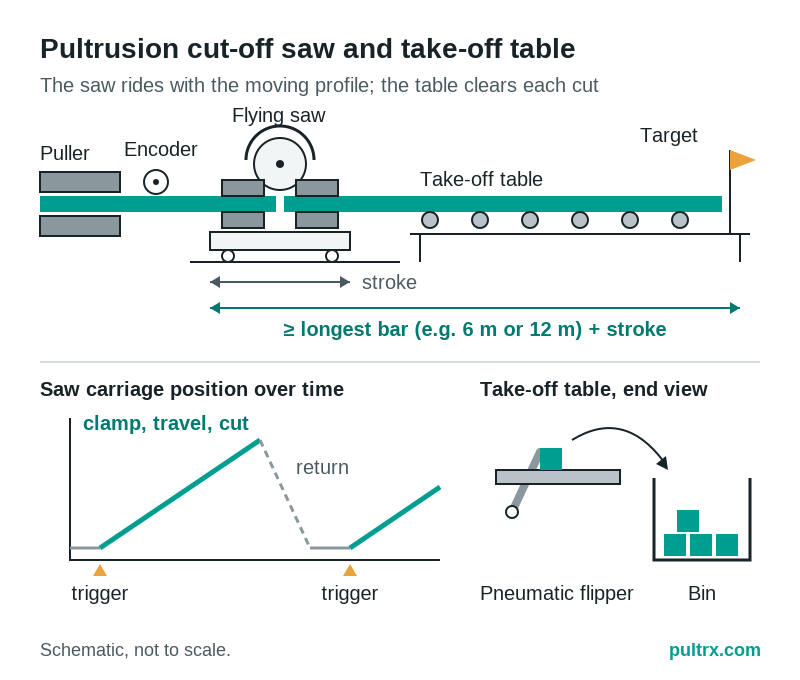
During a cut cycle, pneumatic or hydraulic jaws on the saw carriage clamp the cured profile, allowing the profile itself (or a synchronized servo drive on heavy saws) to carry the carriage forward along linear rails at exact line speed. The spinning blade feeds across or down through the section, retracts clear of the kerf, the jaws release, and a return cylinder or drive brings the carriage back to its home stop before the next cut signal.
How do encoder, target-switch and dual-cut triggers compare?
Strongwell's PULSTAR documentation notes three common ways to trigger and execute the cut on a production line: encoder-measured length, physical dead-stop/target triggering, and dual-cut arrangements for wide or multi-stream tooling.
| Trigger method | How it measures length | What to watch in production |
|---|---|---|
| Rotary encoder | A wheel rides on the profile or puller track and counts pulses to fire the clamp at the programmed length | Wheel slip on dusty or waxy surfaces shifts cut length; calibrate diameter and check clamp engagement delay |
| Downstream target flag / stop | The leading end of the profile touches a limit switch or mechanical flag set on the take-off rail at the exact cut distance | Repeatable on rigid bars and beams; whippy small rods need guide channels so the tip does not miss the flag |
| Multi-cavity synchronized cut | Wide blade stroke or twin saw heads cut two to eight parallel rods, tubes or grating bars in one carriage pass | Every strand must stay clamped on both sides of the blade kerf so outer bars do not pinch the blade or splinter |
Remember thermal contraction when setting cut length on thick structural profiles or GFRP rebar. A bar cut while still warm from the die shrinks slightly as it cools to ambient warehouse temperature; operators verify final length on cooled bars rather than hot off the saw.
Should you specify wet cutting or dry cutting with dust extraction?
Glass and carbon fibers rapidly dull conventional toothed woodworking or metalworking blades. Production flying saws normally run continuous-rim or segmented diamond-grit blades (or reinforced abrasive wheels on dedicated rebar cutters). Choosing between wet and dry cutting affects both downstream housekeeping and profile appearance:
Dry diamond cutting + vacuum hood
- Bars leave the saw dry, ready for immediate ink-jet marking, bundling or end-cap fitting
- Requires a shrouded blade guard and a dedicated cyclone/cartridge dust collector rated for fine composite dust
- Carbon fiber dust is electrically conductive: control panels and VFD cabinets need dust-tight enclosures or filtered air
Wet cutting + recirculating coolant
- Suppresses airborne dust at the blade and cools thick solid rods, heavy beams and high-speed rebar cuts
- Leaves wet slurry on the profile ends that must be wiped, blown off or dried before strapping onto timber
- Needs settling tanks to remove glass fines before coolant is pumped back to the blade nozzle
What does a pultrusion take-off table do after the saw?
Once the blade clears the kerf, the cut piece is free of the puller while the oncoming profile keeps advancing behind it. If the cut bar lingers on dead rollers, the advancing nose rams its tail end, stalling small sections or mis-triggering a target switch. Take-off tables clear each cut piece automatically.
On light profiles and short runs, a gravity roller run-out table with manual offload is enough. For automated or long-length plants, Pultrex Limited (an unrelated UK machine builder, reviewed 2026-11-18) describes bespoke take-off tables built around a motorized roller conveyor with rubber drive rollers that pull the severed length forward faster than line speed, followed by pneumatically operated flippers that tip the bar sideways into an output bin, all powered by and interfaced to the main pultrusion PLC.
Small flexible profiles such as optical cable strength members, tent-pole stock or composite conductor cores skip the cut-off saw and run-out table during long runs, winding onto large-diameter take-up reels instead.
For spooled take-up reels in place of a straight cut-off saw, see the composite core conductor line guide
Is the cut-off saw included in a pultrusion machine quotation?
Never assume from a workshop photograph that the saw and run-out table sit inside the base puller price. Some builders bundle an integrated flying saw on the puller frame, while others quote the cut-off saw, dust collector and take-off table as separate line stations so buyers can match envelope width, wet or dry cutting, and bar length (for example 6 m vs 12 m) to their product.
To see how pultrx separates standard puller scope from downstream stations, check pultrusion machine scope of supply
What should your inquiry specify for the saw and run-out station?
- Cutting envelope: maximum profile width and height, plus multi-cavity center-to-center spacing when pulling several strands at once.
- Carriage travel and line speed: maximum pulling speed in m/min and blade feed time on the thickest wall or solid rod, which set required carriage stroke.
- Cut-length range and tolerance: shortest piece, longest bar (commonly 6 m or 12 m), and required length tolerance at ambient temperature.
- Clamping jaw pads: shaped Polyurethane or V-block jaws that hold thin hollow tubes without crushing them and hold smooth rods without slipping.
- Wet or dry cutting, dust collector airflow and filter type, and whether conductive carbon fiber will run on the same saw.
- Take-off table length, motorized acceleration rollers, pneumatic side-eject flippers and collection rack capacity.
Sources and further reading
- Strongwell: PULSTAR pultrusion machinery brochure
Describes flying cut-off saws where the profile is clamped to a table moving at line speed, encoder-set cut lengths, and dead-stop and dual-cut options.
- Pultrex Limited: Take-off tables for pultrusion installations
Reviewed 2026-11-18. Describes motorized roller conveyors with rubber drive rollers for frictional pulling assist, pneumatically operated flippers into an output bin, and electrical interface to the pultrusion machine. Pultrex Limited (UK) is unrelated to pultrx.
- EPTA: Technical principles of pultrusion
Continuous pultrusion line arrangement: heated curing die, continuous or reciprocating puller and synchronized flying cut-off saw.
Questions buyers ask
What happens if a flying cut-off saw jams during a pultrusion run?
If the saw carriage fails to release its clamp before reaching the end-of-travel limit switch, an emergency interlock must release the saw jaws immediately rather than stopping the puller first. Stopping the puller with resin curing in the heated die risks seizing the profile inside the die.
What blade cuts pultruded fiberglass cleanly without fraying the exit edge?
Continuous-rim or fine-grit electroplated/sintered diamond blades cut cured glass-reinforced profiles cleanly and outlast carbide-tipped blades many times over. Supporting both sides of the kerf with shaped clamp jaws prevents the trailing bottom flange or veil from tearing out as the blade exits.
How long should the take-off table be behind a pultrusion machine?
Allow at least the longest cut bar length (for example 6 m or 12 m) plus clearance for the saw carriage stroke and end-stop hardware, along with fork-truck or overhead-crane aisle space beside the collection cradle so bundles can be removed while the line keeps running.
Why do multi-strand GFRP rebar lines use specialized cutters?
A multi-strand rebar line pulls several sand-coated bars in parallel at higher speeds than heavy structural beams, and silica sand plus glass rapidly wears ordinary blades. Rebar cutters clamp all strands together and use heavy-duty wet abrasive or diamond heads timed to clear fast cycle intervals.
Can one flying saw handle both flat wide panels and small round rods?
Only if its cutting window, blade diameter, cross-travel stroke and interchangeable clamp jaws cover both extremes. Wide deck panels need a long horizontal cross-cut stroke, while multi-cavity small rods need grooved clamp blocks that grip every strand equally.
Summary
How do a pultrusion cut-off saw and take-off table work together?
An encoder or limit switch triggers the flying saw carriage to clamp onto the moving profile, travel downstream at line speed while a diamond or abrasive blade makes a square cut, and retract and return home automatically. Downstream, a passive or motorized take-off table supports the cut length and tips or conveys it into a collection rack without stalling the line.
- Continuous motion
- Carriage clamps the profile and travels with the line during the cut so the die never stops
- Length measurement
- Rotary encoder wheel or downstream target switch; check slip and thermal contraction after cooling
- Blade & dust
- Diamond-grit blades for dry vacuum extraction or wet cutting; standard steel-toothed blades dull rapidly on glass
- Take-off handling
- Roller run-out table, motorized rubber-roller assist, or pneumatic flippers into an output bin
- Scope check
- Confirm in the quotation whether the flying saw and run-out table are inside the machine price or separate line items
Published by pultrx, an integrated pultrusion technology provider working with Henan Zhongsheng as a partner factory. This is a buyer planning guide; the manufacturer confirms project specifications in writing.
Ready to move from reading to a scoped quotation?
Specify your cut-off saw and run-out length