
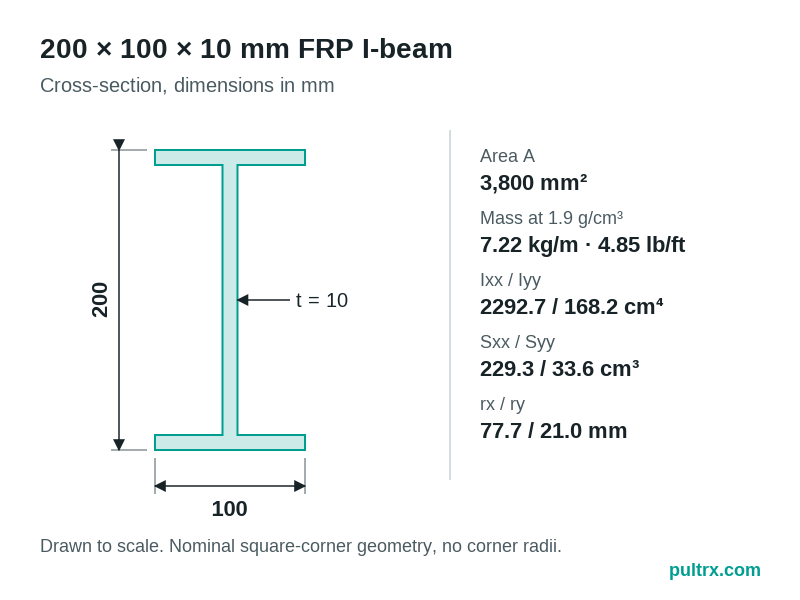
Geometry & mass
What are the nominal section properties and unit weight of 200 × 100 × 10 mm FRP I-beam?
Calculated from nominal millimetre dimensions before corner-fillet deductions, alongside equivalent S275 steel and 6063-T6 aluminum masses.
| Property | Metric value | Imperial / engineering note |
|---|---|---|
| Nominal designation | 200 × 100 × 10 mm | Depth × flange × wall (mm) |
| Inch equivalent | 7.87 × 3.94 in | Converted at 25.4 mm/in |
| Cross-sectional area (A) | 3,800 mm² | 5.89 in² (sharp-corner nominal) |
| FRP unit mass (at 1.9 g/cm³) | 7.22 kg/m | 4.85 lb/ft planning weight |
| Same-size S275 carbon steel mass | 29.83 kg/m | FRP saves 76% deadweight |
| Same-size 6063-T6 aluminum mass | 10.26 kg/m | FRP is 30% lighter than aluminum |
| Major-axis second moment (Ixx) | 2292.7 cm⁴ | 55.08 in⁴ |
| Minor-axis second moment (Iyy) | 168.2 cm⁴ | Ratio Ixx / Iyy = 13.63 |
| Elastic section modulus (Sxx / Syy) | 229.3 / 33.6 cm³ | Extreme-fibre bending modulus |
| Radius of gyration (rx / ry) | 77.7 / 21.0 mm | Used for axial column slenderness L/r |
| External perimeter | 780 mm | Surface veil and coating perimeter |
| Tooling status | Existing die (partner factory) | Pultruded to order; no new die charge |
Weighing 7.22 kg/m (4.85 lb/ft) at 1.9 g/cm³, a 4.5 m bridge stringer weighs 32.5 kg instead of 134.2 kg in structural steel (29.83 kg/m) or 46.2 kg in aluminum (10.26 kg/m), allowing hand rigging in marshes, parks and congested process units.
Major-axis inertia reaches Ixx = 2,292.7 cm⁴ (Sxx = 229.3 cm³, rx = 77.7 mm), while the 100 mm × 10 mm flanges provide Iyy = 168.2 cm⁴, Syy = 33.6 cm³ and ry = 21.0 mm.
Preliminary stiffness check
How much does 200 × 100 × 10 mm FRP I-beam deflect across typical spans under E17 and E23 grades?
Euler bending estimates about the major axis (Ixx = 2292.7 cm⁴) under a 3 kN/m uniform line load, comparing EN 13706-2 Grade E17 (17 GPa) and Grade E23 (23 GPa) minimum longitudinal moduli.
| Simple span (L) | Deflection at 3 kN/m (E17: 17 GPa) | Deflection at 3 kN/m (E23: 23 GPa) | Load for L/180 (E23) | Load for L/240 (E23) |
|---|---|---|---|---|
| 2.5 m (2500 mm) | 3.9 mm (L/639) | 2.9 mm (L/864) | 14.40 kN/m | 10.80 kN/m |
| 3.5 m (3500 mm) | 15.0 mm (L/233) | 11.1 mm (L/315) | 5.25 kN/m | 3.94 kN/m |
| 4.5 m (4500 mm) | 41.1 mm (L/109) | 30.4 mm (L/148) | 2.47 kN/m | 1.85 kN/m |
Under a heavy 3.0 kN/m reference line load at 23 GPa modulus, pure Euler bending deflection equals roughly 2.9 mm at 2.5 m (L/864), 11.1 mm at 3.5 m (L/315) and 30.4 mm at 4.5 m (L/148).
Because pultruded FRP has a longitudinal-to-shear modulus ratio (E/G) near 6 to 7 compared with 2.6 for steel, Timoshenko web shear deflection adds 14 to 18 percent onto Euler deflection at a 2.5 m span (L/h = 12.5) and roughly 8 percent at 3.5 m (L/h = 17.5).
With Ixx/Iyy = 13.6 and ry = 21.0 mm, lateral-torsional buckling governs unbraced girders; lock the top compression flange with bolted FRP bridge decking or transverse cross-frames spaced every 1.0 to 1.2 m, and install full-depth bearing stiffeners over abutment pads.
Run point loads, cantilevers or shear-corrected Timoshenko checks in the FRP section properties & deflection calculator, and verify material grade testing in EN 13706 & ASTM D3917 profile standards.
Fasteners & mating tolerances
How do you detail web stiffeners, flange bolts and girder splices on 200 × 100 × 10 mm I-beam?
Each 100 mm flange offers 45 mm outstands on either side of the 10 mm web, allowing staggered M10 or M12 deck bolts along a 58 to 62 mm transverse gauge across the flange (29 to 31 mm each side of centerline) while clearing the internal web-flange fillet. Primary beam-to-column shear framing uses paired 75 × 75 × 8 mm or 100 × 100 × 8 mm FRP clip angles bolted across the 180 mm clear web with three or four M16 stainless bolts.
At bridge abutments and beneath concentrated column posts, bond and bolt 40 mm wide pultruded web-stiffener blocks inside both web pockets so concentrated bearing forces pass through the 200 mm depth without crushing the web-flange root.
| Interface or feature | Drawing & assembly specification |
|---|---|
| Web pocket geometry | 180 mm clear height × 45 mm pocket depth per side; accepts paired M16 shear cleats and full-height bonded bearing stiffeners. |
| 100 mm × 10 mm flanges | Accepts M12 heavy-duty grating saddle clips or M10 deck-plank bolts at 30 mm from centerline (20 mm edge distance to flange tip). |
| Abutment bearing pad | Minimum 100 mm longitudinal seat length on elastomeric pads with lateral keeper angles restraining both flanges against rollover. |
| Vertical load path rule | Never hang heavy process pipes from the bottom flange alone; bolt drop hangers through the 10 mm web or clamp over the top flange. |
Shop tooling, diamond blades and bonded-bolted joint layout: how to cut, drill and join fiberglass profiles.
Request a quotation
Get a quotation for 200 × 100 × 10 mm FRP I-beam
Send your cut lengths, piece count, resin system and destination port. An engineer in Shanghai reviews the schedule and replies in English.
Prefer email or chat? Write to inquiry@pultrx.com or message Celion on WhatsApp. Drawings can follow by email.
Service environments & resin selection
Where does 200 × 100 × 10 mm I-beam serve in bridges and chemical plants?
Trail agencies, wetland boardwalk engineers and coastal rail depots use paired or multi-stringer 200 × 100 × 10 mm FRP I-beams for 3.0 to 4.5 m footbridge spans that helicopter or carry-in crews assemble without heavy cranes. Petrochemical tank farms and electroplating halls use the same section in vinyl ester resin as primary mezzanine girders supporting acid scrubbers and access walkways.
When floor head-height is tight or loads fall below 2.0 kN/m, our partner factories offer an intermediate 159 × 88 × 6/10 mm existing metric I-beam die as well as wide-flange 102 × 102 × 8 mm H-columns. Spans beyond 4.5 m typically transition to trussed FRP Pony-truss frames using 100 × 100 × 8 mm square tube chords.
Compare adjacent metric dies
Other metric i-beam engineering sheets
FAQ
What do buyers ask before ordering 200 × 100 × 10 mm FRP I-beam?
How much does shear deflection add on a 3.5 m pedestrian bridge stringer?
At a 3.5 m span (span-to-depth ratio L/h = 17.5), web shear deformation typically adds 8 to 10 percent onto pure Euler bending deflection when in-plane shear modulus G sits around 3.2 to 4.0 GPa. Always sum both Euler bending (5wL⁴/384EI) and Timoshenko shear (wL²/8kAG) terms when checking L/300 or L/400 footbridge comfort criteria.
What natural frequency check applies to 200 × 100 × 10 mm footbridges?
Lightweight FRP footbridges have low self-mass (7.22 kg/m per girder plus FRP decking), so pedestrian step harmonics can excite vertical bounce if fundamental frequency drops into the 1.6 to 4.5 Hz walking band. Keeping live-load mid-span deflection tight and adding a third center stringer keeps short 3.0 to 4.0 m spans stiff and comfortable underfoot.
Why are web stiffeners needed over supports on a 10 mm thick FRP web?
Although 10 mm is thick longitudinally, transverse compressive modulus and interlaminar shear strength at the web-to-flange T-junction are governed by resin and stitched mat rather than axial roving. Bonded and bolted web-stiffener blocks spread concentrated abutment reactions across the full 180 mm clear web height.
Can Henan Zhongsheng produce 200 × 100 × 10 mm girders in vinyl ester fire-retardant grade?
Yes, partner factories including Henan Zhongsheng pultrude heavy 10 mm sections in both isophthalic polyester and vinyl ester matrices, with optional fire-retardant additives and UV-inhibited surface veils. Thick 10 mm walls run on controlled thermal die zones to prevent internal exotherm microcracking.
Is 200 × 100 × 10 mm stocked off the shelf or pultruded to order on an existing die?
All metric girders run to order on an existing die in our partner-factory network rather than sitting in mixed speculator stock, allowing bridge stringers to be cut to exact span length (for example 3.6 m or 4.6 m) with zero waste offcuts. Include resin type, quantity and delivery port on your order schedule.