
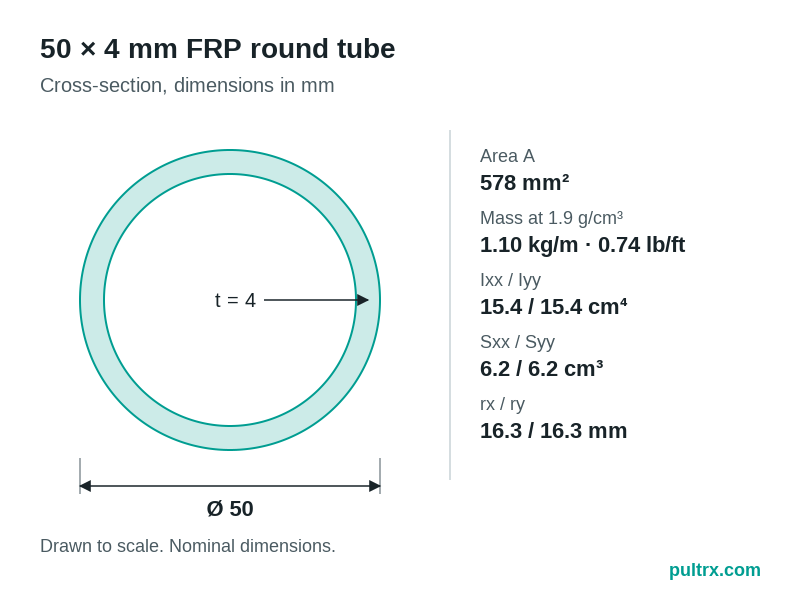
Geometry & mass
What are the nominal section properties and unit weight of 50 × 4 mm FRP round tube?
Calculated from nominal millimetre dimensions before corner-fillet deductions, alongside equivalent S275 steel and 6063-T6 aluminum masses.
| Property | Metric value | Imperial / engineering note |
|---|---|---|
| Nominal designation | 50 × 4 mm | OD × wall (mm) |
| Inch equivalent | 1.97 × 0.16 in | Converted at 25.4 mm/in |
| Cross-sectional area (A) | 578 mm² | 0.90 in² (sharp-corner nominal) |
| FRP unit mass (at 1.9 g/cm³) | 1.10 kg/m | 0.74 lb/ft planning weight |
| Same-size S275 carbon steel mass | 4.54 kg/m | FRP saves 76% deadweight |
| Same-size 6063-T6 aluminum mass | 1.56 kg/m | FRP is 30% lighter than aluminum |
| Major-axis second moment (Ixx) | 15.4 cm⁴ | 0.37 in⁴ |
| Minor-axis second moment (Iyy) | 15.4 cm⁴ | Ratio Ixx / Iyy = 1.00 |
| Elastic section modulus (Sxx / Syy) | 6.2 / 6.2 cm³ | Extreme-fibre bending modulus |
| Radius of gyration (rx / ry) | 16.3 / 16.3 mm | Used for axial column slenderness L/r |
| External perimeter | 157 mm | Surface veil and coating perimeter |
| Tooling status | Existing die (partner factory) | Pultruded to order; no new die charge |
With a 578 mm² annulus weighing 1.10 kg/m (0.74 lb/ft) at 1.9 g/cm³, a 6 m rail stick weighs only 6.6 kg compared with 27.2 kg in steel pipe (4.54 kg/m) and 9.4 kg in aluminum (1.56 kg/m), cutting rooftop and platform deadload.
Axisymmetric properties of Ixx = Iyy = 15.4 cm⁴, Sxx = Syy = 6.2 cm³ and rx = ry = 16.3 mm resist horizontal crowd push, downward lean and diagonal wind loads equally regardless of rail slope.
Preliminary stiffness check
How much does 50 × 4 mm FRP round tube deflect across typical spans under E17 and E23 grades?
Euler bending estimates about the major axis (Ixx = 15.4 cm⁴) under a 0.6 kN/m uniform line load, comparing EN 13706-2 Grade E17 (17 GPa) and Grade E23 (23 GPa) minimum longitudinal moduli.
| Simple span (L) | Deflection at 0.6 kN/m (E17: 17 GPa) | Deflection at 0.6 kN/m (E23: 23 GPa) | Load for L/180 (E23) | Load for L/240 (E23) |
|---|---|---|---|---|
| 0.9 m (900 mm) | 2.0 mm (L/460) | 1.4 mm (L/622) | 2.07 kN/m | 1.56 kN/m |
| 1.2 m (1200 mm) | 6.2 mm (L/194) | 4.6 mm (L/262) | 0.87 kN/m | 0.66 kN/m |
| 1.5 m (1500 mm) | 15.1 mm (L/99) | 11.2 mm (L/134) | 0.45 kN/m | 0.34 kN/m |
Across typical guardrail post spacings of 0.9 m, 1.2 m and 1.5 m under a 0.6 kN/m line load at 23 GPa modulus, simple-span deflection equals roughly 1.4 mm (L/622), 4.6 mm (L/262) and 11.2 mm (L/134); continuous multi-bay rails spliced across three or more posts deflect roughly 40 to 50 percent less than single-bay segments.
Circular geometry provides a closed polar torsional constant J = 30.8 cm⁴ (twice Ixx), resisting eccentric offset bracket torques cleanly without open-section warping.
Under OSHA / EN ISO 14122-3 concentrated mid-bay point loads (such as 0.9 kN or 300 N/m depending on occupancy class), keeping post centers at or below 1.2 to 1.35 m holds rail flex comfortably inside industrial handrail limits.
Run point loads, cantilevers or shear-corrected Timoshenko checks in the FRP section properties & deflection calculator, and verify material grade testing in EN 13706 & ASTM D3917 profile standards.
Fasteners & mating tolerances
How do 50 mm handrail fittings, internal spigots and post saddles fit 50 × 4 mm round tube?
Molded FRP and cast 316 stainless 50 mm slip-on tees, 90-degree elbows and adjustable stair knuckles slide directly over the 50 mm outside diameter, secured with structural epoxy adhesive plus cross-pinned M6 stainless rivets or M8 through-bolts. Where flush continuous rails cross intermediate square posts (such as 50 × 50 × 6 mm stanchions), pass the 50 mm tube straight through a 51 mm bored post hole or seat it in contoured saddle brackets.
Inside the 42 mm nominal bore, join rail runs inline using machined 41.5 mm OD solid FRP rod spigots or turned nylon/composite splice pins 200 mm long (100 mm bonded into each rail end). Whenever a structural through-bolt clamps radially across the tube, insert an internal sleeve or dowel so wrench torque cannot ovalize or split the 4 mm wall.
| Interface or feature | Drawing & assembly specification |
|---|---|
| 50 mm outside diameter | Matches metric 50 mm molded FRP handrail elbows, tees and wall returns; state OD tolerance priority when clamp fit governs. |
| 42 mm nominal bore ID | Accepts 41 to 41.5 mm OD internal splice spigots with 0.25 to 0.5 mm radial adhesive bondline clearance. |
| Scaffold clamp note | Standard BS/EN scaffold couplers fit 48.3 mm OD pipe rather than 50 mm; use our existing 48 × 5 mm round tube die if steel scaffold couplers govern. |
| Radial bolt reinforcement | M8 stainless cross-bolts with curved saddle washers and internal crush plugs at high-load insulating brace pins. |
Shop tooling, diamond blades and bonded-bolted joint layout: how to cut, drill and join fiberglass profiles.
Request a quotation
Get a quotation for 50 × 4 mm FRP round tube
Send your cut lengths, piece count, resin system and destination port. An engineer in Shanghai reviews the schedule and replies in English.
Prefer email or chat? Write to inquiry@pultrx.com or message Celion on WhatsApp. Drawings can follow by email.
Service environments & resin selection
Where is 50 × 4 mm round tube chosen for guardrails and electrical utility gear?
Substation transformer yards, railway electrification gantries, chemical tank roofs and wastewater walkways specify safety-yellow (RAL 1003 / 1023) 50 × 4 mm round tube for top rails, mid rails and ladder safety-cage hoops. Warm-to-touch low thermal conductivity prevents frostbite or solar-heated burn hazards on exposed outdoor rails, while high dielectric strength protects linemen near energized busbars.
Within the exact same 50 mm outside diameter, our partner factories also run a lighter 50 × 3 mm existing die (44 mm bore) for lightly loaded kneerails and a heavier 50 × 5 mm existing die (40 mm bore, Ixx = 18.1 cm⁴) for high-traffic 1.5 m post bays or heavy dielectric brace struts.
FAQ
What do buyers ask before ordering 50 × 4 mm FRP round tube?
Will 48.3 mm scaffolding clamps fit onto a 50 × 4 mm FRP round tube?
Fixed 48.3 mm scaffold couplers are undersized by 1.7 mm on a 50 mm tube and can score the protective outer veil if forced shut. Projects built around standard 48.3 mm scaffold hardware should specify the 48 × 5 mm existing die from our metric round-tube chart, while 50 × 4 mm pairs with dedicated 50 mm handrail fittings.
What post spacing works best with 50 × 4 mm top rails and mid rails?
Industrial platforms typically space 50 × 50 × 6 mm or 60 × 60 × 4 mm square FRP stanchions at 1.0 to 1.25 m centers when stringing 50 × 4 mm continuous rails. If architectural layouts stretch post spacing to 1.5 m, either splice rails continuously across three spans or upgrade the top rail to the 50 × 5 mm existing die.
How is dielectric performance maintained on substation insulating struts?
Electrical utility struts use void-free E-glass roving and non-conductive pigments (avoiding carbon-black colorants), with closed cell foam plugs or bonded end caps sealing the 42 mm bore against internal condensation tracks. Keep external synthetic veil surfaces clean and intact by cutting and drilling with diamond-grit tooling.
How do you prevent UV fiber bloom on outdoor safety-yellow handrails?
Specify UV-inhibited resin paired with a thick polyester surface veil, and add a factory-applied two-pack aliphatic polyurethane coating when rails sit in high-altitude or tropical UV zones. That outer resin-rich barrier keeps glass filaments locked beneath the grip surface for comfortable bare-hand contact.
Is 50 × 4 mm round tube run on an existing die?
Yes, 50 × 4 mm runs on an existing die in our partner-factory network alongside 50 × 3 mm and 50 × 5 mm companion walls. Confirm whether outside socket fit or 42 mm internal bore clearance is your critical datum on your section drawing.