
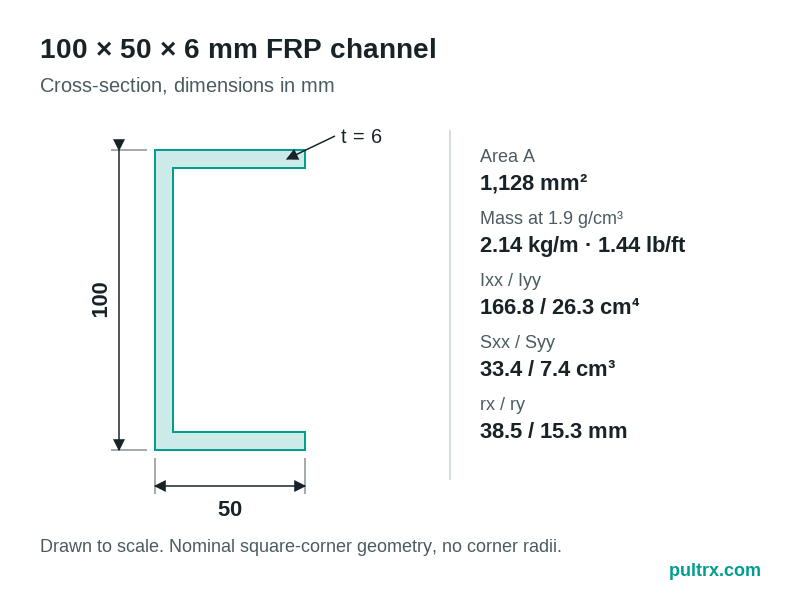
Geometry & mass
What are the nominal section properties and unit weight of 100 × 50 × 6 mm FRP channel?
Calculated from nominal millimetre dimensions before corner-fillet deductions, alongside equivalent S275 steel and 6063-T6 aluminum masses.
| Property | Metric value | Imperial / engineering note |
|---|---|---|
| Nominal designation | 100 × 50 × 6 mm | Depth × flange × wall (mm) |
| Inch equivalent | 3.94 × 1.97 in | Converted at 25.4 mm/in |
| Cross-sectional area (A) | 1,128 mm² | 1.75 in² (sharp-corner nominal) |
| FRP unit mass (at 1.9 g/cm³) | 2.14 kg/m | 1.44 lb/ft planning weight |
| Same-size S275 carbon steel mass | 8.85 kg/m | FRP saves 76% deadweight |
| Same-size 6063-T6 aluminum mass | 3.05 kg/m | FRP is 30% lighter than aluminum |
| Major-axis second moment (Ixx) | 166.8 cm⁴ | 4.01 in⁴ |
| Minor-axis second moment (Iyy) | 26.3 cm⁴ | Ratio Ixx / Iyy = 6.35 |
| Elastic section modulus (Sxx / Syy) | 33.4 / 7.4 cm³ | Extreme-fibre bending modulus |
| Radius of gyration (rx / ry) | 38.5 / 15.3 mm | Used for axial column slenderness L/r |
| External perimeter | 388 mm | Surface veil and coating perimeter |
| Tooling status | Existing die (partner factory) | Pultruded to order; no new die charge |
With a 1,128 mm² cross-section weighing 2.14 kg/m (1.44 lb/ft) at 1.9 g/cm³, one installer can lift a 6 m length weighing 12.8 kg by hand, compared with 53.1 kg in carbon steel (8.85 kg/m) or 18.3 kg in aluminum (3.05 kg/m).
Major-axis inertia reaches Ixx = 166.8 cm⁴ (Sxx = 33.4 cm³, rx = 38.5 mm), whereas asymmetric open flanges produce Iyy = 26.3 cm⁴ (Syy = 7.4 cm³, ry = 15.3 mm), giving a 6.3-to-1 directional stiffness ratio.
Preliminary stiffness check
How much does 100 × 50 × 6 mm FRP channel deflect across typical spans under E17 and E23 grades?
Euler bending estimates about the major axis (Ixx = 166.8 cm⁴) under a 1 kN/m uniform line load, comparing EN 13706-2 Grade E17 (17 GPa) and Grade E23 (23 GPa) minimum longitudinal moduli.
| Simple span (L) | Deflection at 1 kN/m (E17: 17 GPa) | Deflection at 1 kN/m (E23: 23 GPa) | Load for L/180 (E23) | Load for L/240 (E23) |
|---|---|---|---|---|
| 1.2 m (1200 mm) | 1.0 mm (L/1260) | 0.7 mm (L/1705) | 9.47 kN/m | 7.10 kN/m |
| 1.8 m (1800 mm) | 4.8 mm (L/373) | 3.6 mm (L/505) | 2.81 kN/m | 2.10 kN/m |
| 2.4 m (2400 mm) | 15.2 mm (L/158) | 11.3 mm (L/213) | 1.18 kN/m | 0.89 kN/m |
Loaded along its strong axis at 1.0 kN/m and 23 GPa modulus, pure bending deflection rises from about 0.7 mm at 1.2 m span to 3.6 mm at 1.8 m (L/505) and 11.3 mm at 2.4 m (L/213), assuming twist is prevented.
Because an open C-channel's shear center lies outside the back of the 6 mm web rather than through its centroid, vertical loads applied on the 50 mm top flange induce combined bending and torsional twist unless cross-rungs, grating clips or concrete anchorage restrain rotation.
When two 100 × 50 × 6 mm channels are bolted back-to-back across spacer washers, the pair forms a symmetric double-channel beam with 333.6 cm⁴ combined inertia and zero eccentric twist.
Run point loads, cantilevers or shear-corrected Timoshenko checks in the FRP section properties & deflection calculator, and verify material grade testing in EN 13706 & ASTM D3917 profile standards.
Fasteners & mating tolerances
How do you bolt into the 100 mm web and 50 mm flanges without twisting the channel?
Bring vertical reactions directly into the 100 mm web face via bolted web cleats rather than seating unbraced flange tips on narrow ledges. The 88 mm clear web height comfortably accepts two staggered or vertical M10 bolts at 40 mm pitch while preserving 30 mm edge distance to the outer flange faces.
Along the 50 mm flanges, clear inside width after subtracting the 6 mm web and internal root radius leaves roughly 38 mm of flat bearing shelf, fitting single-row M8 or M10 fasteners positioned 28 to 30 mm from the outside heel.
| Interface or feature | Drawing & assembly specification |
|---|---|
| Web depth & pocket | 100 mm overall height with 88 mm clear opening between inside flange faces; captures 38 mm molded FRP grating with room for hold-down clips. |
| Flange shelf geometry | 50 mm overall flange width and 6 mm thickness; keep bolt holes centered at 28 to 30 mm from the back of the web to clear the inside fillet. |
| Anchor & cleat sizing | M10 316 stainless chemical anchors through the back web into basin concrete, backed by 3 mm thick 40 × 40 mm plate washers. |
| Back-to-back pairing | Two channels bolted web-to-web accept 10 mm gusset plates between webs for symmetric truss chords and pipe-rack headers. |
Shop tooling, diamond blades and bonded-bolted joint layout: how to cut, drill and join fiberglass profiles.
Request a quotation
Get a quotation for 100 × 50 × 6 mm FRP channel
Send your cut lengths, piece count, resin system and destination port. An engineer in Shanghai reviews the schedule and replies in English.
Prefer email or chat? Write to inquiry@pultrx.com or message Celion on WhatsApp. Drawings can follow by email.
Service environments & resin selection
Where does 100 × 50 × 6 mm FRP channel fit in cable trays and treatment basins?
Municipal water and wastewater plants bolt 100 × 50 × 6 mm channels directly to concrete tank walls as launders, scum-baffle guides and grating perimeter ledgers, where submerged hydrogen sulfide and ferric chloride rapidly pit galvanized steel. Electrical contractors use the same section as heavy-duty ladder-tray side rails across 1.8 to 2.4 m support brackets.
If heavy anchor tension or cantilever bending exceeds a 6 mm web's capacity within the same 100 × 50 mm envelope, our partner factories hold an existing 100 × 50 × 10 mm heavy-wall channel die. For longer walkway spans needing higher section modulus without jumping to 150 mm depth, step up to the 120 × 65 × 6 mm channel.
Compare adjacent metric dies
Other metric channel engineering sheets
- 120 × 65 × 6 mm FRP channelWide-flange 120 × 65 × 6 mm pultruded C-channel (2.71 kg/m, Ixx 316.6 cm⁴, 108 mm clear web) proportioned for platform framing joists, pipe-support headers and chemical process skids.
- 150 × 60 × 7 mm FRP channelThick-walled 150 × 60 × 7 mm pultruded C-channel (3.40 kg/m, Ixx 576.5 cm⁴, 136 mm clear web) built for industrial stair stringers, coastal jetty edge trim and braced walkway joists.
- 210 × 80 × 5 mm FRP channelDeep, thin-wall 210 × 80 × 5 mm pultruded C-purlin channel (3.42 kg/m, Ixx 1,174.0 cm⁴, 200 mm clear web) optimized for corrosive industrial roof purlins and long-span solar PV racking.
FAQ
What do buyers ask before ordering 100 × 50 × 6 mm FRP channel?
Why does a 100 × 50 × 6 mm channel twist when loaded on its top flange?
Open C-sections carry their shear center behind the outer face of the web, so downward loads resting on the 50 mm flange create a torque arm relative to the shear axis. Tying opposite channels together with ladder rungs at 300 mm centers or clamping floor grating across both flanges locks out that torsional rotation.
Will standard 38 mm or 50 mm molded FRP grating sit inside this channel?
Yes, the 88 mm clear vertical gap between flanges easily accepts 25 mm, 38 mm or 50 mm molded grating panels when the channel is used as a flush curb frame. When inverted or mounted web-against-concrete as a wall ledger, the 50 mm top flange provides a 44 mm clear bearing projection past the web.
What resin grade is recommended for submerged wastewater basin channels?
Isophthalic polyester resin handles neutral municipal sewage, potable water filtration (with NSF-certified resin systems where specified) and humid gallery air. Specify vinyl ester resin whenever industrial effluent introduces warm caustic washdowns, sodium hypochlorite dosing lines or low-pH digester gas.
How does 100 × 50 × 6 mm channel compare with the 100 × 50 × 6 mm I-beam?
Both profiles share the exact same 1,128 mm² area, 2.14 kg/m weight and 166.8 cm⁴ major-axis inertia, yet the channel's flat back bolts flush against concrete walls and equipment frames. Choose the 100 × 50 × 6 mm I-beam for freestanding centered joists, and choose the channel for wall ledgers, rim trim and ladder-tray rails.
Is 100 × 50 × 6 mm available on an existing die without custom tooling cost?
Yes, 100 × 50 × 6 mm runs on an existing die in our partner-factory network and is pultruded to order in custom transport lengths up to 11.8 m for 40-foot containers. Include pre-drilling drawings or unpunched stock lengths on your purchase order.