
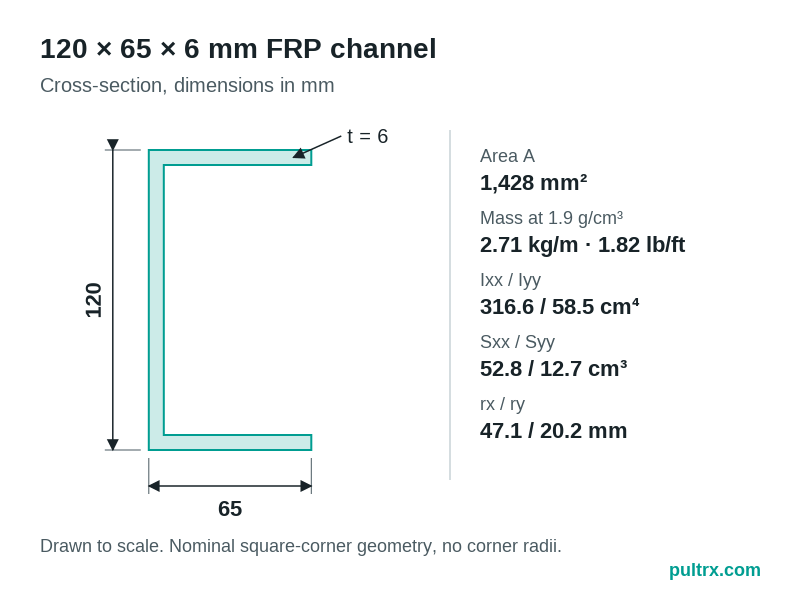
Geometry & mass
What are the nominal section properties and unit weight of 120 × 65 × 6 mm FRP channel?
Calculated from nominal millimetre dimensions before corner-fillet deductions, alongside equivalent S275 steel and 6063-T6 aluminum masses.
| Property | Metric value | Imperial / engineering note |
|---|---|---|
| Nominal designation | 120 × 65 × 6 mm | Depth × flange × wall (mm) |
| Inch equivalent | 4.72 × 2.56 in | Converted at 25.4 mm/in |
| Cross-sectional area (A) | 1,428 mm² | 2.21 in² (sharp-corner nominal) |
| FRP unit mass (at 1.9 g/cm³) | 2.71 kg/m | 1.82 lb/ft planning weight |
| Same-size S275 carbon steel mass | 11.21 kg/m | FRP saves 76% deadweight |
| Same-size 6063-T6 aluminum mass | 3.86 kg/m | FRP is 30% lighter than aluminum |
| Major-axis second moment (Ixx) | 316.6 cm⁴ | 7.61 in⁴ |
| Minor-axis second moment (Iyy) | 58.5 cm⁴ | Ratio Ixx / Iyy = 5.42 |
| Elastic section modulus (Sxx / Syy) | 52.8 / 12.7 cm³ | Extreme-fibre bending modulus |
| Radius of gyration (rx / ry) | 47.1 / 20.2 mm | Used for axial column slenderness L/r |
| External perimeter | 488 mm | Surface veil and coating perimeter |
| Tooling status | Existing die (partner factory) | Pultruded to order; no new die charge |
Cross-sectional area totals 1,428 mm² for a nominal weight of 2.71 kg/m (1.82 lb/ft) at 1.9 g/cm³: adding 27 percent mass over a 100 × 50 × 6 mm channel boosts major-axis inertia by 90 percent to Ixx = 316.6 cm⁴ while staying far lighter than steel (11.21 kg/m) and aluminum (3.86 kg/m).
Expanding the flange to 65 mm lifts minor-axis inertia more than twofold to Iyy = 58.5 cm⁴ (Syy = 12.7 cm³, ry = 20.2 mm) alongside Sxx = 52.8 cm³ and rx = 47.1 mm, noticeably improving lateral stability during erection.
Preliminary stiffness check
How much does 120 × 65 × 6 mm FRP channel deflect across typical spans under E17 and E23 grades?
Euler bending estimates about the major axis (Ixx = 316.6 cm⁴) under a 1.2 kN/m uniform line load, comparing EN 13706-2 Grade E17 (17 GPa) and Grade E23 (23 GPa) minimum longitudinal moduli.
| Simple span (L) | Deflection at 1.2 kN/m (E17: 17 GPa) | Deflection at 1.2 kN/m (E23: 23 GPa) | Load for L/180 (E23) | Load for L/240 (E23) |
|---|---|---|---|---|
| 1.5 m (1500 mm) | 1.5 mm (L/1021) | 1.1 mm (L/1381) | 9.21 kN/m | 6.91 kN/m |
| 2.2 m (2200 mm) | 6.8 mm (L/324) | 5.0 mm (L/438) | 2.92 kN/m | 2.19 kN/m |
| 3.0 m (3000 mm) | 23.5 mm (L/128) | 17.4 mm (L/173) | 1.15 kN/m | 0.86 kN/m |
Under a 1.2 kN/m uniform load at 23 GPa longitudinal modulus, restrained simple-beam deflection measures roughly 1.1 mm at 1.5 m span, 5.0 mm at 2.2 m (L/438) and 17.4 mm at 3.0 m (L/172).
Even with 65 mm flanges raising ry to 20.2 mm, eccentric vertical loads applied near the flange tip act roughly 80 mm away from the external shear center behind the web; pair channels with grating saddle clips at 600 mm intervals or diaphragm tie bolts at mid-span.
At 1.5 m short spans (L/h = 12.5) supporting concentrated pump or valve skids, add 12 to 15 percent Timoshenko web shear deflection onto the Euler bending curve when verifying equipment alignment tolerances.
Run point loads, cantilevers or shear-corrected Timoshenko checks in the FRP section properties & deflection calculator, and verify material grade testing in EN 13706 & ASTM D3917 profile standards.
Fasteners & mating tolerances
What bolt diameters and gauge lines fit the 65 mm flange and 120 mm web?
A 65 mm flange provides 59 mm of projection past the 6 mm web face, giving clean wrench socket clearance around M12 hex heads along a 36 to 40 mm back-mark gauge line while retaining 25 to 29 mm edge distance to the flange toe. That extra 15 mm over a 50 mm flange also lets J-clips and M-clips clamp walkway grating without crowding the web fillet.
At beam-to-column shear joints, connect the 108 mm clear web using double M12 bolts spaced 50 mm apart vertically through a 75 × 75 × 8 mm FRP clip angle so bearing reactions bypass the eccentric flange.
| Interface or feature | Drawing & assembly specification |
|---|---|
| Clear web height | 108 mm flat web zone between 6 mm flanges; accepts two vertical M12 bolts at 50 mm pitch with ample clearance for washer flats. |
| Flange gauge line | 65 mm flange accommodates M10 or M12 bolts on a 38 mm gauge from the outer web back, leaving 27 mm toe edge distance. |
| Grating bearing seat | 59 mm net flange projection supports 30 to 50 mm grating end bearing plus expansion gap on maintenance catwalks. |
| Handrail post mounting | 120 mm outer web face accepts side-mounted 50 × 50 mm square handrail stanchions using two through-bolts and internal post spacers. |
Shop tooling, diamond blades and bonded-bolted joint layout: how to cut, drill and join fiberglass profiles.
Request a quotation
Get a quotation for 120 × 65 × 6 mm FRP channel
Send your cut lengths, piece count, resin system and destination port. An engineer in Shanghai reviews the schedule and replies in English.
Prefer email or chat? Write to inquiry@pultrx.com or message Celion on WhatsApp. Drawings can follow by email.
Service environments & resin selection
When should chemical-plant platforms specify 120 × 65 × 6 mm channel?
Chlor-alkali cell rooms, acid pickling lines and solvent tank farms use 120 × 65 × 6 mm vinyl ester channels for elevated walkway rim beams, toe-plate curbs and secondary pipe-shoe bearers across 2.0 to 2.5 m bays. Non-sparking, electrically insulating behavior also eliminates equipotential bonding jumpers along secondary tray supports.
Our partner factories run narrower 120 × 25 × 5 mm, 120 × 30 × 5 mm and 120 × 40 × 5 mm existing dies for light trim, none of which have the flange width for structural M12 bolting that 120 × 65 × 6 mm provides. When stair stringer spans stretch past 2.6 m or tread bolts demand thicker bearing walls, step up to the 150 × 60 × 7 mm channel.
Compare adjacent metric dies
Other metric channel engineering sheets
- 100 × 50 × 6 mm FRP channelCompact 100 × 50 × 6 mm pultruded C-channel (2.14 kg/m, Ixx 166.8 cm⁴, 88 mm clear web) used for heavy cable tray side rails, clarifier weir framing and equipment rim trim.
- 150 × 60 × 7 mm FRP channelThick-walled 150 × 60 × 7 mm pultruded C-channel (3.40 kg/m, Ixx 576.5 cm⁴, 136 mm clear web) built for industrial stair stringers, coastal jetty edge trim and braced walkway joists.
- 210 × 80 × 5 mm FRP channelDeep, thin-wall 210 × 80 × 5 mm pultruded C-purlin channel (3.42 kg/m, Ixx 1,174.0 cm⁴, 200 mm clear web) optimized for corrosive industrial roof purlins and long-span solar PV racking.
FAQ
What do buyers ask before ordering 120 × 65 × 6 mm FRP channel?
Why choose 120 × 65 × 6 mm over narrower 120 × 40 × 5 mm FRP channels?
A 40 mm flange leaves barely 30 mm past the web fillet, restricting connections to light M6 or M8 screws and giving minimal grating bearing width. Stepping up to 120 × 65 × 6 mm permits structural M12 flange bolting, raises wall bearing thickness by 20 percent and boosts minor-axis inertia Iyy to 58.5 cm⁴.
Can guardrails bolt directly to the side of a 120 × 65 × 6 mm walkway curb channel?
Side-mounted guardrail posts exert concentrated overturning torque on an open channel web, so every post location must coincide with a transverse floor joist or include a gusset return bracket tied beneath the platform grating. Without transverse back-bracing at the post base, the 6 mm open web twists outward under horizontal rail test loads.
Which resin matrix handles sulfuric acid mist and caustic soda splash?
Bisphenol-A epoxy vinyl ester resin combined with ECR-glass rovings and double synthetic surface veils is standard for hot acid mist, hypochlorite splash and pH swings in chemical plants. List reagent concentrations and operating temperatures on your order schedule so resin cure and veil weight match service severity.
Can two 120 × 65 × 6 mm channels form a pipe-support header beam?
Yes, bolting two 120 × 65 × 6 mm channels back-to-back with a 10 mm gap creates a 140 mm wide top bearing table with Ixx = 633.2 cm⁴ while allowing U-bolt hangers or drop rods to pass straight down the center slot without drilling flanges. Fit spacer blocks at every load point to prevent web pinching.
Is 120 × 65 × 6 mm produced on an existing die?
Yes, this profile runs on an existing die in our partner-factory network with no custom die charge. Orders are pultruded to cut length rather than pulled from mixed warehouse remnants, keeping color, resin batch and dimensional tolerances uniform across your platform package.