
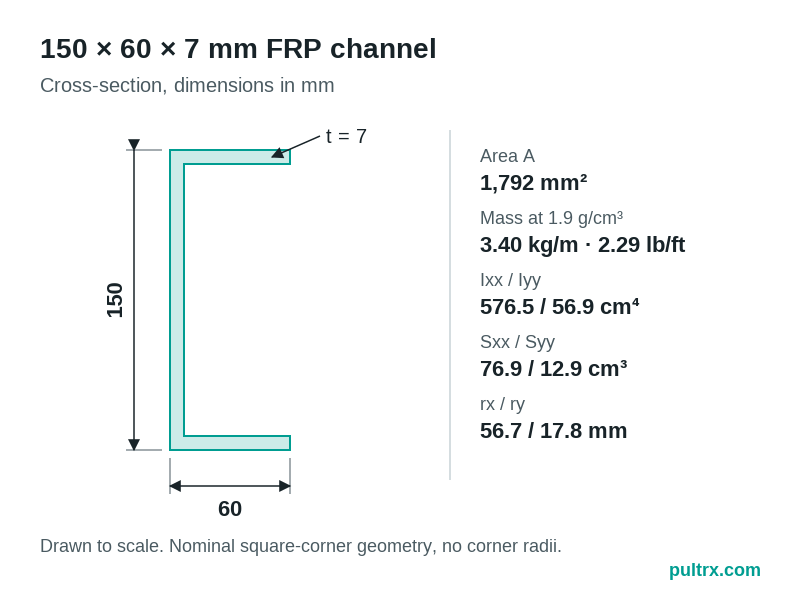
Geometry & mass
What are the nominal section properties and unit weight of 150 × 60 × 7 mm FRP channel?
Calculated from nominal millimetre dimensions before corner-fillet deductions, alongside equivalent S275 steel and 6063-T6 aluminum masses.
| Property | Metric value | Imperial / engineering note |
|---|---|---|
| Nominal designation | 150 × 60 × 7 mm | Depth × flange × wall (mm) |
| Inch equivalent | 5.91 × 2.36 in | Converted at 25.4 mm/in |
| Cross-sectional area (A) | 1,792 mm² | 2.78 in² (sharp-corner nominal) |
| FRP unit mass (at 1.9 g/cm³) | 3.40 kg/m | 2.29 lb/ft planning weight |
| Same-size S275 carbon steel mass | 14.07 kg/m | FRP saves 76% deadweight |
| Same-size 6063-T6 aluminum mass | 4.84 kg/m | FRP is 30% lighter than aluminum |
| Major-axis second moment (Ixx) | 576.5 cm⁴ | 13.85 in⁴ |
| Minor-axis second moment (Iyy) | 56.9 cm⁴ | Ratio Ixx / Iyy = 10.13 |
| Elastic section modulus (Sxx / Syy) | 76.9 / 12.9 cm³ | Extreme-fibre bending modulus |
| Radius of gyration (rx / ry) | 56.7 / 17.8 mm | Used for axial column slenderness L/r |
| External perimeter | 526 mm | Surface veil and coating perimeter |
| Tooling status | Existing die (partner factory) | Pultruded to order; no new die charge |
At 1,792 mm² area and 1.9 g/cm³ density, linear mass is 3.40 kg/m (2.29 lb/ft), saving 10.67 kg/m compared with steel (14.07 kg/m) and 1.44 kg/m against aluminum (4.84 kg/m), so two riggers can position a 4 m stair flight over water without barge cranes.
Major-axis properties reach Ixx = 576.5 cm⁴, Sxx = 76.9 cm³ and rx = 56.7 mm, while the 60 mm flange yields Iyy = 56.9 cm⁴, Syy = 12.9 cm³ and ry = 17.8 mm (an Ixx/Iyy ratio of 10.1).
Preliminary stiffness check
How much does 150 × 60 × 7 mm FRP channel deflect across typical spans under E17 and E23 grades?
Euler bending estimates about the major axis (Ixx = 576.5 cm⁴) under a 1.5 kN/m uniform line load, comparing EN 13706-2 Grade E17 (17 GPa) and Grade E23 (23 GPa) minimum longitudinal moduli.
| Simple span (L) | Deflection at 1.5 kN/m (E17: 17 GPa) | Deflection at 1.5 kN/m (E23: 23 GPa) | Load for L/180 (E23) | Load for L/240 (E23) |
|---|---|---|---|---|
| 1.8 m (1800 mm) | 2.1 mm (L/860) | 1.5 mm (L/1164) | 9.70 kN/m | 7.28 kN/m |
| 2.5 m (2500 mm) | 7.8 mm (L/321) | 5.8 mm (L/434) | 3.62 kN/m | 2.72 kN/m |
| 3.2 m (3200 mm) | 20.9 mm (L/153) | 15.4 mm (L/207) | 1.73 kN/m | 1.29 kN/m |
Carrying 1.5 kN/m across restrained simple spans at 23 GPa modulus, Euler mid-span deflection rises from roughly 1.6 mm at 1.8 m to 5.8 mm at 2.5 m (L/435) and 15.4 mm at 3.2 m (L/207).
With a 10.1-to-1 ratio between Ixx and Iyy plus an external shear center behind the 7 mm web, unbraced single channels twist sideways above 2.0 m unless stair treads, tie rods or continuous deck planks lock both flanges in plane.
On inclined 35-to-42-degree stair flights up to 3.2 m slope length, bolted FRP stair treads spaced every 250 to 280 mm act as rigid cross-diaphragms that stabilize the top compression flange against lateral-torsional roll.
Run point loads, cantilevers or shear-corrected Timoshenko checks in the FRP section properties & deflection calculator, and verify material grade testing in EN 13706 & ASTM D3917 profile standards.
Fasteners & mating tolerances
How do stair treads, tie rods and landing cleats attach to 150 × 60 × 7 mm channel?
In stair stringer duty, mount 50 × 50 × 6 mm FRP support angles inside the 136 mm clear web pocket using two M12 A4-80 stainless bolts per tread end, keeping holes at least 30 mm away from sloped miter cuts at top and bottom landings. Supplement stair flights over 2.4 m with an M12 stainless tie rod and spacer sleeve directly beneath mid-flight treads.
Along the 60 mm flanges, a 35 mm bolt gauge from the outer web face leaves 25 mm to the flange tip and 18 mm clear inside the 7 mm web plus root fillet, accommodating M10 deck clips cleanly.
| Interface or feature | Drawing & assembly specification |
|---|---|
| Web flat height | 136 mm clear inner web between 7 mm flanges; accepts molded stair tread nosings and two-bolt 90 mm deep landing shear cleats. |
| 7 mm wall bearing | Thicker 7 mm web and flange walls resist ovalization around M12 tread bolts under repetitive footfall and dynamic wave uplift. |
| Flange fastening zone | 60 mm wide flange (53 mm net projection); drill 11 mm holes for M10 fasteners along a 35 mm gauge line from the back face. |
| Mitered landing shoes | Saw-cut stringer heels bolt into 8 mm stainless or FRP base gussets; coat exposed glass ends with marine vinyl ester sealer. |
Shop tooling, diamond blades and bonded-bolted joint layout: how to cut, drill and join fiberglass profiles.
Request a quotation
Get a quotation for 150 × 60 × 7 mm FRP channel
Send your cut lengths, piece count, resin system and destination port. An engineer in Shanghai reviews the schedule and replies in English.
Prefer email or chat? Write to inquiry@pultrx.com or message Celion on WhatsApp. Drawings can follow by email.
Service environments & resin selection
Why is 150 × 60 × 7 mm preferred for stair stringers and coastal walkways?
Saltwater desalination intakes, offshore boat-landing gangways and coastal boardwalks choose 150 × 60 × 7 mm channels because chlorides and tidal splash never trigger rust jacking or galvanic weld decay at tread joints. Isophthalic polyester with UV veil serves atmospheric coastal air, while vinyl ester resin is specified in splash zones and brine sumps.
Notice the informative trade-off against the deeper 210 × 80 × 5 mm existing die: both channels weigh almost identically (3.40 vs 3.42 kg/m), yet 150 × 60 × 7 mm concentrates glass into a 7 mm wall for heavy bolted stair joints, whereas 210 × 80 × 5 mm spreads a 5 mm wall to double bending inertia for lightly bolted roof purlins.
Compare adjacent metric dies
Other metric channel engineering sheets
- 100 × 50 × 6 mm FRP channelCompact 100 × 50 × 6 mm pultruded C-channel (2.14 kg/m, Ixx 166.8 cm⁴, 88 mm clear web) used for heavy cable tray side rails, clarifier weir framing and equipment rim trim.
- 120 × 65 × 6 mm FRP channelWide-flange 120 × 65 × 6 mm pultruded C-channel (2.71 kg/m, Ixx 316.6 cm⁴, 108 mm clear web) proportioned for platform framing joists, pipe-support headers and chemical process skids.
- 210 × 80 × 5 mm FRP channelDeep, thin-wall 210 × 80 × 5 mm pultruded C-purlin channel (3.42 kg/m, Ixx 1,174.0 cm⁴, 200 mm clear web) optimized for corrosive industrial roof purlins and long-span solar PV racking.
FAQ
What do buyers ask before ordering 150 × 60 × 7 mm FRP channel?
How far can 150 × 60 × 7 mm FRP stair stringers span without an intermediate landing post?
Paired 150 × 60 × 7 mm stringers carrying 900 mm wide industrial stairs typically span 2.5 to 3.2 m inclined length within L/250 to L/300 service deflection targets under standard 2.5 to 4.0 kN/m² live loads. Flights exceeding 3.2 m either add an intermediate support frame or move up to a 200 × 100 × 10 mm FRP I-beam carriage.
Which way should the 60 mm flanges face on a pair of stair stringers?
Fabricators usually turn the 60 mm flanges inward (toe-to-toe) so tread ends tuck neatly inside the 136 mm web channels while leaving smooth, flush outside faces for bolting handrail stanchions. Turning flanges outward leaves unobstructed inner webs for wide pre-molded treads, provided mid-span tie rods restrain outward roll.
How do you prevent galvanic corrosion where stainless bolts meet FRP in seawater?
Because E-glass FRP is an electrical insulator, it never drives galvanic current against 316 or duplex 2205 stainless fasteners the way carbon fiber or aluminum does. Avoid tight stagnant crevices without sealant in warm seawater so stainless bolts stay oxygenated against crevice pitting.
Can Henan Zhongsheng supply pre-mitered or pre-drilled stringer pairs?
Partner plants including Henan Zhongsheng can supply either full mill lengths (such as 5.8 m or 6.0 m) for shop fabrication or CNC-drilled, miter-cut stringer kits matched to approved fabrication drawings. Sending hole coordinates on your section drawing avoids on-site dust handling.
Does 150 × 60 × 7 mm require any new pultrusion die investment?
No, 150 × 60 × 7 mm is an existing die in our partner-factory network ready for made-to-order production runs. Lead time and minimum meterage depend on resin chemistry, fire-retardant additives and custom pigment selection.