
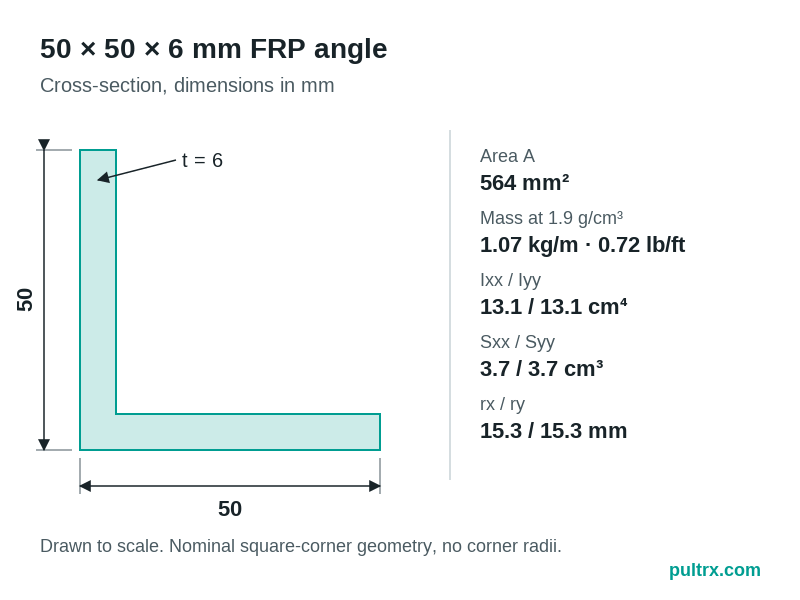
Geometry & mass
What are the nominal section properties and unit weight of 50 × 50 × 6 mm FRP angle?
Calculated from nominal millimetre dimensions before corner-fillet deductions, alongside equivalent S275 steel and 6063-T6 aluminum masses.
| Property | Metric value | Imperial / engineering note |
|---|---|---|
| Nominal designation | 50 × 50 × 6 mm | Leg A × leg B × thickness (mm) |
| Inch equivalent | 1.97 × 1.97 × 0.24 in | Converted at 25.4 mm/in |
| Cross-sectional area (A) | 564 mm² | 0.87 in² (sharp-corner nominal) |
| FRP unit mass (at 1.9 g/cm³) | 1.07 kg/m | 0.72 lb/ft planning weight |
| Same-size S275 carbon steel mass | 4.43 kg/m | FRP saves 76% deadweight |
| Same-size 6063-T6 aluminum mass | 1.52 kg/m | FRP is 30% lighter than aluminum |
| Major-axis second moment (Ixx) | 13.1 cm⁴ | 0.32 in⁴ |
| Minor-axis second moment (Iyy) | 13.1 cm⁴ | Ratio Ixx / Iyy = 1.00 |
| Elastic section modulus (Sxx / Syy) | 3.7 / 3.7 cm³ | Extreme-fibre bending modulus |
| Radius of gyration (rx / ry) | 15.3 / 15.3 mm | Used for axial column slenderness L/r |
| External perimeter | 200 mm | Surface veil and coating perimeter |
| Tooling status | Existing die (partner factory) | Pultruded to order; no new die charge |
Calculated on square-corner geometry at 1.9 g/cm³, cross-sectional area equals 564 mm², putting linear weight at 1.07 kg/m (0.72 lb/ft) compared with 4.43 kg/m in carbon steel and 1.52 kg/m in aluminum. Symmetric legs give Ixx = Iyy = 13.1 cm⁴ and elastic section modulus Sxx = Syy = 3.7 cm³ about axes parallel to the faces, with the elastic centroid located 14.7 mm from each outer heel.
Radius of gyration reaches rx = ry = 15.3 mm about the geometric axes, while the minor principal axis drops to rv = 9.8 mm across the 45-degree diagonal. Stepping up from 50 × 50 × 5 mm adds roughly 18 percent more bearing area around drilled fastener holes without enlarging outer bracket footprints.
Preliminary stiffness check
How much does 50 × 50 × 6 mm FRP angle deflect across typical spans under E17 and E23 grades?
Euler bending estimates about the major axis (Ixx = 13.1 cm⁴) under a 0.6 kN/m uniform line load, comparing EN 13706-2 Grade E17 (17 GPa) and Grade E23 (23 GPa) minimum longitudinal moduli.
| Simple span (L) | Deflection at 0.6 kN/m (E17: 17 GPa) | Deflection at 0.6 kN/m (E23: 23 GPa) | Load for L/180 (E23) | Load for L/240 (E23) |
|---|---|---|---|---|
| 0.8 m (800 mm) | 1.4 mm (L/558) | 1.1 mm (L/755) | 2.52 kN/m | 1.89 kN/m |
| 1.2 m (1200 mm) | 7.3 mm (L/165) | 5.4 mm (L/224) | 0.75 kN/m | 0.56 kN/m |
| 1.6 m (1600 mm) | 22.9 mm (L/70) | 17.0 mm (L/94) | 0.31 kN/m | 0.24 kN/m |
Under a 0.6 kN/m uniform line load, mid-span Euler bending deflection rises from about 1.1 to 1.4 mm across 0.8 m up to 5.4 to 7.2 mm across 1.2 m (for longitudinal moduli between 23 and 17.2 GPa), then jumps past 17 mm at 1.6 m. For single-angle tray supports or shelf ledges, 1.0 to 1.2 m is the practical serviceability ceiling before moving up to 75 × 75 × 6 mm.
Because span-to-depth ratio is only 16 at an 0.8 m span, low interlaminar shear modulus (roughly 3 GPa) adds 12 to 16 percent shear deformation on top of Euler figures. Single angles loaded through one leg also twist toward the heel shear center unless bolted against continuous tray rungs or enclosure panels.
Run point loads, cantilevers or shear-corrected Timoshenko checks in the FRP section properties & deflection calculator, and verify material grade testing in EN 13706 & ASTM D3917 profile standards.
Fasteners & mating tolerances
How should M8 or M10 bolts be positioned on 50 × 50 × 6 mm FRP angle?
Place a single fastener line at a 28 to 30 mm gauge measured from the outside heel using M8 (9 mm hole) or M10 (11 mm hole) Grade 316 stainless bolts. That geometry preserves a 20 to 22 mm edge distance to the free leg toe while keeping standard 16 mm (M8) or 20 mm (M10) flat washers clear of the internal root fillet.
Avoid oversized 30 mm fender washers on M10 hardware at a 28 mm backmark because the washer rim will ride onto the radiused inside corner and cock the nut under torque. Where clipped frame corners transmit shear in two directions, maintain at least 36 to 40 mm longitudinal pitch between adjacent bolts and seal raw drilled holes with catalyzed resin in wet acid service.
| Interface or feature | Drawing & assembly specification |
|---|---|
| Single-row bolt gauge | 28 to 30 mm from outer heel for M8 or M10 hardware, leaving 20 to 22 mm minimum toe edge margin. |
| Inside root fillet | Pultruded inside corner carries a radiused fillet; chamfer mating square steel blocks by 4 to 5 mm so faces seat flat. |
| Washer envelope | Standard DIN 125 flat washers (16 mm OD for M8, 20 mm OD for M10) sit flat inside the 44 mm net inner leg face. |
| Cut-length tolerance | Pultruded to order in mill lengths up to 6.0 m or shop-sawn to schedule; mark datum faces from the outside heel on drawings. |
Shop tooling, diamond blades and bonded-bolted joint layout: how to cut, drill and join fiberglass profiles.
Request a quotation
Get a quotation for 50 × 50 × 6 mm FRP angle
Send your cut lengths, piece count, resin system and destination port. An engineer in Shanghai reviews the schedule and replies in English.
Prefer email or chat? Write to inquiry@pultrx.com or message Celion on WhatsApp. Drawings can follow by email.
Service environments & resin selection
Where does 50 × 50 × 6 mm FRP angle fit versus 75 mm angle?
In analyzer shelters, rectifier cabinets and chemical dosing skids, 50 × 50 × 6 mm angle forms stiff corner framing and panel mounting cleats without consuming internal cabinet clearance. Cable-management installers also cut short lengths into splice plates, vertical riser clips and 300 to 450 mm wall brackets supporting non-metallic cable ladder runs.
Isophthalic polyester with UV-inhibited surface veil handles outdoor utility racks and cooling mist, whereas vinyl ester is specified around hydrochloric pickling fumes, sodium hypochlorite day tanks or battery rooms. When horizontal spans exceed 1.2 m or M12 bolts are required with full 2.5d edge distance, step up to 75 × 75 × 6 mm angle (Ixx 46.9 cm⁴).
Compare adjacent metric dies
Other metric angle engineering sheets
- 75 × 75 × 6 mm FRP angleMedium-duty 75 mm metric equal angle (1.64 kg/m, Ixx 46.9 cm⁴) sized for M12 bolted gussets, cooling-tower diagonals and chemical duct stiffeners.
- 75 × 75 × 8 mm FRP angleHeavy-wall 8 mm metric equal angle (2.16 kg/m, Ixx 60.2 cm⁴) built for high bolt-bearing shear cleats, submerged weir ledges and fill-pack supports.
- 100 × 100 × 6 mm FRP angleWide-leg 100 mm metric equal angle (2.21 kg/m, Ixx 114.4 cm⁴) for trench grating curb frames, odor-control cover rims and marine utility hangers.
- 100 × 50 × 5 mm FRP unequal angleDirectional 2:1 metric unequal angle (1.38 kg/m, Ixx 76.7 cm⁴ vs Iyy 13.6 cm⁴) for rainscreen sub-girts, solar PV rail adapters and slim-flange lintels.
FAQ
What do buyers ask before ordering 50 × 50 × 6 mm FRP angle?
Does 50 × 50 × 6 mm FRP angle require new tooling?
No new tooling charge applies because 50 × 50 × 6 mm runs on an existing die held in our partner-factory network. Profiles are pultruded to order against your cut-length schedule and chosen resin grade rather than pulled from off-the-shelf retail racks.
Can M12 bolts be installed in a 50 mm FRP angle leg?
Drilling a 13 mm clearance hole for M12 hardware on a 30 mm gauge leaves only 20 mm to the leg toe (1.54d), which falls below recommended composite edge-distance ratios under shear loading. Stick with M8 or M10 fasteners on 50 mm legs, or move up to 75 × 75 × 6 mm angle if plant standards mandate M12 bolting.
How much lighter is 50 × 50 × 6 mm FRP angle than steel?
At 1.9 g/cm³ nominal density, this profile weighs 1.07 kg/m (0.72 lb/ft) versus 4.43 kg/m for an identical carbon-steel L50×50×6 bar, cutting dead weight by 76 percent. Even against 6061-T6 aluminum at 1.52 kg/m, the fiberglass section trims mass by nearly 30 percent while eliminating galvanic coupling.
Why do mating plates need a corner chamfer inside the angle?
Unlike cold-formed sheet metal, pultruded angles incorporate a roving-rich internal root fillet that transfers transverse stress between legs. Machining a 4 to 5 mm bevel on square gusset plates or clamping against the flat outer heel faces prevents point contact on that fillet.
What information is needed on the purchase order for custom cut pieces?
List resin family (isophthalic polyester, vinyl ester or fire-retardant formulation), color, piece count, cut lengths and any shop-drilled hole gauges referenced from the outer heel. The order schedule confirms the producing partner factory, dimensional tolerances and minimum production run.