
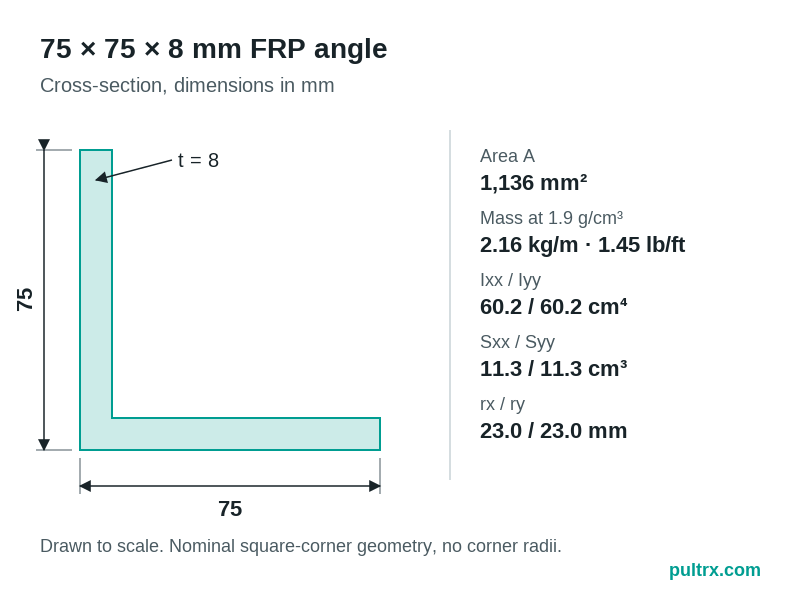
Geometry & mass
What are the nominal section properties and unit weight of 75 × 75 × 8 mm FRP angle?
Calculated from nominal millimetre dimensions before corner-fillet deductions, alongside equivalent S275 steel and 6063-T6 aluminum masses.
| Property | Metric value | Imperial / engineering note |
|---|---|---|
| Nominal designation | 75 × 75 × 8 mm | Leg A × leg B × thickness (mm) |
| Inch equivalent | 2.95 × 2.95 × 0.31 in | Converted at 25.4 mm/in |
| Cross-sectional area (A) | 1,136 mm² | 1.76 in² (sharp-corner nominal) |
| FRP unit mass (at 1.9 g/cm³) | 2.16 kg/m | 1.45 lb/ft planning weight |
| Same-size S275 carbon steel mass | 8.92 kg/m | FRP saves 76% deadweight |
| Same-size 6063-T6 aluminum mass | 3.07 kg/m | FRP is 30% lighter than aluminum |
| Major-axis second moment (Ixx) | 60.2 cm⁴ | 1.45 in⁴ |
| Minor-axis second moment (Iyy) | 60.2 cm⁴ | Ratio Ixx / Iyy = 1.00 |
| Elastic section modulus (Sxx / Syy) | 11.3 / 11.3 cm³ | Extreme-fibre bending modulus |
| Radius of gyration (rx / ry) | 23.0 / 23.0 mm | Used for axial column slenderness L/r |
| External perimeter | 300 mm | Surface veil and coating perimeter |
| Tooling status | Existing die (partner factory) | Pultruded to order; no new die charge |
At 1.9 g/cm³, nominal mass is 2.16 kg/m (1.45 lb/ft) against 8.92 kg/m for steel L75×75×8 and 3.07 kg/m for aluminum, trimming three quarters of structural steel deadweight. Bending inertia climbs to Ixx = Iyy = 60.2 cm⁴ with elastic section modulus Sxx = Syy = 11.3 cm³ and centroid position 21.7 mm from each outer heel.
Radius of gyration equals rx = ry = 23.0 mm (and rv = 14.7 mm across the minor diagonal), virtually unchanged from 75 × 75 × 6 mm because added thickness builds inward. What changes substantially is flange plate stiffness (proportional to t³, rising 2.37 times from 6 mm to 8 mm), which resists prying and concentrated bearing.
Preliminary stiffness check
How much does 75 × 75 × 8 mm FRP angle deflect across typical spans under E17 and E23 grades?
Euler bending estimates about the major axis (Ixx = 60.2 cm⁴) under a 1 kN/m uniform line load, comparing EN 13706-2 Grade E17 (17 GPa) and Grade E23 (23 GPa) minimum longitudinal moduli.
| Simple span (L) | Deflection at 1 kN/m (E17: 17 GPa) | Deflection at 1 kN/m (E23: 23 GPa) | Load for L/180 (E23) | Load for L/240 (E23) |
|---|---|---|---|---|
| 1.0 m (1000 mm) | 1.3 mm (L/786) | 0.9 mm (L/1063) | 5.91 kN/m | 4.43 kN/m |
| 1.5 m (1500 mm) | 6.4 mm (L/233) | 4.8 mm (L/315) | 1.75 kN/m | 1.31 kN/m |
| 2.2 m (2200 mm) | 29.8 mm (L/74) | 22.0 mm (L/100) | 0.55 kN/m | 0.42 kN/m |
Subjected to a 1.0 kN/m uniform load, Euler mid-span sag stays below 1.3 mm on a 1.0 m ledger and reaches 4.8 to 6.4 mm across 1.5 m (L/315 to L/236 for 23 to 17.2 GPa), before climbing to 22.0 to 29.5 mm over 2.2 m. Continuous concrete-wall anchor bolts at 600 to 900 mm centers turn weir or grating ledgers into stiff short-span beams.
On short 1.0 m shear spans (span-to-depth ratio 13.3), web shear strain adds roughly 14 percent to pure flexural deflection. When comparing equal-mass alternatives for pure bending beyond 1.6 m, note that 100 × 100 × 6 mm weighs nearly the same (2.21 kg/m) while delivering 114.4 cm⁴ of inertia if clearance allows 100 mm legs.
Run point loads, cantilevers or shear-corrected Timoshenko checks in the FRP section properties & deflection calculator, and verify material grade testing in EN 13706 & ASTM D3917 profile standards.
Fasteners & mating tolerances
How do M12 and M16 shear cleats perform in 75 × 75 × 8 mm FRP angle?
An 8 mm leg develops roughly 33 percent higher longitudinal and transverse pin-bearing capacity per bolt than 6 mm laminate, making M12 hardware (13 mm hole at 45 mm heel gauge) ideal for heavily loaded beam web cleats. M16 bolts (17.5 mm hole) also fit at a 43 to 45 mm gauge, leaving 30 to 32 mm toe distance (nearly 2.0d) for anchor bolts into concrete.
Account for a slightly larger 5 to 7 mm internal root fillet on 8 mm dies when seating 30 mm OD M16 washers: verify at least 38 mm from the outer heel to the near edge of the washer, meaning a 53 mm bolt gauge would push too close to the toe unless beveled square washers are specified. Pair clipped shear angles in double-shear on both sides of I-beam webs to avoid eccentric heel prying.
| Interface or feature | Drawing & assembly specification |
|---|---|
| M12 structural cleat | 45 mm heel backmark with 13 mm hole; provides 30 mm toe margin and clears standard 24 mm flat washers. |
| M16 concrete anchor | 43 to 45 mm heel backmark with 17.5 mm hole; check washer rim clearance against the 5 to 7 mm inside root radius. |
| Double-angle web clip | Bolting opposed 75 × 75 × 8 mm cleats across channel or I-beam webs eliminates torsional prying on bolt heads. |
| Submerged cut sealing | Brush two-part vinyl ester or epoxy sealer onto sawn ends and counterbores prior to immersion in clarifier basins. |
Shop tooling, diamond blades and bonded-bolted joint layout: how to cut, drill and join fiberglass profiles.
Request a quotation
Get a quotation for 75 × 75 × 8 mm FRP angle
Send your cut lengths, piece count, resin system and destination port. An engineer in Shanghai reviews the schedule and replies in English.
Prefer email or chat? Write to inquiry@pultrx.com or message Celion on WhatsApp. Drawings can follow by email.
Service environments & resin selection
Why specify 75 × 75 × 8 mm angle for cooling-tower ledgers and wastewater basins?
In field-erected cooling towers, 75 × 75 × 8 mm angle supports heavy water-logged PVC fill packs and fiberglass grating walkways where concentrated bearing blocks sit directly on the horizontal leg. Municipal and industrial wastewater plants bolt it along concrete sedimentation walls as effluent launder brackets, scum-baffle mounts and submerged chain-flight rail seats.
Continuous immersion in hydrogen sulfide vapor, ferric chloride coagulant or chlorinated secondary effluent favors vinyl ester resin with synthetic polyester veil over standard orthophthalic grades. Where headroom is tight around launder troughs, this 75 mm heavy-wall angle carries grating reactions without projecting 100 mm into flow channels.
Compare adjacent metric dies
Other metric angle engineering sheets
- 50 × 50 × 6 mm FRP angleCompact 6 mm thick equal-leg metric angle (1.07 kg/m, Ixx 13.1 cm⁴) for stiff equipment cleats, battery rack framing and cable-tray wall brackets.
- 75 × 75 × 6 mm FRP angleMedium-duty 75 mm metric equal angle (1.64 kg/m, Ixx 46.9 cm⁴) sized for M12 bolted gussets, cooling-tower diagonals and chemical duct stiffeners.
- 100 × 100 × 6 mm FRP angleWide-leg 100 mm metric equal angle (2.21 kg/m, Ixx 114.4 cm⁴) for trench grating curb frames, odor-control cover rims and marine utility hangers.
- 100 × 50 × 5 mm FRP unequal angleDirectional 2:1 metric unequal angle (1.38 kg/m, Ixx 76.7 cm⁴ vs Iyy 13.6 cm⁴) for rainscreen sub-girts, solar PV rail adapters and slim-flange lintels.
FAQ
What do buyers ask before ordering 75 × 75 × 8 mm FRP angle?
Why pick 75 × 75 × 8 mm over 100 × 100 × 6 mm when both weigh around 2.2 kg/m?
Choose 75 × 75 × 8 mm whenever tight equipment clearances, narrow concrete curbs or beam web depths forbid a 100 mm leg, or when bolt bearing and flange prying control over mid-span bending. Pick 100 × 100 × 6 mm (Ixx 114.4 cm⁴ versus 60.2 cm⁴) when open simple spans exceed 1.6 m and leg projection is unconstrained.
Can chemical anchor studs be torqued directly against the 8 mm FRP leg?
Yes, provided the concrete wall behind the heel is flat or shimmed with non-shrink grout so torque does not bend the angle leg over voids. Use Grade 316 or duplex 2205 stainless flat washers and tighten to controlled snug-tight values rather than steel slip-critical torque tables.
Is an even thicker 75 × 75 × 10 mm metric angle available on an existing die?
Yes, our metric size chart also includes a 75 × 75 × 10 mm existing die for extreme splice-angle and heavy column-seat duties. Most beam cleats and basin ledgers satisfy bearing checks in 8 mm wall without adding the extra 0.50 kg/m of the 10 mm section.
How does water absorption affect submerged wastewater brackets?
Pultruded profiles made with isophthalic or vinyl ester resin and a resin-rich surface veil exhibit low moisture uptake along uncut surfaces, while exposed glass ends absorb water faster if left raw. Sealing field-drilled holes and sawn faces preserves long-term wet interlaminar shear strength.
Are mill test reports available with pultruded angle shipments?
Inspection records covering dimensional checks, Barcol hardness and the lot mechanical tests listed on your purchase order ship with marked bundles. State any third-party witness testing or resin traceability requirements before production starts.