
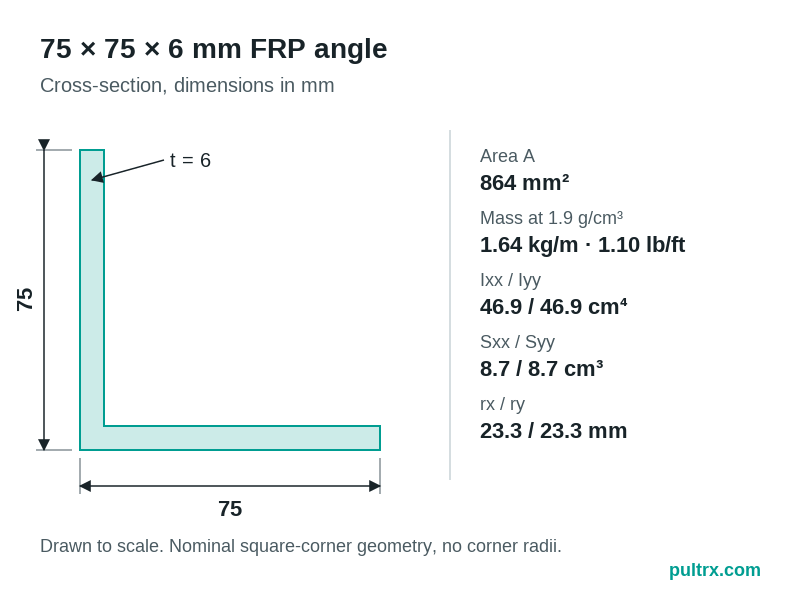
Geometry & mass
What are the nominal section properties and unit weight of 75 × 75 × 6 mm FRP angle?
Calculated from nominal millimetre dimensions before corner-fillet deductions, alongside equivalent S275 steel and 6063-T6 aluminum masses.
| Property | Metric value | Imperial / engineering note |
|---|---|---|
| Nominal designation | 75 × 75 × 6 mm | Leg A × leg B × thickness (mm) |
| Inch equivalent | 2.95 × 2.95 × 0.24 in | Converted at 25.4 mm/in |
| Cross-sectional area (A) | 864 mm² | 1.34 in² (sharp-corner nominal) |
| FRP unit mass (at 1.9 g/cm³) | 1.64 kg/m | 1.10 lb/ft planning weight |
| Same-size S275 carbon steel mass | 6.78 kg/m | FRP saves 76% deadweight |
| Same-size 6063-T6 aluminum mass | 2.33 kg/m | FRP is 30% lighter than aluminum |
| Major-axis second moment (Ixx) | 46.9 cm⁴ | 1.13 in⁴ |
| Minor-axis second moment (Iyy) | 46.9 cm⁴ | Ratio Ixx / Iyy = 1.00 |
| Elastic section modulus (Sxx / Syy) | 8.7 / 8.7 cm³ | Extreme-fibre bending modulus |
| Radius of gyration (rx / ry) | 23.3 / 23.3 mm | Used for axial column slenderness L/r |
| External perimeter | 300 mm | Surface veil and coating perimeter |
| Tooling status | Existing die (partner factory) | Pultruded to order; no new die charge |
Nominal square-corner area is 864 mm², giving a unit mass of 1.64 kg/m (1.10 lb/ft) at 1.9 g/cm³, compared with 6.78 kg/m for hot-rolled steel and 2.33 kg/m for structural aluminum. Equal legs produce Ixx = Iyy = 46.9 cm⁴ and section modulus Sxx = Syy = 8.7 cm³, with the centroid 21.0 mm from either outer face.
Geometric radius of gyration measures rx = ry = 23.3 mm, whereas the weak principal axis across the diagonal sits at rv = 14.8 mm. With a leg width-to-thickness ratio of 12.5, the 6 mm flange balances torsional-flexural stability against weight in medium-span tension-compression diagonals.
Preliminary stiffness check
How much does 75 × 75 × 6 mm FRP angle deflect across typical spans under E17 and E23 grades?
Euler bending estimates about the major axis (Ixx = 46.9 cm⁴) under a 0.8 kN/m uniform line load, comparing EN 13706-2 Grade E17 (17 GPa) and Grade E23 (23 GPa) minimum longitudinal moduli.
| Simple span (L) | Deflection at 0.8 kN/m (E17: 17 GPa) | Deflection at 0.8 kN/m (E23: 23 GPa) | Load for L/180 (E23) | Load for L/240 (E23) |
|---|---|---|---|---|
| 1.0 m (1000 mm) | 1.3 mm (L/765) | 1.0 mm (L/1035) | 4.60 kN/m | 3.45 kN/m |
| 1.5 m (1500 mm) | 6.6 mm (L/227) | 4.9 mm (L/307) | 1.36 kN/m | 1.02 kN/m |
| 2.0 m (2000 mm) | 20.9 mm (L/96) | 15.5 mm (L/129) | 0.58 kN/m | 0.43 kN/m |
Carrying a 0.8 kN/m uniform load, simple-span Euler deflection holds near 1.0 to 1.3 mm at 1.0 m and 4.9 to 6.5 mm at 1.5 m (L/307 to L/229 across 23 to 17.2 GPa), rising to 15.5 to 20.7 mm at 2.0 m. Keeping unbraced shelf or louver spans at or below 1.5 m satisfies typical L/240 industrial deflection targets.
When detailed as a single-angle compression strut in cooling-tower X-bracing, check slenderness about rv = 14.8 mm rather than rx = 23.3 mm: an unbraced 1.5 m half-diagonal yields L/rv = 101. Bolting two angles back-to-back across gussets removes end eccentricity and doubles flexural rigidity.
Run point loads, cantilevers or shear-corrected Timoshenko checks in the FRP section properties & deflection calculator, and verify material grade testing in EN 13706 & ASTM D3917 profile standards.
Fasteners & mating tolerances
What bolt gauge and edge margins work best on 75 × 75 × 6 mm FRP angle?
Detail M12 bolts (13 mm drilled clearance holes) along a 42 to 45 mm backmark from the outer heel, leaving 30 to 33 mm of solid laminate to the free toe (2.5d to 2.75d). Standard 24 mm OD flat washers sit well outside the 4 to 6 mm inside corner fillet while distributing clamping pressure across the surface veil and mat plies.
At truss node gussets requiring two or three fasteners in line, space M12 holes at 48 to 55 mm longitudinal pitch (4d minimum) with a 35 mm end distance to the sawn cut. Combine stainless bolts with polyurethane or epoxy adhesive on permanent chemical-plant joints where thermal cycling could otherwise loosen dry friction interfaces.
| Interface or feature | Drawing & assembly specification |
|---|---|
| M12 gauge line | 42 to 45 mm from outside heel; yields 30 to 33 mm toe edge distance and 36 to 39 mm heel-side clearance. |
| Longitudinal pitch | 48 mm minimum center-to-center spacing along the profile axis for M12 shear connections; 35 mm minimum end margin. |
| Back-to-back pairing | 6 mm or 8 mm FRP gusset spacer washers maintain consistent slot gap when twin angles frame a shared node plate. |
| Inch-series comparison | Measures 1.2 mm narrower per leg and 0.35 mm thinner than 3 × 3 × 1/4 in (76.2 × 76.2 × 6.35 mm); verify jig stops before mixing. |
Shop tooling, diamond blades and bonded-bolted joint layout: how to cut, drill and join fiberglass profiles.
Request a quotation
Get a quotation for 75 × 75 × 6 mm FRP angle
Send your cut lengths, piece count, resin system and destination port. An engineer in Shanghai reviews the schedule and replies in English.
Prefer email or chat? Write to inquiry@pultrx.com or message Celion on WhatsApp. Drawings can follow by email.
Service environments & resin selection
Where do cooling towers and chemical plants specify 75 × 75 × 6 mm angle?
Counterflow and crossflow cooling-tower builders use 75 × 75 × 6 mm angle for bay diagonal bracing, drift-eliminator support rails, air-inlet louver frames and fan-cylinder stiffener rings. In chlor-alkali cell rooms, fertilizer granulators and sulfuric acid mist ducts, it serves as external rectangular duct stiffening flanges and walkway knee-braces.
Specify isophthalic polyester for treated cooling water up to moderate pH and ambient UV exposure, or upgrade to vinyl ester where hot brine carryover, chlorine dioxide or acidic condensate contacts cut ends. If pin-bearing shear at bolted column cleats governs before bending stiffness, move to 75 × 75 × 8 mm on the exact same 75 mm footprint.
Compare adjacent metric dies
Other metric angle engineering sheets
- 50 × 50 × 6 mm FRP angleCompact 6 mm thick equal-leg metric angle (1.07 kg/m, Ixx 13.1 cm⁴) for stiff equipment cleats, battery rack framing and cable-tray wall brackets.
- 75 × 75 × 8 mm FRP angleHeavy-wall 8 mm metric equal angle (2.16 kg/m, Ixx 60.2 cm⁴) built for high bolt-bearing shear cleats, submerged weir ledges and fill-pack supports.
- 100 × 100 × 6 mm FRP angleWide-leg 100 mm metric equal angle (2.21 kg/m, Ixx 114.4 cm⁴) for trench grating curb frames, odor-control cover rims and marine utility hangers.
- 100 × 50 × 5 mm FRP unequal angleDirectional 2:1 metric unequal angle (1.38 kg/m, Ixx 76.7 cm⁴ vs Iyy 13.6 cm⁴) for rainscreen sub-girts, solar PV rail adapters and slim-flange lintels.
FAQ
What do buyers ask before ordering 75 × 75 × 6 mm FRP angle?
Can 75 × 75 × 6 mm FRP angle substitute directly for 3 × 3 × 1/4 in angle?
For most braced frames and duct flanges, its 46.9 cm⁴ moment of inertia lies close enough to 3 × 3 × 1/4 in (51.6 cm⁴) to pass structural checks at identical M12 bolt gauges. Check pre-slotted steel shoes or molded clip pockets first, because the metric leg is 1.2 mm shorter and 0.35 mm thinner.
When should a designer upgrade from 75 × 75 × 6 mm to 75 × 75 × 8 mm?
Choose the 8 mm wall when bolted bearing stress, clip-angle prying or local flange buckling under concentrated grating saddles controls your calculation rather than span deflection. The thicker section raises cross-sectional area by 31.5 percent and Ixx to 60.2 cm⁴ while keeping identical 75 mm outer dimensions.
Is 75 × 75 × 6 mm angle held in warehouse inventory or run to order?
All metric sizes run on existing dies within our partner-factory network and are pultruded to order so resin matrix, fire-retardant additives and exact cut lengths match project specifications. Your section drawing and order schedule establish lead time, factory assignment and lot testing.
How should diagonal X-braces be connected where two angles cross at mid-span?
Place both angles heel-to-back across the crossing point with a 6 mm FRP packing washer if gussets offset the planes, and install a single M12 stainless bolt with broad flat washers on both outer faces. That mid-point tie halves the in-plane buckling length and damps fan-induced vibration in cooling-tower bays.
Which resin grade suits hot wet plume zones above cooling-tower fill?
Isophthalic polyester performs reliably in standard municipal make-up water below 50 °C, whereas bisphenol-A epoxy vinyl ester is preferred for seawater towers, elevated biocide dosing or process blowdown above 55 °C. Include flame-spread requirements on your purchase order whenever tower codes require fire-retardant resin.